Sunday, 15 February 2015

RAPTOR WATCH

It had been quite mild during Sunday 15th when the sun was out. However towards the end of the afternoon it turned cold again when the murk descended, which made for a chilly harrier-watch on the Shop Lane seawall. Here Andy Field and Matt Larkin were scanning the distant Langenhoe Point for marsh harriers, watching them as they came into roost.

At least thirteen marsh harriers were counted, possibly one or two more but sadly no sign of any hen harriers. There was a female merlin however which sat on a bush for a few minutes, before flying rapidly off.
(The harrier roost count carried out at the same time opposite West Mersea on the Old Hall Marshes revealed 32 marsh harriers but no hen harriers).

Other birds noted were a male goldeneye, 8 red-breasted mergansers, 20 avocets, one common snipe, and ten linnets.
Matt reported seeing a muntjac deer in a pig paddock in Shop Lane mid afternoon.

Two common buzzards were seen whilst walking the Maydays seawall on Saturday 14th, one bird circling overhead, pictured above, while the second bird perched on a bush on Langenhoehall Marsh. The marsh harriers were showing well with a couple of males displaying over the back of the Island and at least five other birds seen on Langenhoe ranges.

In the Pyefleet a pair of red-breasted mergansers and a great crested grebe were the only birds of note along with lots of wigeon, teal and shelduck.

A pair of grey partridge were unexpectedly seen in one of the Maydays fields, the male bird calling out loudly. The male stonechat was still present while other small birds on the farm included 10 reed buntings, 15 yellowhammers and 15 corn buntings.

A walk along the Strood seawall on Friday 13th produced good views of a kingfisher along the dyke, on one occasion diving down and catching a small tiddler. Also a common buzzard mobbed off the Island by a pair of carrion crows. After the buzzard had crossed the channel and then Ray Island, another crow mobbed it when it reached the Peldon side. A marsh harrier flew along the Peldon seawall.

A stonechat, ten linnets, rock pipit and five skylarks were the main small birds noted.

Amongst the boat moorings from the Hard were seen two shags perched on buoys in the far channel next to the Sorcerer boat.

In Firs Chase, West Mersea, the pied blackbird was seen in a neighbours garden, a robin was building a nest in a ivy covered tree and a tawny owl called at night.

On Thursday 12th Steve Entwistle saw two Slavonian grebes and 12 red-breasted mergansers off West Mersea.

Tuesday, 10 February 2015

WIND-LESS

There was no wind during Tuesday 10th, so the big wind-turbines seemingly towering over the entrance to the river Blackwater, were idle for the day. The sea was like a mill-pond especially in the morning.

A quick glance out south-westwards from the park early afternoon just ahead of the high tide, revealed lots of grebes offshore. Aided by a little click-counter in my hand, at least 450 great crested grebes were counted with possibly more further into the distance appearing as tiny specks at the mouth of the Blackwater. Also 8 Slavonian grebes a little bit closer, offshore from Coopers Beach. One common seal swimming about too.

On Sunday 8th there were 11 Slavonian grebes, 300+ great crested grebes and 22 red-breasted mergansers seen offshore from the park at the end of the day.

Other birds noted at the park on Tuesday 10th included a peregrine flying over the car park in the morning, the male house sparrow chirping away for the third day in the car park, Cetti's warbler and water rail both calling from the park pond and 2000 golden plover circling over the grazing fields late afternoon.

Nine redwing perched in a tall tree in the car park on Monday 9th while ten song thrushes were feeding in the nearby field. The previous evening these song thrushes had been seen heading to roost in the copse by the pond.

On the pond the family of four swans, pair of little grebes, 8 tufted ducks and 12 gadwall were the main birds here.

On Monday 9th Andy Field walked the north side of the Island and noted a pair of stonechats, peregrine, 2000 golden plover and 2000+ brent geese on Reeveshall.

A badger trotted along the road just inside the park entrance an hour after dark on Monday night, while the next day one of the red squirrels was seen from Shop Lane by Martin Cock.( I gather the Mersea red squirrels featured on Radio 4 early this morning!).

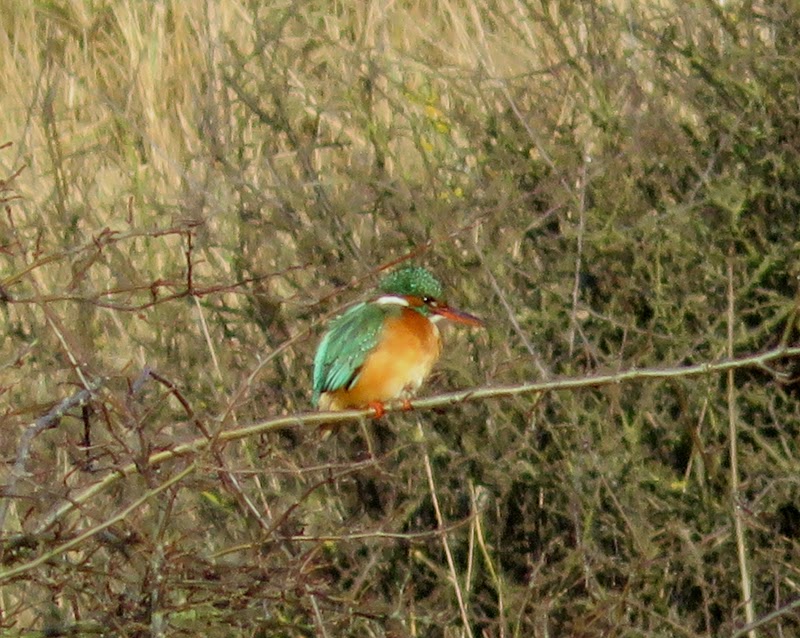
This female kingfisher perched up on a bush in the morning sunshine on Sunday 8th near Ivy Farm. Although a bit distant for the small camera, the colours of the bird really stood out in the bright light, especially the very orange bill. The bird flew along the dyke towards the Oyster Fishery.

On the dyke by the Golfhouse was this male gadwall, not usually a section of water where gadwalls are seen.

Three marsh harriers were flying around Langenhoe Point, 20 red-breasted mergansers were in the Colne and a pair of Canada geese flew across the river in the morning, as did a mistle thrush from Ivy Farm.
The stonechat was photographed by the park seawall on Sunday by Matt Larkin.

At Maydays on Sunday a ringtail hen harrier flew over the fields, and  a peregrine, pair of common buzzards, pair of stonechat and a green sandpiper were all seen by Martin Cock.

At times there have been big flocks of wigeon in the park's grazing fields, although some head out to rest on the sea. This pair were photographed by Alan Reynolds on the frozen dyke on 23rd January.

Thursday, 5 February 2015

SHY SQUIRREL

The red squirrel introduction programme got a little bit of publicity on Thursday 5th, when the regional BBC visited East Mersea. This individual pictured above was a bit nervous in the pen in Shop Lane, having spent the last week here after being brought from Pensthorpe in Norfolk.

The local BBC reporter Felicity Simper came along to find out how the red squirrel project was going, meeting up with the project leader Richard Taylor, pictured above in the centre, beside the release pen. A piece was recorded for BBC Essex radio which got broadcast early Thursday evening , while the story is also due to feature on the regional TV news on Friday early evening.

 When the cameraman first walked over to the release pen, one of the original wild squirrels scampered off the top of the pen and climbed up a nearby tree before disappearing into its small drey up high.

The sparrowhawks were showing in the area with one bird flashing through the little woodland, and then a male bird put on a display flight above the nearby Shop Lane wood.

The cold temperatures remained throughout Thursday with a cold north-east wind blowing all day along with light flurries of snow in the afternoon. The park pond pictured above was still partly frozen, with this group of mallard standing on the ice. Twenty gadwall, a few shoveler, mallard, little grebe, mute swans and a tufted duck were seen in the morning.

The previous day the Cetti's warbler was heard calling by the pond for the first time for about five weeks. One little owl was glimpsed in the distance on a hedge at the end of the afternoon, calling out to at least one other little owl nearby.

The park's grazing fields were largely empty of birds on Wednesday morning, partly due to the frozen surface but also due to a peregrine that swooped low over the fields scattering all the waders and wildfowl away. The peregrine smacked into a wood pigeon with such force that a puff of white feathers came out of the poor pigeon. The peregrine brought the bird down to the back of this field whereupon it then spent several minutes feeding on it.

A short while later a marsh harrier passed over the fields, also spooking the many birds off the saltmarsh and the fields too. Around 500 brent geese, 25 lapwing, 30 curlew and 20 black-tailed godwits were some of the birds on the fields. Some of the 200 wigeon dropped into the dyke where 6 tufted duck were present.

Nine red-breasted mergansers flew up river past the Point in the morning and at least one common seal was in the river. In the distance two marsh harriers were seen flying around over Langenhoe.

The kingfisher has been seen over the last three days over the saltmarsh near the Point at the corner of the seawall. On Wednesday it flashed along the dyke by the Golfhouse and perched in the full sunshine on one of the bushes over the water. The little egret was also seen feeding in this area too.

The female stonechat has been very confiding along the seawall, perching quite close to anyone walking alongside and nine skylarks flew around the saltmarsh near the Point. A fieldfare was by the park entrance first thing on Wednesday.

At the end of Tuesday a barn owl flew across the car park carrying a vole, and appeared to be heading towards Bromans Farm. There was also the surprising sight of a pipistrelle bat flying around the park entrance just as darkness descended on Tuesday.

At West Mersea a kingfisher was seen by the Strood seawall on Wednesday morning by Andy Field. Offshore from Seaview was a Slavonian grebe along with about 300 great crested grebes and Mediterranean gull with ten sanderling noted on the beach.

Monday, 2 February 2015

PARKY ALONG PYEFLEET

The sun was shining but the northerly wind still had an icy touch to it, as it blew across the Pyefleet Channel at Maydays onto Andy Field and myself on Monday 2nd. Overnight temperatures had dropped to freezing overnight leaving patches of ice on the Maydays saltmarsh where the high tide had been late last night.

There wasn't too much to see along the Pyefleet as the tide was up. Six red-breasted mergansers and a great crested grebe were noted along with small numbers of teal, wigeon and shelduck along the water's edge.

The main group of waders was a mixed flock on a Maydays field with 400 golden plover, 70+ lapwing, 400+ dunlin with a few grey plover too. Another mixed plover flock was on Reeveshall with about 500 birds seen in the air at one point.

At least three marsh harriers were seen over Langenhoe, another over Reeveshall and a fifth bird further up channel towards the Strood. A kestrel was seen hovering by Maydays farm.

Smaller birds noted included a stonechat by the dyke, 5 yellowhammers, 10 reed buntings, 10 chaffinch, 20 meadow pipits, 1 rock pipit, 5 house sparrows and 10 skylarks.

On the west side of West Mersea a corn bunting was perched up on wires alongside Chapmans Lane on Monday morning. Looking offshore from Kingsland Road a great northern diver was near the Nass beacon while 2 red-breasted mergansers flew up river.

This thick hedge provided some shelter from the strong wind that blew during Sunday 1st, on the walk between Meeting Lane and Shop Lane in East Mersea. Despite the shelter many small birds kept a low profile.

Three main flocks were noted though. A thousand wood pigeons flew over Meeting Lane as if they'd been disturbed from a nearby rape field. At the back of Reeveshall a flock of about 700 golden plover were feeding in a field with some lapwing. Closer to the Reeveshall seawall were 700+ brent geese feeding on one of the pastures.

Offshore from West Mersea 3 red-throated divers and 2 Slavonian grebes were seen by Daryl Rhymes on Sunday, while a shag was seen amongst the moorings from the Hard by Andy Field.

Saturday, 31 January 2015

FLURRIES ALONG STROOD

Something spooked a big flock of brent geese to take to the air by the Strood during a heavy snow shower during the afternoon of Saturday 31st.

A big flock of at least 1500 brent geese flew overhead right into the direction of the north-west wind with the big snow flakes driving into their faces. It was a great winter spectacle with all the geese calling loudly to each other, the whole sky of white was filled with the black shapes of geese. Their passage overhead took longer than usual in the driving snow shower. Most of the geese dropped down noisily into the Strood Channel.

A spotted redshank was wading in the deep water of the Strood channel, the first sighting of the winter here. The only other birds noted during the low tide walk were 50 knot and 150 teal.

Around the flooded fields a pair of stonechat was by the dyke while other small birds seen were 2 corn buntings that flew off a bush towards the bottom of Strood Hill, 4 reed buntings, rock pipit, 4 meadow pipits and also 10 goldfinches by the caravan site. A group of six little egrets were stalking the ditches.

In Firs Chase on Saturday morning a male blackcap was feeding on some honeysuckle berries right beside my back door. First ever winter sighting of a blackcap in the garden.

The day before brent geese were also the most obvious birds on the Strood fields during a visit there on Friday morning.
Around 1000 geese were feeding in the very muddy fields beside the seawall.

The flock had been spooked off the back wheat fields higher up the slope, before landing closer to the seawall. All the brent geese appeared to be the dark-bellied race with no black brants or pale-bellied being found.

This small group of brent geese were feeding right in front of the Dabchicks Sailing club on Friday morning.

The main highlight during the walk on Friday was watching a peregrine in full hunting mode, trying to chase down a poor redshank, which eventually managed to escape by flying as high into the sky as it could. It climbed so high it soon became just a tiny speck through the binoculars and with the peregrine in hot pursuit, however the hunter surprisingly gave up the chase high over the Strood Channel. It turned its attention elsewhere and swooped back down onto the fields before landing on a tussock in the muddy field.

A common buzzard flew low past the peregrine on the field, heading up the slope where it perched in a tree. The buzzard must have flown onto the Island from the Feldy / Peldon direction, an unusual direction for this new arrival. A female marsh harrier was seen hunting over the Feldy seawall a short while earlier.

Two stonechats were seen, one close to the dyke and another working its way along to a back ditch. Other small birds were 2 rock pipits, 3 reed buntings, 5 meadow pipits and 5 skylarks.

Lots of waders were feeding in the muddy fields during the high tide with 100 golden plover, 50 lapwing, 50 ringed plover, 50 dunlin, 10 grey plover, 10 turnstone and 20 redshank. Along the Strood 50 knot was the only wader flock of note.

A male pintail flew along the Strood channel towards the Hard late on Friday morning. In the Quarters six red-breasted mergansers and 10 little grebes were seen.

Thursday, 29 January 2015

FLIGHT OF THE CURLEW

This curlew obligingly passed over the camera of Alan Reynolds, allowing this flight view at the country park on Friday 23rd.
Curlew often pass overhead as they fly over the seawall, commuting between the fields and the mudflats

One of the 2000+ dunlin also photographed by Alan on the mudflats beside the park.

A day of contrasting weather during Thursday 29th, here this pair of oystercatchers enjoying the morning sunshine beside the Point. It clouded over in the afternoon, eventually turning very dark when a snow shower passed over at the end of the day.

The tide was just starting to ebb and the usual mix of waders gathered along the water's edge such as dunlin, knot, grey plover, redshank, turnstone, ringed plover and also 20 sanderling in front of the cliff.

Nothing noted on a choppy and cold river Colne, while a rock pipit and reed bunting were seen at the Point.

A sparrowhawk flew low inland over the fields from the direction of the Point, not quite heading towards another sparrowhawk perched in a tree near the park pond. A little egret also perched up in the sunshine during the early morning high tide.

In the fields 200 golden plover, 500 wigeon, 150 teal and 50 lapwing were the main flocks at high tide. The female stonechat perched on the back of the truck beside the seawall.

Ten tufted ducks were on the park pond with another four along the dyke. This male seemed to be doing a spot of quacking. Ten gadwall were also present along with a few mallard and shoveler.

Two female teal were feeding in the grass field in front of the hide on Thursday morning.

On Wednesday 28th a Slavonian grebe and common scoter were seen offshore by Andy Field.

There was the very rare Island sighting of two bullfinches along hedgerows in East Mersea between Shop Lane and Meeting Lane, seen by Martin Cock. The birds did not hang around long and weren't seen again after this initial sighting. This is the first bullfinch Martin has seen on the Island for almost 15 years.
Also noted here was a wintering chiffchaff, the second one seen in consecutive days after another earlier one was seen in Cross Lane the day before.
Amongst the brent geese flock feeding next to Cross Lane was a brent with a white neck and white in the wings, reported by Martin and sounding like a partial albino.

A barn owl put on a nice hunting display across the whole park in the last hour of Tuesday 27th, dropping down into the long grass on several occasions but without catching any prey. At one point I lost it to view and walked over to the patch of long grass to look for it, whereupon it suddenly took flight just in front of me, continuing on its way.

Also that afternoon the little owl was heard calling from the north side of the park while in the early evening the rare sound of a tawny owl called loud and clear several times from a tree in West Mersea between The Lane and Firs Chase.

Other birds noted at the park have been 20 blackbirds and 3 song thrushes feeding together in the car park, 2 goldcrests feeding with the tit flock and two great spotted woodpeckers have often been flying across the park together.

A weasel scampered across the car park on a hunting trip on Wednesday 28th. There was a belated report that Emily Mussett was lucky to see a red squirrel on the ground under the trees behind the bird hide about a month ago. The squirrel quickly disappeared and wasn't seen again.

Sunday, 25 January 2015

JACK IN THE MARSH

There was a flock of about 500 brent geese in the park's grazing fields on a chilly morning on Sunday 25th. In amongst the dark-bellied brent, was the regular pale-bellied brent goose.

The jack snipe was seen again in flight over the saltmarsh pools near the Point. It dropped back down in its usual spot on the right hand pool, left hand corner. Fifteen common snipe were also hiding in the saltmarsh too.

Also at the Point were 6 reed buntings, 5 skylarks and a rock pipit with at least one stonechat on the seawall but possibly a second bird further along. Maybe the regular bird flew along the seawall very quickly!

Offshore 6 red-breasted mergansers and a great crested grebe in the river and a common seal.

In horse paddocks to the north of the park 7 fieldfares, 6 mistle thrushes and 2 song thrushes were seen, with a male sparrowhawk seen along one of the paths.

On the pond 16 gadwall were the main duck of note, the swan family of four still present while at the end of the day the little owl sat up on the hedgerow for Andy and Steve to see. Three goldcrests were feeding in the park in the morning near the pond and a mistle thrush sang from a tall tree.

At West Mersea Andy Field saw common scoter, 2 pintail and 2 shags in the river and Cobmarsh area earlier on Sunday.

The wigeon enjoyed grazing the fields on a sunny Saturday 24th with about 400 birds seen. Nearly 2000 birds were seen in the fields by Andy on the following day.
Several wader species roosted on the fields on the high tide on Saturday with 200 dunlin running around, also a few black-tailed godwits, curlew, redshank, grey plover, turnstone, lapwing and one snipe.

In the park 3 redwing, 5 song thrushes, 10 chaffinches and 20 blackbirds were seen in the car park area on Saturday morning.

This grey heron is often feeding in the pond alongside Bromans Lane near the park entrance as the traffic passes close-by. The wary bird soon took off when the car stopped beside it.

First thing on Saturday morning a large flock of a thousand wood pigeons circled above rape fields near Weir Farm in East Mersea.

Andy Field walked the Reeveshall seawall towards Maydays on Friday 23rd and noted common buzzard, displaying sparrowhawks, stonechat, 15 corn buntings, 4 marsh harriers on Langenhoe, barn owl on Langehoehall and goldcrest in Shop Lane. Common buzzard also noted at Weir Farm.
The most unusual sighting was of a skylark which dropped down to hide under his legs whilst on the Maydays saltmarsh, as if the bird was escaping from a pursuing merlin, although no raptor was seen.

On Tuesday 20th two Slavonian grebes were seen off the country park at high tide while at Coopers Beach three were seen along with 250 great crested grebes by Martin Cock. Also little owl at the Youth Camp.

The first moth to be logged at the country park this year was this winter moth, which spent all of Sunday resting on the outside white wall of the Information room.