Friday, 11 November 2022

CONFIDING SANDERLING

A confiding sanderling was feeding along the water's edge on the East Mersea Point on Friday 11th.

The small flock of eight sanderling after having a last feed, gathered on the Point before flying off to roost for the high tide period. A rock pipit, four meadow pipits and two reed buntings were seen at the Point.

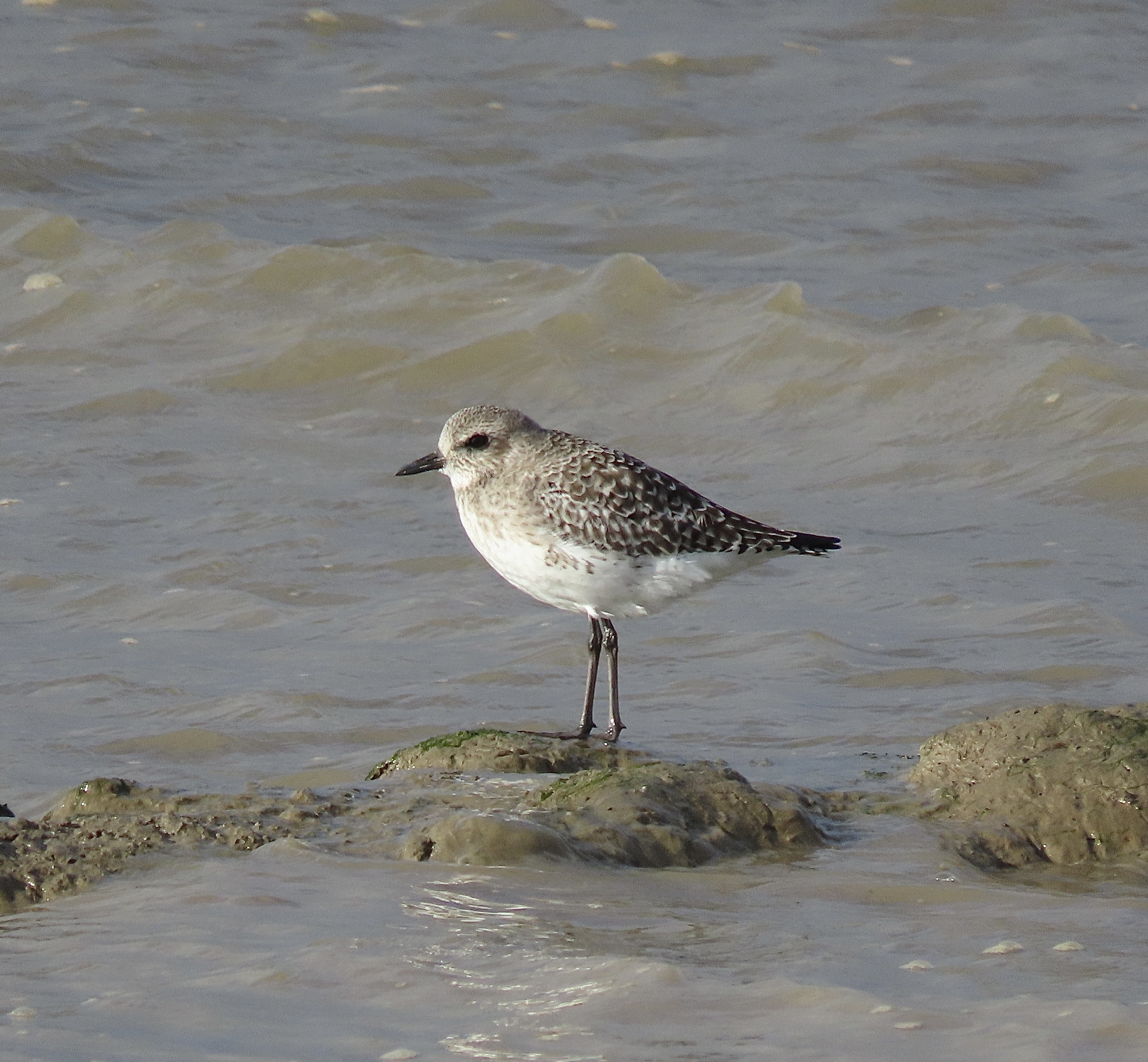
At least thirty grey plover were feeding on the mud in behind the East Mersea Point just before the high tide on Friday.

A flock of 300 dunlin was having a last feed before the tide covered the mud near the Point.
Ten avocets flew up river and 200 redshank were roosting on the saltmarsh pools.

A male wigeon was feeding near the Point, one of 100 seen in the area.

Three hundred brent geese were feeding in the park's grazing fields, 152 curlew were roosting in the fields and four stonechats seen here and nearby seawall too.
On the park pond two gadwall, 45 teal and eight shoveler were of interest, a buzzard perched on a bush near the pond and a Cetti's warbler sang. A common darter flying about was a late individual for the season.

At least one lesser redpoll, maybe a second bird, was seen in an apple tree in Michael Thorley's East Mersea garden near Meeting Lane on Friday morning. A new species for Michael's garden list.

A grey squirrel was seen in a private woodland near the East Mersea Oyster Fishery on Friday by Martin Cock.

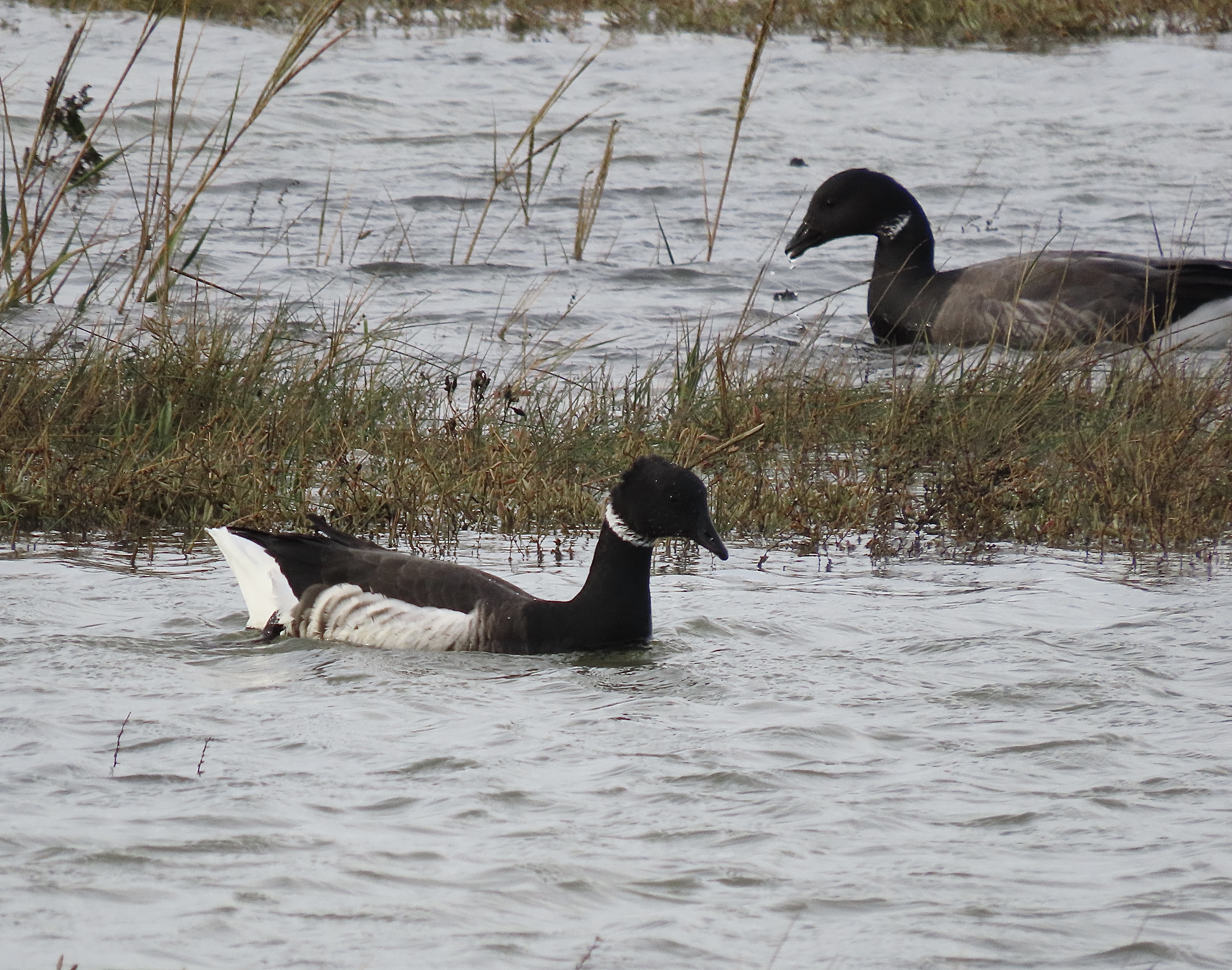
The black brant provided close views on Thursday 10th as it fed in the saltmarsh in front of the Firs Chase caravan park.

As the high tide filled up the saltmarsh creeks, the black brant fed with the flock of brent geese, in total there were 400 seen along the Strood channel on Thursday.

A small flock of 100 brent geese was feeding in a recently sown grass field by the Strood on Thursday, here grazing beside a recently planted hawthorn hedge.
Two buzzards, 50 skylarks, two sparrowhawks, 14 stock doves, stonechat and 25 linnets were seen over the fields, while two rock pipits were on the saltmarsh and a marsh harrier was over Ray Island.

A brown hare was tucked down low and hard to spot in the middle of one of the Strood fields on Thursday.

A redshank was feeding close to the Strood seawall on Thursday, while forty avocets seen in the channel. Looking across to the Feldy marshes a large flock of 3000+ golden plover was seen in the air, before they dropped back down onto the fields there.
A grey wagtail flew west off the Island, calling as it passed over the Yacht club and continued over the Mersea Quarters to Feldy.

Martin Cock saw an eider in the Mersea Quarters on Thursday, also the black brant at Rewsalls and a few goldcrests in Shop Lane.

Three mistle thrushes were seen by Jon Waters near the Golfhouse paddocks on Thursday morning.

Wednesday, 9 November 2022

MOBBED BUZZARD

A buzzard got mobbed by a carrion crow as it flew over one of the fields at Rewsalls on Wednesday 9th.

The buzzard managed to shake off the attentions of the crow and landed in a tree at the side of the field. Earlier the presumed same buzzard was seen swooping low over the main buildings at the Youth Camp.

A male kingfisher was seen perched beside a pond at the back of the East Mersea boating lake on Wednesday. Although the kingfisher was much closer when it was first seen, it only flew to the back of the small pond to perch, allowing a few pictures to be taken of it.

A black brant was feeding with a small flock of 120 brent geese, first on the flooded saltings at Rewsalls before flying onto the nearby wheat field. The brant is pictured second from the left, showing a blacker colouration with a whiter flank and a wider white neck band than on the nearby dark-bellied brent geese.

A flock of 132 curlew gathered on the side lake at Rewsalls for the high tide roost, also here 20 turnstone, ten dunlin, fifty redshank and twenty little grebes. Fifteen black-tailed godwits flew off here to feed beside the brent geese on a muddy corner of the wheat field. Four shelduck were on the marshes and a siskin flew west with a couple of goldfinches.

High tide water was still pouring onto the marshes and into the side-lake midday on Wednesday.
A red admiral and a common darter were seen near the Youth Camp.

A rock pipit was feeding along the back of the beach by the Youth Camp on Wednesday.

Seven little egrets were feeding in a pond at Waldegraves Holiday park on Wednesday and a sparrowhawk was seen flying over the area.

A little owl was playing hard to spot, as it perched in an old hawthorn tree near the fishing lakes at Waldegraves on Wednesday.

It was a surprise to see lots of honeysuckle in flower in Cross Lane for this time of the year. A Cetti's warbler was singing at the bottom of the lane also a goldcrest feeding with a long-tailed tit flock.

A grey wagtail was photographed by Andy Field, at the side of the park pond at Cudmore Grove country park on Wednesday. The bird was first seen by Martin Cock.

It's not often a grey wagtail is seen feeding on the ground on the Island, as most sightings are fly-overs.
Andy also heard two water rails and a Cetti's warbler calling at the park pond, two chiffchaffs and a goldcrest in the trees at the park, while two stonechats, 136 curlews and 150 brent geese including 24 juvenile brent were also noted at the park on Wednesday morning.

A painted lady butterfly photographed by Andy at the park is a late sighting for the year.

A male common darter photographed by Andy at the park.

A female common darter also photographed at the park by Andy on Wednesday.

Seemed strange to see a flock of thirty avocets floating in the middle of the Strood channel during the high tide on Tuesday 8th. Along the channel were 200 brent geese, two shelduck and 11 ringed plover flying over.

A flock of 65 golden plover was resting in one of the Strood fields during the Tuesday high tide.
In the fields were 30 stock doves, 32 Mediterannean gulls, 100 skylarks, 150 starlings, 20 reed buntings, twenty linnets, two stonechats, ten meadow pipits with two rock pipits along the seawall. 
A goldcrest was with a tit flock beside the Firs Caravan park.

In the Maydays and Bower Hall area, Martin Cock noted two buzzards, two marsh harriers, yellowhammer and a stonechat on Tuesday.

A turnstone was standing on the hammerhead causeway at the West Mersea Hard on Monday 7th. It was seen after stepping of the Lady Grace boat having helped the RSPB carry out one of their winter bird surveys of the recent beach recharge areas of Cobmarsh Island, Packing Marsh Island, Old Hall Pt and Shingle-head Pt..

Birds of note during the boat trip included a pair of Egyptian geese on Cobmarsh along with a high tide roost of 110 oystercatchers and 50 sanderling. A male eider was resting on the edge of the saltmarsh at Old Hall Point and a merlin was seen chasing a ringed plover. A purple sandpiper was with 400 dunlin at Shingle-head Point, also 30 sanderling here, while a red-throated diver flew into Tollesbury Fleet.

A lesser redpoll flew over the birches at Feldy View on Monday morning, also a goldcrest with a long-tailed tit flock, while a stonechat and buzzard were seen near the bottom corner of the Firs Caravan site.

On Sunday 6th along the Strood seawall there were 150 brent geese, 200 wigeon, 20 avocets, 30 black-tailed godwits, marsh harrier, sparrowhawk and two stonechat.


Saturday, 5 November 2022

LATE TERN

A late Sandwich tern was watched fishing in front of the Coopers Beach clubhouse on Saturday 5th. It's unusual to see terns still about in November, although one did overwinter round Mersea a few years back.

The Sandwich tern flew up and down a few times, diving into the high tide a couple of times without catching anything. A great crested grebe was the only other bird of note offshore.
The weather turned drizzly during Saturday morning, so only an hour was spent looking at the partially flooded Rewsalls marshes at high tide. Birds on the marshes included 30 curlew, eight black-tailed godwits, 20 teal, ten dunlin, 50 redshank and 12 little egrets, while a sparrowhawk flushed a few birds as it passed along the back. In the field behind there were 25 Mediterranean gulls, five black-tailed godwits and a little egret feeding. A Cetti's warbler was singing by the football pitch and two reed buntings also noted. A grey wagtail flew over the entrance to Coopers Beach.

A buzzard was seen flying over the field near Blue Row on Saturday, while in West Mersea two lesser redpolls were seen by Steve Entwistle in birch trees at Empress Drive. A red kite was reported by Frances Mckay flying over the allotments on Saturday.

A mix of waders pictured here feeding at Cudmore Grove as the tide receded on Friday 4th, with redshank, sanderling and dunlin shown.
Andy Field saw at the park on Friday 550 dunlin, four knot, 40 sanderling, 39 ringed plover and a bar-tailed godwit on the mud, while in the fields was the first grazing flock of the winter of 320 brent geese, also 45 curlew and four stonechats.
Five shelduck were seen flying up river which appear to be the first noticeable arrival of the autumn birds.

There were lots of ducks on the park pond on Friday with 150 teal showing a recent influx, also four shoveler, 15 wigeon, 20 mallard and ten little egrets roosting, with a Cetti's warbler and water rail heard calling. Four lesser redpolls were seen feeding in birch trees near the park's workshop.
A weasel ran across the Golfhouse track and a red squirrel was seen by Andy near the park entrance.

Martin Cock walked the Reeveshall seawall from Shop Lane on Friday and reported two stonechats, marsh harrier, buzzard, good numbers of young geese among the brent flock, also a red squirrel in Fishponds Wood.

At West Mersea Steve Entwistle saw two lesser redpolls in Feldy View, Paul Rowe watched from Old Hall 200 cormorants flying from the estuary past the West Mersea Hard towards the Strood. Earlier on Friday Martin watched a good passage of wood pigeons flying over West Mersea first thing in the morning.

Recent rains have filled up a pond recently dug at the lower part of the Strood Hill field - presumably the intention of the farmer was to create this pond having recently excavated it.
On Thursday afternoon in the Strood fields a male sparrowhawk stood on the ground looking at the small bird flocks such as 70 skylarks, ten corn buntings, 20 linnets and three stonechats. Two buzzards and a Cetti's warbler were noted while five marsh harriers were seen flying over Ray Island - some heading to Old Hall, others heading to the Langenhoe roost.

A little egret perched on a post in the Strood channel on Thursday afternoon, while later eight were seen perched in trees on Ray Island preparing to roost for the evening there.
Along the channel were 150 brent geese, 250 wigeon, 38 avocets, 100 golden plover, two greenshank, two knot and 200 dunlin.
In Feldy View there were eleven lesser redpolls feeding in the birch trees.

Offshore from the Esplanade on Thursday afternoon Steve Entwistle reported a great northern diver, eleven great crested grebes and a distant peregrine on the roof of the Bradwell power station.
In Cross Lane after the morning rain, Martin Cock saw four goldcrest, a large tit flock and two great spotted woodpeckers.

On Wednesday 2nd there were still six lesser redpolls feeding in the birch trees in Feldy View with another couple of birds seen flying over the nearby seawall calling. 

A pair of pied wagtails was feeding along the top of the Strood seawall on Wednesday.

Two meadow pipits were also feeding on the top of the Strood seawall on Wednesday, also a rock pipit flying about.
Other birds noted in the channel were 100 brent geese, 100 golden plover, while a marsh harrier and a buzzard were also seen. In the fields were 200 starling, 80 linnets, ten corn buntings, stonechat, 70 skylarks, six stock doves, while 200 wood pigeons were seen flying west in small flocks.

At Maydays on Wednesday Martin Cock reported four red-breasted mergansers, peregrine, marsh harrier and a rock pipit.

At least four lesser redpolls were feeding in the silver birches in Feldy View on Tuesday1st.

Wednesday, 2 November 2022

MIGRANT MOTHS

Some interesting moths were trapped in the Firs Chase garden during the last week of October. One of the most notable was the scarce migrant micro moth Yellow-underwing Pearl Uresiphita gilvata, which appears to be the first record for Essex. It was trapped on Thursday 27th during a warm night with southerly winds.

The Yellow-underwing Pearl kindly posed with its forewings open to show the yellow underwings.

A Scarce Bordered Straw was another scarce migrant to the moth trap on Thursday 27th - the first record for the garden.

Five Rusty-dot Pearls were logged on the 27th, another migrant micro-moth. Other migrant moths that night included a Silver Y, 20 Rush Veneers and four Diamond-back moths. Twenty-six species were noted that night, a reasonable garden tally here for the end of October.

The delicate looking Olive-tree Pearl, Palpita vitrealis with its translucent wings is another migrant and was trapped on Friday 28th.

The migrant micro Crocidosema plebejana was also recorded on the 28th.

Plumed-Fan-foot was seen on the 27th.

An Oak Rustic was recorded on the 28th - just the second garden record after the first one last year on 30th October. A species that is slowly spreading.

Blair's Shoulder Knot

Always nice to see a Merveille du Jour - three records during October.

A very green Red-green Carpet

 Cypress Carpet

Feathered Thorn

Green-brindled Crescent