Monday, 8 July 2013

SCORCHER ALONG SEAWALLS


There was a colourful patch of poppies to admire near the Maydays Farm seawall on a scorching hot Sunday 7th. The heat haze hindered views into the distance but it was a nice feeling to have a warm breeze blowing.

Lots of meadow brown butterflies were on the wing with 70+ noted, some resting low down while many others feeding on flowers like this creeping thistle.


A handful of large skippers were also seen along the seawall top, this one nectaring on creeping thistle. Also on the wing were ten small tortoiseshells, small white and a couple of small / Essex skippers. Along the dyke an emperor dragonfly and a four-spotted chaser were flying about.

David Nicholls reported a very late green hairstreak in his West Mersea garden on the 7th. One of the latest sightings in Essex this summer and normally a month later than usual.

The incoming tide had covered most of Pyefleet mud by late morning with one greenshank, 50 redshank, 50 black-tailed godwit, 10 curlew, 10 oystercatchers the main waders noted. One great crested grebe, 3 common tern and a little tern were noted along the channel as well as a common seal heading upstream.

A hobby circled high over Langenhoehall marsh while a male marsh harrier was displaying and calling high up over the nearby Langenhoe ranges.

Around the Maydays farm, there were two yellow wagtails, singing corn bunting, 2 reed buntings, 3 reed warblers, 2 yellowhammers, lesser whitethroat and five house martins by the buildings.
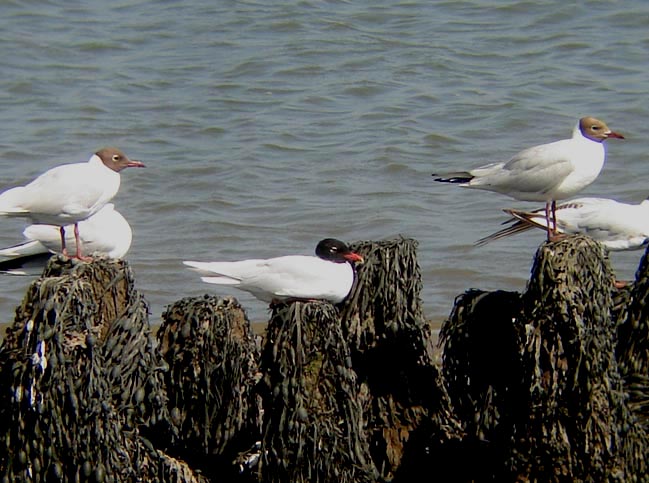
One of the birds of note during a walk along the Strood seawall on a hot Monday 8th, was this adult Mediterranean gull pictured above in the centre amongst a few black-headed gulls. The bird posed long enough on the posts for this digi-binned picture to be taken. It later flew and landed in the middle of the channel.

Amongst the small selection of waders along the channel as the tide came in were two greenshank, 25 redshank, 10 curlew, whimbrel, one lapwing and ten oystercatchers. One common tern flew past as did a couple of little egrets and two grey herons flew off the fields.

Inside the seawall were 2 kestrels, 2 reed buntings, yellow wagtail, 5 singing reed warblers and 4 linnets.
The main butterflies of note were meadow browns and a few small tortoiseshells with a six-spot burnet moth catching the eye too.

Saturday, 6 July 2013

TWIN TORTOISESHELLS


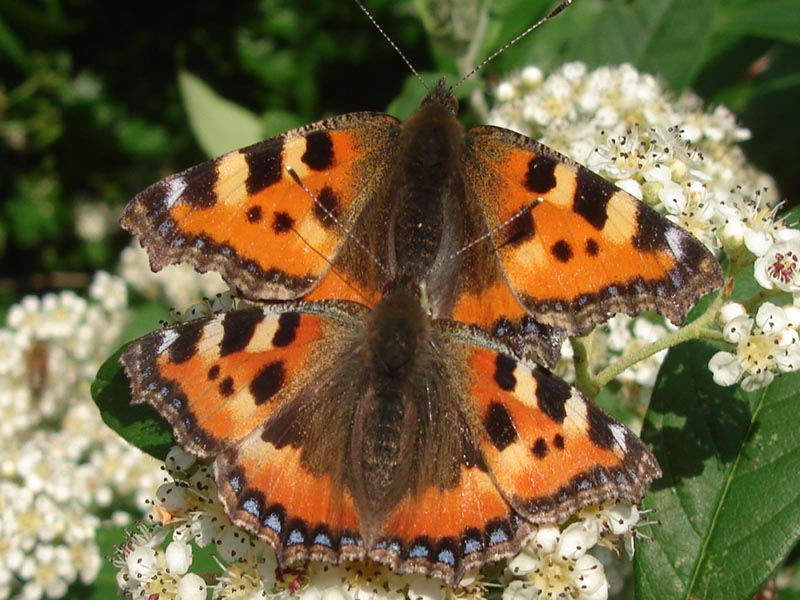
Up to ten small tortoiseshells have been attracted to the cotoneaster bushes near the buildings of the country park in recent days. In previous years there have been more red admirals than other butterflies around the cotoneasters but so far this year only the one has been spotted.
The first ruddy darters of the summer were seen along the seawall on the 1st and the sunny weather saw 2 adders basking on the 4th at the park.


Walked the Reeveshall seawall in the evening of Thursday 4th and my eye was caught by two brown herring gull chicks on top of this old building on Pewit Island in the Pyefleet Channel. Although there's been some gull interest in nesting on this Island's saltmarsh in recent years, it's a bit of surprise to see the nest with the chicks on the roof.

Along the mud on the Pyefleet waders of note were 45 black-tailed godwits, 10 bar-tailed godwits, 13 avocets, 75 redshank, 10 curlew and 10 turnstone. Four common terns and 8 little terns were also noted and amongst the 20 shelduck were the pair with ten ducklings. One common seal rested on the mud opposite Maydays.

A barn owl was hunting along the reed-fringed fleet on Reeveshall and then flew across the Pyefleet to hunt on Langenhoe. A short while later a second barn owl was watched also hunting the back of Reeveshall fields and ditches. A marsh harrier perched on a post near the Reeveshall fleet and a greenshank was feeding on the pool.

Twenty sand martins and 25 swifts flew over Reeveshall, while a male yellowhammer, reed warbler and 4 linnets were noted on Reeveshall. On Langenhoe a cuckoo perched up on a bush and there were also 3 marsh harriers flying around.

At the park at dusk a Mediterranean gull joined twenty black-headed gulls feeding on summer chafers which were flying off the ground to swarm round the tree tops.

A little owl perched on overhead wires beside Bromans Lane at dusk on Tuesday 2nd.


A little egret has this sailing dinghy to thank on Monday 1st as the sailors rescued it out of the river with an oyster clamped round its toes. Having been alerted by a visitor, I found the egret standing on the beach but when it flew away, it's leg dangled down with a muddy oyster attached to the toes. Maybe the egret dropped into the water hoping the oyster would loosen its grip. After ten minutes of sitting on the water, the bird seemed to be getting lower in the water and more immersed. Luckily this passing yacht were alerted and they scooped it out of the water and took it back to Brightlingsea where it would get sorted out.

Thursday, 4 July 2013

MOTHING NIGHTS


The moth trap was brightened up by this immaculate looking scarce silver-lines moth in the morning of Thursday 4th. Despite it being a widespread moth generally, it's been a few years since one of these graced the trap here and I'd forgotten how bright green they are. The moth is found in parklands and woodlands where the caterpillars feed on oak.

The warm weather over the last few nights have provided good opportunities for mothing sessions at the park.


The delicate bordered white looks more like a small butterfly with the brown markings and the wings being held upright. Luckily it is quite an obliging moth to photograph and stays still long enough to click a few images. A widespread moth although usually noted here just on a single occasion each year.


The distinctive and bulky looking swallow prominent is a common moth at the park. The first individual of the year was seen at the end of May and no doubt there will be others still to appear too.


The strangely cryptic pale prominent moth has some fairly dull markings but an amazing profile to mimic a piece of bark or a dead leaf. The head of the moth in this picture above is on the right.


Two traps were used on Sunday night with this Gardiner trap being brought out for the first time this season. It has three bulbs, including 150w halogen bulb, on top of a large perspex box, with the moths lured to the lights and then dropping down inside. The trap was checked at 4am before the birds were up, with about 150 macro-moths of 42 species were noted. Moths were then released back into long grass nearby.

Five species of hawkmoth was a pleasant surprise with small elephant, elephant, poplar, privet and eyed hawkmoths either in or on the trap.

Other moths of interest seen in recent nights have included blotched emerald, buff arches, marbled brown, riband wave, bordered pug, pale oak beauty, mottled beauty,  treble brown spot, barred straw, barred yellow, pebble prominent, maple prominent, poplar grey, short-cloaked moth, turnip, white-point, common wainscot, burnished brass, starwort and a brown rustic.

Sunday, 30 June 2013

CHASING INSECTS


Plenty of sunshine throughout Sunday 30th at the country park for insect activity. This female broad-bodied chaser was resting on a bramble stalk along a ditch during the morning. A male with the blue body was seen in the same area earlier on by Steve Entwistle - the same location where broad-bodied was seen last year too. Another female was flying about yesterday just inside the park entrance. Also noted yesterday was a male hairy hawker, emperor and a female black-tailed skimmer along with blue-tailed and azure damselflies.

A good variety of butterflies were noted through the day with 3 common blue, 1 holly blue, 1 small skipper, 4 large skipper, 15 small heath, 6 speckled wood, 20 meadow brown, 1 red admiral and 4 small tortoiseshells.


A couple of the eye-catching six-spot burnet moths were resting amongst the long grass, freshly emerged from their pupal cases. Judging by the amount of other pupal cases attached to the long grass stalks, there should be a reasonable emergence of adult six-spots over the next month.


Patches of ox-eye daisies stand out amongst the long grass next to clumps of greater knapweed just coming into flower. Meadow browns and large skippers were feeding on the purple flowers.

It was almost too hot for any bird activity with the songsters much quieter now. Lesser whitethroat, whitethroat were singing in the park while 3 reed warblers were singing in the reeds. On the fields 7 lapwing, little egret, 20+ mallard, 3 teal and a shoveler were noted. The male kestrel was seen taking food into the nestbox. There was the nice sight of a water vole swimming along the edge of the dyke, disappearing into a burrow on the waterline.

In the evening two corn buntings were sitting on wires over Chapmans Lane, 20 swifts were flying around their nesting houses in Upland Road, while at dusk a little owl was perched on a sign at the top of Waldegraves Lane.

The previous day Steve noted at Gyants Marsh, common buzzard, peregrine and the garden warbler singing. Common blue, meadow brown, large white, large skippers were some of the butterflies seen on the wing here.


The moth trap operating through Saturday night produced 80 moths of 25 species including the first buff arches, pictured above. This common moth has caterpillars that feed on bramble of which there's plenty at the park.

Some of the other moths recorded included elephant hawk, lime hawk, peppered, garden carpet, cinnabar, sandy carpet, clouded silver, common white wave, white point, angle shades, marbled minor, turnip, dark arches and snout.

Thursday, 27 June 2013

HAWKMOTH HAUL


An impressive array of hawkmoths graced the moth trap by dawn on Thursday 27th at the country park. This is the first time six species of hawkmoth have turned up together on the same night here. Having been carefully removed from the trap, they were photographed and then tucked away in nearby bushes.
The top four in the picture show from the left, small elephant hawk, poplar hawk, privet hawk and the elephant hawk on the right. The lower two show lime hawk with an eyed hawk to its right.

The last good hawkmoth season was during the balmy summer of 2006 when eight species were recorded at the park during the last week of June. Still waiting this year to be seen is the pine hawkmoth and the hummingbird hawkmoth.


This lime hawkmoth was the first one of the summer and a freshly marked individual it appears to be too. The camouflage markings make is a striking moth to look at - if you can find it in the foliage! This moth was the first moth to drop into the trap just after it was switched on at 10.30pm on Wednesday.
The privet hawkmoth was also the first one of the summer.


Couldn't resist taking another photo of the elephant hawkmoth, this time resting on a flower of the purple flowered rock-rose, perfect colour match! This was the only hawkmoth which turned up with a second individual, as all the other hawkmoths were singles.


At last a striking cream spot tiger moth graced the trap, the first one to do so this year. The poor weather in the spring last year and repeated again this year have hit numbers of this moth badly. None were caught last year, so this individual is the first for two years to visit the trap. Three springs ago twelve were noted in the trap one night.


The Skinner trap photographed at 4.30am on Thursday morning just as it was starting to get light. The trap had already been checked in the half-hour prior to this, so that any early birds didn't enjoy easy pickings and also so that I could check the moths before any flew off before the daylight set in.

Just over 150 individuals were counted with two thirds of these inside the actual trap. Fifty species were represented which made it a rewarding night. It appeared to stay cloudy throughout the night with some light drizzle to start with and it also stayed warm too. A couple of pipistrelle bats circled above the trap as some of the moths were heading to the light.

Some of the other moths noted were figure of eighty, latticed heath, marbled brown, clouded silver, clouded border, brindled pug, coxcomb prominent, lychnis, white-point, dark arches, light arches, grey dagger, birds wing, common rustic, treble lines, mottled rustic, vines rustic and silver-Y.


Spent an hour in the early evening on Thursday along the Reeveshall seawall to check the pool here. Eight avocet, green sandpiper, 4 black-tailed godwit, 8 curlew, pair of tufted duck, mallard, little egret, grey heron and a pair of mute swans were all seen here.

Along the nearby Pyefleet 5 bar-tailed godwit, 20 curlew, little tern, common tern, Mediterranean gull, 3 avocet were of interest. There was also a very young brood of 10 shelducks along the near mud which would be nice to think they were the ones dodging the traffic the East Mersea road the previous day. Four marsh harriers flew around over Langenhoe while 20 swifts and a pair of linnets was seen over Reeveshall.

Wednesday, 26 June 2013

OUT OF THE BLUE


The first common blue butterflies at the park this summer were fluttering amongst the long grass on Wednesday 26th. The morning warmed up nicely when the sun shone through and a number of butterflies were seen on the wing. Four common blues were seen, the first large skipper at the park this summer and also half a dozen meadow browns too. Also seen during the morning were small tortoiseshell, red admiral, speckled wood and several small heaths. The previous day a green hairstreak was still on the wing near the car park - a very late date.

Also enjoying the Wednesday morning warmth were four of the regular adders near the car park.

Five teal were the only birds of note on the park's grazing fields while four mistle thrushes were on the park.

At the beginning of the day there was drama along the East Mersea road near the pub when a pair of shelduck wandered onto the road with their very young brood of 12 ducklings. Unfortunately the parents wanted to walk along the road rather than simply cross it and being a busy narrow road, it wasn't long before traffic was forced to slow down to a halt. In the confusion the parents took to the air leaving the ducklings to run underneath the cars. One duckling was scooped up by one driver from under the waiting school bus and I rescued another one and put them back with the others which were eventually guided into a field entrance -still minus the parents. At least they were off the road and traffic could continue. There was no indication whether the adults were heading to the south shore of the Island, or to the muddy Pyefleet to the north.

On Tuesday the cuckoo was heard calling near the entrance to the country park and later a pair of Mediterranean gulls flew over the park calling. A reed warbler was heard singing from the bushes beside the car park.


There were fifty moths of twenty species in the trap after the Tuesday night session at the park, with this distinctive buff-tip moth pictured above, disguised as a snapped off twig. This was the first one of the season here.

The first peppered moth of the season was also noted pictured above, a common moth in small numbers here.


This scorched wing has a name that suitably describes the slightly charred effect to the markings.

This male puss moth was a nice surprise in the trap as it's not been recorded much in the past coming to the trap at the park and yet the caterpillars are often found feeding on the white poplar leaves. The male has these large feather-like antennae for tracking down the females.

Tuesday, 25 June 2013

BLUSTERY FOR BUTTERFLIES


This orange-tip butterfly with its tatty wings, looks like it has seen better days. It was a surprise to see one still around on a breezy Monday 24th beside a footpath to the west of Shop Lane, as their main peak showing was about a month ago.

There was also the pleasant surprise of a late green hairstreak fluttering over the same corner of oil-seed rape flowers. The poor weather over the last couple of months has really drawn out the season for these butterflies, which aren't normally seen as late as the last week in June.


This large skipper pictured above was the first one I've seen this summer, resting along the same Shop Lane footpath. Also noted were a few small heaths, speckled wood, red admiral and a small white - a nice variety on show considering the breeze and the lack of sunshine that Monday morning.

A common buzzard was seen perched on a tree at the back of Gyants Marsh, before taking off, circling around a few times. A short while later it was back on its perch before flying north-east over the Reeveshall fields. One of the local female marsh harriers was also seen close to the path as it hunted over the fields. A sparrowhawk flew away from the wood at the end of Shop Lane.

A male yellowhammer flew over, the garden warbler and blackcap were singing in Gyants Marsh while green woodpecker and a stock dove were also noted.


It was a pleasant walk along the Strood seawall on Sunday morning although not much noted in the windy conditions with the tide covering most of the mudflats. Three Mediterranean gulls were the main highlight as they flew towards the Hard. The only waders noted were a few oystercatchers and a redshank on the Ray. A couple of reed warblers sang low down in the reeds and a reed bunting was seen too.

Over the weekend at the country park, four avocets were still on the saltmarsh pools near the Golfhouse, four little terns were seen resting on the beach at the Point as was a pair of ringed plovers and a painted lady butterfly was seen again at the Point on Saturday.

Eight lapwings were mobbing a fox in the grazing fields late Saturday afternoon while on the pools eight teal were of note for the time of year. Eight swan cygnets and two pochard were still on the park pond.


There's a nice showing of sea holly and sea spurge plants along the beach near the Waldegraves Decoy Point. Despite the ravages of coastal erosion and the subsequent loss of beach, both species continue to thrive on a number of the Island's beaches. Sea spurge used to be quite scarce on the north-Essex beaches so it has been nice to see it flourishing over the recent years along Mersea's shoreline.

Andy Radley rescued a grass-snake entangled in his pond netting in his Firs Road garden on Friday evening. The snake was released across the road in the cemetery.