Monday, 1 August 2011

ADMIRALS AND PEACOCKS


There has been a good showing of red admirals, photo above, and peacock butterflies at the park especially on the flowering buddleia. The park missed out this June on the normal good showing of red admirals that usually feed on the cotoneaster flowers. Instead the best counts so far this summer appear to be coinciding with the buddleia flowering. Over the recent weekend there were 10 red admirals, 4 peacocks and 2 commas feeding on the buddleia. Also noted on Sunday 31st were brown argus, common blue, small copper, small heath, large white, small white, speckled wood, meadow brown, hedge brown and Essex / small skipper.

Also enjoying the sunshine near water were emperor dragonfly, migrant hawker, common darter, ruddy darter, small red-eyed damselfly and blue-tailed damselfly.

An adder was found hiding along the usual hedgeline by the gravel track in the park but proved to be very shy. An adder was also found on Sunday sadly run over by a car on the East Mersea road near Bromans Lane.

There was the great but increasingly rare sight at the park these days of a noisy feeding flock of about 350 starlings. Groups descend on the rowan trees or the bramble bushes quickly stripping off as many berries as they can with as much twittering as they can.

In the park fields on Sunday 4 little egrets roosted for high tide in the kestrel's oak tree, while in the pools 20 black-tailed godwits fed and there was a yellow wagtail flew near the cattle.

A hobby raced over low over the car park on Saturday afternoon where 5 mistle thrushes fed on the rowan berries and a nightingale called from the bushes. A sedge warbler feeding in one of the hedges near the park pond was a visitor to the site. Offshore 4 eider were seen close to the shore of the park.

On Friday 2 crossbills flew high north-east over the car park calling loudly. A turtle dove purred from the edge of the car park early in the morning but not heard after that.


The moth trap operating through Sunday night caught just over 100 moths including this common brown-tailed moth pictured above. The season is just about at an end for these brown-tails with numbers probably peaking about a month ago.


This twin-spotted wainscot wasn't the most eyecatching moth in the trap but it was one I hadn't seen at the park before. The photo above was taken just before the moth scuttled into a gap in the top of a picnic table. Each white spot on the wing has a second white dot close-by but I needed my glasses on to see the second dot. The species is listed as an Essex red data book species with previous county records being mainly beside marshes and along the coast.


There haven't been many chocolate-tip moths at the park this summer with this one only the second or third record this year.


This pale pyralid moth caught the eye as it sat on the edge of the trap. There's no common English name for this micro-moth Evergestis extimalis although it's a close relative of the garden pebble moth. It's a scarce resident in the south-east of England and sometimes a migrant and it's listed as an Essex red data book species with most previous records close to the coast.

Amongst the usual 30 species of macro-moth were poplar hawkmoth, least carpet, early thorn, flounced rustic, white-line dart, white-point and a drinker.

The annual moth trapping session at Hugh Owen's at Langenhoe took place on Friday night in the hope of finding the nationally rare white-spotted pinion moth. Sadly the skies were clear and there was no sign of the pinion. Some of the other moths noted were lesser-spotted pinion, latticed heath, straw underwing, white-point, rosy rustic, bulrush wainscot, red twinspot carpet and least carpet.


A walk around the Rewsall marshes on Saturday produced a willow warbler in sub-song, greenshank, 7 golden plover 25 linnets and a big flock of 400 starlings.


This female drinker moth was found along one of the grassy paths hanging from a grass stalk having laid a handful of eggs.

Both Martin Cock and Steve Entwistle visited Maydays over the weekend and noted a wheatear on Saturday along with 2 common sandpipers, 2 greenshank, 7 knot and good numbers of black-tailed godwits and avocets. Five common seals were also seen in the Pyefleet, the highest count this year so far.

Thursday, 28 July 2011

MERSEA MAMMALS


Managed to see a variety of mammals on the Island over the last few days with this hedgehog being one of them. It was found on Tuesday 26th by Sami and Andrea Murray in a vulnerable location by the roadside of Empress Avenue in West Mersea. It looked like it was a well grown youngster and quite lively when touched. Instead of curling into the ball, it would jerk its head back if it got touched. It was suggested that the best place to release it away from traffic was in an overgrown corner of the grassy Willoughby "car park", which is just a few streets away from where it was found.


Charlie Pollard found this dead pipistrelle bat lying in his Shop Lane garden in East Mersea. There was no sign as to how it died but it did look like a young one and not fully grown in size. There is a small population of pipistrelles often seen hunting along Shop Lane during summer at dusk.

The previous night on Wednesday, the annual Brockwatch event was successful with several folk managing to see 6 badgers and 3 foxes at dusk near the park pond. When one of the badgers trundled across the field towards its regular hole in a hedge, one of the waiting fox cubs playfully chased it and was immediately rebuffed by the badger.

Continuing the mammal theme, the harbour porpoise was seen in the river Colne at two different times during Thursday. In the morning it was seen from the seawall near the Golfhouse and then it was seen in the evening whilst walking the Shop lane seawall but looking east to the Colne. This porpoise appears to be still feeding in the same area since it was first seen 11 days earlier.

As well as enjoying the porpoise a common seal swam just offshore from the park on Thursday too.

Lots of waders were feeding along the Pyefleet Channel on Thursday evening with the tide slowly coming back in. Although 14 species were seen the main waders seemed to be either avocet, black-tailed godwits or redshank. Some rough counts were 1 spotted redshank, 200 redshank, 50 curlew, 2 common sandpiper, 10 dunlin, 10 knot, 8 turnstone, 4 ringed plover, 70 grey plover, 10 lapwing, 50 oystercatcher, 250 avocet, 300 black-tailed godwit and 50 bar-tailed godwit. One group of 170 avocets were gathered in the Reeveshall bay near to the pool where 4 youngsters were still being supervised by their parents. Also on the pool were little egret, mute swan, 2 mallard, 10 greylag geese and 2 lapwing. Two male yellowhammers were singing from Reeveshall hedges.

On Langenhoe 30 little terns were gathered on the Point, 4 common terns along the Channel but only two marsh harriers seen over the Langenhoe marsh. Two grey herons stood along the edge of the Pyefleet and a brood of 10 large shelducklings were noted.

Earlier on Thursday the green sandpiper flew low over the park pond and the nearby pools where there were 10 black-tailed godwits feeding. Five yellow wagtails were noted along the seawall either in the fields close to the cattle or on the saltmarsh. Offshore from the park were the sub-adult male eiders with one or two little terns and common terns flying past. A little owl attracted the attention of lots of little birds as it perched in a tree just north of the park.

The sunshine in the afternoon brought some of the butterflies out to feed on the car park buddleia with 7 red admirals, 2 peacocks, 2 comma, meadow brown, hedge brown, small white along with several appearances by a hummingbird hawkmoth.


The moth trap was put out during Tuesday and Wednesday nights with about 70 moths on the first night while 250 individuals on the following night was more productive. The nut-tree tussock pictured above is a widespread moth over most of Essex but is surprisingly absent on Mersea - until this one appeared!


A couple of white-line darts, one pictured above, were found in the trap at dawn on Thursday. Although it has been recorded before here, normally only one individual each year, so not a common moth at the park.


This nicely marked small blood-vein is the first one of the year and was in the trap after Tuesday night's trapping session.

Some of the 48 species of macro moths noted during the two nights were oak hook-tip, riband wave, blood-vein, clouded border, least carpet, red twin-spot carpet, July highflier, lime-speck pug, willow beauty, coxcomb prominent, brown-tail, ruby tiger, scarce footman, common footman, dingy footman, shuttle-shaped dart, flame shoulder, large yellow underwing, lesser yellow underwing, lesser broad-bordered yellow underwing, least yellow underwing, dark arches, light arches, dun-bar, brown-line bright-eye, bright-line brown-eye, lychnis, knot grass, uncertain, snout, common rustic, white-point, clay, smoky wainscot, flounced rustic, rosy rustic, shaded broad bar, buff ermine, peppered moth, scalloped oak, early thorn and dusky sallow.

Sunday, 24 July 2011

BUTTERFLY WATCHING


It was a good day for watching butterflies with a good number of various species around the country park on Sunday 24th. It's not often two species bask side by side on the same leaf but this picture shows a hedge brown and a comma enjoying the sunshine together.

Some very rough estimates of butterflies around the park in the morning included 5 purple hairstreak, 4 common blue, 1 small copper, 4 brown argus, 100 hedge brown, 70 meadow brown, 1 small heath, 1 large skipper, 30 small skipper / Essex skipper sps, 4 speckled wood, 1 large white, 2 small white, 1 green-veined white, 5 comma, 3 peacock and 15 red admiral. Also on the wing were 5 six-spot burnet moths and shaded broad-bar, while on the buddleia in the car park a hummingbird hawkmoth made a brief appearance.

Steve Entwhistle and Martin Cock both managed to see a few ringlets along the footpath east of Meeting Lane in East Mersea. Seven purple hairstreaks were also seen on oaks here too.


Sheltering on the south side of some bushes were a few dragonflies with this male ruddy darter enjoying the warmth on some bare ground.


There were several common darters noted along one path with this female resting on an oak bush. Others noted in the area and over nearby water were emperor dragonfly, small red-eyed damselfly, blue-tailed damselfly and various azure/common blue damselflies.

The main bird highlight was a pair of hobbies that flew over the park in the morning, sending 50+ sand martins into a flock high in the air. Whilst watching one hobby spiral upwards to gain height, a second bird appeared and was immediately mobbed by the first bird, which called as it launched each dive. Later in the afternoon a sparrowhawk was seen gliding west from the park with swallows and martins seeing it off.

The nightingale was heard calling from bushes in the car park whilst a handful of mistle thrushes enjoyed the ripening rowan berries. On the park pond the tufted ducklings, mallard and a few teal were the main wildfowl here while on the nearby pools a little egret and black-tailed godwits were noted. No sign of the green sandpiper that was seen the day before although it was probably hidden inside the thick dock growth.


A change of scene for an hour with a late evening walk along the Reeveshall seawall on Sunday. Two hobbies passed overhead with one bird mobbing the other, a repeat of the morning's action over the park. Both birds headed to the back of the Reeveshall fields.

The tide was only just starting to recede with the main wader on show being avocets. Three youngsters from the pool seemed to have crossed over the seawall and were feeding on the mud, while the other brood of four young were still feeding on the pool. Both sets of parents were very anxious and vocal as I walked along the nearby seawall. Along the tide-line in the nearby Reeveshall bay were 160 avocets with various other avocet flocks dropping down elsewhere along the Pyefleet Channel. Also on the mud was a mixed godwit group of 50+ bar-tails and black-tails as well as 50+ redshank.

Over Reeveshall 300 rooks and jackdaws flew off north-east to roost with one rook catching the eye with big white wing-tips. Also little egret, 50 sand martins heading to roost and 25 curlew feeding in the grass field. A yellowhammer was singing from a hedgeline near the Oyster Fishery.

On Langenhoe 4 marsh harriers were flying over the marsh and there were about 20 little terns and a common tern seen near the Point.


Dave Bragg found this striking vapourer moth caterpillar in his Broomhills Road garden n West Mersea. The moth is reasonably common and widespread although it hasn't been recorded at the country park for about five years. The caterpillars feed on the leaves of a variety of tree species.

Friday, 22 July 2011

MATING MOTHS


This pair of mating six-spot burnet moths were among about ten six-spots in the country park on a sunny morning on Friday 22nd. In this picture the male has coupled up as soon as the female has emerged from her chrysalis. After last year's bumper crop of six-spot burnet moths, there's not been as many on the wing this year here.


The blur of the rapidly beating wings of the hummingbird hawkmoth seem to blend into the flowers of the buddleia in this picture. This one was seen feeding on the bush in the Cudmore Grove car park in the morning, the first sighting so far this year on the Island that I've know of.


The sunshine brought a nice variety of butterflies out at the park with at least three brown argus' noted, one obliging argus pictured above. These tiny butterflies were sometimes seen feeding on bird's foot trefoil or on knapweed.


It's useful to see the underside of the argus just for confirmation so that the equally similar looking female common blue female butterfly can be discounted. One of the differences that shows up well here is the pair of dots side-by-side near the leading edge of the hindwing - they're almost in the centre of this picture. The female common blue lacks this pair of dots but getting close enough to them when at rest isn't always easy.

Nearby a couple of male common blue butterflies were flitting amongst the long grass.


There are still lots of meadow browns about the park although some of them are looking a bit faded and tatty like this one seen on the buddleia bush.
Other butterflies seen were red admiral, peacock, comma, hedge brown, green-veined white, small white and small heath.


The first small red-eyed damselfly of the summer was seen resting on an oak bush. It's brown-red eye colour suggest a young male which hasn't quite acquired the dark red eye colour.
This damselfly has been resident at the park for a number of years, just a handful of years after it was first discovered breeding in the UK, a few miles to the south-west of Mersea Island.

A couple of emperor dragonflies were seen hawking over the park pond and there were some distant azure / common blue damselflies low over the water too.

There were still 7 small tufted ducklings on the pond as well as the four older ducklings from another brood. Only a couple of black-tailed godwits on the pools but around 150 on the mud opposite the park where a couple of knot and a handful of grey plover were noted by Andy Field. Along the beach about 70 sand martins were flying about near the cliff.


This small toadlet was seen hopping across the garden towards a pond feature where it then pondered it's next move.

Wednesday, 20 July 2011

MOTH GROUP VISIT


Members of the Essex Moth Group made their annual visit to the country park on Tuesday 19th.
Five traps were set up near the car park with two of them continuing till dawn by which time the final tally was about 50 macro moths. This figure is down by 25 species on last year's tally, no doubt due to the cool and clear night.


Members had already gone home and missed seeing this spectacular garden tiger moth which arrived at the trap between 1am and 4am. This species has been recorded at each meeting of the Moth Group here at the park over the last four years but has always waited till everybody has gone home!
Numbers of garden tiger moths have drecreased in recent years in the many parts of the UK.


The nationally scarce saltmarsh loving ground lackey moth provided some interest. One or two are normally seen in the trap here each summer.


The big drinker moths are turning up at the traps at the moment and will continue to be regular visitors for the next 2 or 3 weeks. Bigger in size were three oak eggars that came to some of the traps.


This small emerald pictured above also turned up at last year's moth group session here and was the only record last summer.


The bulrush wainscot is reasonably widespread across the county near marshes and the coast and as the name suggests, has reedmace (bulrush) as the larval foodplant. It has been recorded here before but only in small numbers.

Some of the other moths noted were pine hawkmoth, oak hook-tip, chinese character, riband wave, maidens blush, least carpet, yellow-barred brindle, lime-speck pug, small dusty wave, swallowtailed, willow beauty, scalloped oak, latticed heath, early thorn, peppered, ruby tiger, buff ermine, brown-tail, common footman, scarce footman, dingy footman, coxcomb prominent, shuttle shaped dart, large yellow-underwing, lesser-yellow underwing, broad-bordered yellow-underwing, lesser broad-bordered yellow-underwing, dusky sallow, lunar-spotted pinion, dun-bar, brown-line bright-eye, bright-line brown-eye, dark arches, light arches, poplar grey, lesser common rustic, uncertain, white-point, clay, smoky wainscot, snout, flame shoulder and shaded broad bar. There was also the nice sight of the great silver water beetle at one of the traps.

Earlier in the day 2 yellow wagtails flew over calling, a whimbrel was heard out on the mudflats and the regular nightingale was calling again from the car park up until dusk.
The previous day there was a steady flow of swifts across the island all morning with at least 300 making their way westwards.

Andy Field visited Langenhoe Ranges with Richard Hull on the 20th and noted 6 greenshank, 40 green sandpipers, 250 black-tailed godwits, 100 bar-tailed godwits, 130 avocets, little ringed plover, peregrine and 2 sandwich terns. Recently there has been a good count of 100 little terns on the shingle point of Langenhoe.

Sunday, 17 July 2011

SHOWERY WEEKEND


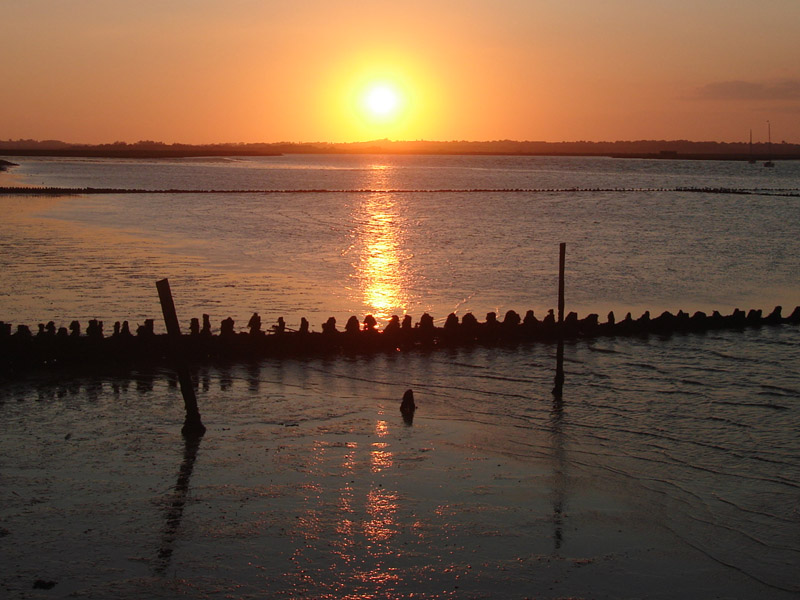
It was another day of showers on Sunday 17th with some torrential downpours at times. The sun managed to shine through on a few occasions such as with this view of the mudflats by the park.
As the tide receded in the early evening about 100 black-tailed godwits in summer plumage were feeding on the mud along with 25+ bar-tailed godwits. Also seen were the first group of grey plovers back after the breeding season with 8 counted. Two knot had been seen earlier in the day with 8 birds seen yesterday.


Enjoyed watching a harbour porpoise swimming about in the river Colne on Sunday morning. It was first seen heading up the east side of the river before it slowly fed it's way across to the Point coming to within about 50m of the beach. It would surface two or three times at a go, before dropping back down for about 30 seconds. It was a challenge trying to work out where it would come back up again because it was continually changing direction. It was last seen opposite the entrance of the Pyefleet Channel having been watched in the estuary for 30 - 40 mins.

Also seen feeding in the estuary was a common seal that appeared to swim out of the Pyefleet and out to sea. Lots of little terns flew up-river with about 30 birds seen in various flocks. Three avocets that were on the mud dropped briefly onto the saltmarsh pools and a closer look at them later revealed them to be two well fledged youngsters with an adult. A yellow wagtail flew across the Point calling.


The blustery conditions at the country park weren't so nice for the sand martins along the cliff. However some of the sand martins were heard calling anxiously near the grazing fields and after a few minutes a hobby was seen perched on the oak tree where the kestrels nested. It appeared to be a young hobby with duller markings and with very pale-red "trousers". Having surveyed the fields from its good vantage point and watched the martins flying about for about ten minutes, it flew off fast over the park. The 20 black-tailed godwits continued feeding in the pool. There was no sign of the two green sandpipers that had been at the pools the day before.

On the pond a new brood of 7 tufted ducklings swam out into the open water. These are a lot smaller than the three other older ducklings from an earlier brood. Ten teal were counted along with two pochard and about 20 mallard. A nightingale has continued to call quietly from the bushes in the car park over the weekend.


In one or two places at the park amongst the long grass are big clumps of the ladies bedstraw. Each stalk has hundreds of tiny yellow flowers which manage to attract various insects to them.

Not many butterflies on the wing over the weekend although meadow browns, hedge browns and the skipper sps were seen along with red admiral, speckled wood, small white and large white.


The first ruby tiger moth of the summer was found in the trap on Saturday morning. Several individuals are often noted during late July and early August and although it's a widespread moth, it always adds a bit of colour to the trap.


A handful of the common latticed heaths were in the trap, one in the photo above. Other moths of note amongst the hundred moths included the first drinker of the summer, white-point, small blood-vein, as well as the usual ones of recent nights.

Friday, 15 July 2011

ON THE PULL


A short time was spent on Friday 15th pulling up the ragwort plants with their bright yellow flowers from the park's grazing fields. Having cattle in these fields, horses in nearby fields and also hay being cropped nearby, the ragwort has to be controlled here so that it doesn't pose a threat to livestock.


The pools in the fields are still holding water as in the picture above, although much of the muddier corners have been colonised by masses of docks. A green sandpiper was seen flying off the pools and headed over the fields. A common gull was seen with three black-headed gulls in the pools but little else here. A little egret has been feeding along the central ditch for the last few days. A yellow wagtail flew over the park calling for the second day running.

Amongst the grassland a small number of skylarks, linnets, meadow pipits and starlings were seen. There were also lots of sand martins and one or two swallows hawking over the fields and dyke. During the nice sunny morning there was another impressive swarm of sand martins on the beach with about 300 birds flying about. No sign of any hobbies today although two circled over the park yesterday afternoon leading to the martins to gather much higher in the sky.

On the park pond the tufted duck was with four ducklings and the little grebe chicks could be heard calling, while pochard, teal and about 20 mallard were present too. Flying over the pond on Thursday were 3 green woodpeckers and four mistle thrushes that were feeding on nearby rowan berries.

On Wednesday 3 greenshank flew over the mudflats calling and then later another small group flew high over the park heading west in the early evening. A greenshank was also seen flying over the Point on Tuesday. One of the presumed local nightingales has been calling from the bushes in the car park over the last few days.

A little owl was seen again at dusk perched on a telegraph pole near Meeting Lane on Thursday evening.
Martin Cock saw a common sandpiper on the Coopers Beach seawall on Tuesday and also a Mediterranean gull too. East of Meeting Lane the two red-legged partridges were seen again in their regular field and also 5 purple hairstreaks near here.


This small copper was resting on one or two of the dried cow-pats in the field near the pond on Friday afternoon. Other butterflies noted during the day have been red admiral, peacock, large white, small white, skippers sps, meadow brown and hedge brown. The first hedge brown at the park this summer was noted on Tuesday. Flying about the long grass were a handful of six-spot burnet moths and also a shaded broad-bar.

David Nicholls reported the rare sighting of a white-letter hairstreak in trees in his garden in Queen Anne Road, West Mersea on Saturday 10th. Having got reasonable views to start with, it then flew up high and wasn't seen again. The last documented white-letter hairstreak sighting on the Island was 1984 but strangely only just round the corner to this sighting, about 200m away in Broomhills Road.


The most interesting moth in the trap at the park on Friday morning was this large oak eggar. One or two individuals are recorded here each summer and although it's reasonably common, it is still a nice moth to see. Although it stayed dry overnight it was a disappointing night with only about 70 moths of 15 species.


It was a better night on Tuesday with 200 moths of 24 species noted in the trap the next morning. Two dark sword grass moths were the most interesting, one pictured above. These are common immigrants from the continent, although numbers vary each year.

Other moths noted over the two nights included poplar hawkmoth, early thorn, chinese character, riband wave, least carpet, magpie, shaded broad-bar, scalloped oak, clouded border, browntail common footman, scarce footman, buff emine, shuttle shaped dart, clay, dark arches, dun-bar, brown-line bright-eye, smoky wainscot, uncertain, lunar-spotted pinion, dusky sallow, and double square-spot.