Saturday, 29 September 2012

LOUNGING LIZARDS

Several common lizards were lounging in the sunshine on the edge of West Mersea on a sunny Saturday 29th. This one pictured above was one of two seen basking on some posts near the Feldy cemetery, while a further seven were seen on the bare tops of old ant-hills on the St Peters Meadow. Five were seen together on one ant-hill top.

Also seen at St Peters were 2 chiffchaffs, 2 blackcaps and a family of goldfinches feeding with a tit flock. Two wasp spiders were seen on the edge of the meadow near the boardwalk. One large female wasp spider was reported a couple of days ago in one of the nearby Coast Road gardens.


Butterflies were keeping out of the fresh north-westerly breeze with this red admiral one of several seen near the Feldy cemetery, along with a couple of commas. A small tortoiseshell and small white were noted by the Strood seawall.


The stubble field alongside the Strood seawall proved attractive for the small birds to feed in, so worth a closer look during Saturday morning.  The biggest flock was 150 linnets along with 25 goldfinches while 10 corn buntings, 20 meadow pipits, 3 reed buntings and 5 skylarks were seen flying around at various times.
Also seen here was a kestrel hovering over the fields, 50 golden plover, 20 lapwing flying around,and 50+ swallows passing through.

The tide had covered most of the mud a couple of hours before the mid-day high tide. In the distance a common buzzard flew low past the Ray Channel as it headed south-west, followed shortly after by a marsh harrier and then a bit higher up a sparrowhawk taking the same flightpath over the Strood causeway.
There was a report of curlew sandpiper seen from the Strood causeway during Saturday.

In Firs Chase a sparrowhawk glided over the road, a Mediterranan gull circled over calling, while at least 3 goldcrests were feeding with a tit flock.

A late Saturday afternoon lap of the country park producd views of a wheatear on the beach, 10 little egrets, 250 golden plover and 2 avocets out on the mud, while 100 wigeon, 200 teal, 10 snipe were on the pools. At the park pond 7 gadwall, 5 shoveler, 2 tufted duck were amongst the 40+ mallard.
Liz Huxley reported 3 immature eiders in the Colne off the East Mersea Point.


There ws a nice sunset across the Strood Channel on Friday evening although most of the waders appeared in silhouette on the mud looking into the sun. No great variety of waders but a good scattering across the mud. Black-tailed godwits-75+, redshank-200, oystercatchers-20, golden plover-50, grey plover-50 and curlews-50 were the rough numbers seen.

Seventy wigeon flew out of the dyke and back onto the mudflats in the channel. Six little egrets gathered along the bottom of the Strood channel before flying off to the nearby Ray Island evening roost, where they were joined by at least another 4 little egrets.

Earlier in the day a siskin was seen feeding with some goldfinches ner the park entrance.

A painted lady butterfly was seen in the country park on Thursday morning.

Two grey wagtails flew over the park entrance as they headed east.

Tuesday, 25 September 2012

GOLDIE GROUP


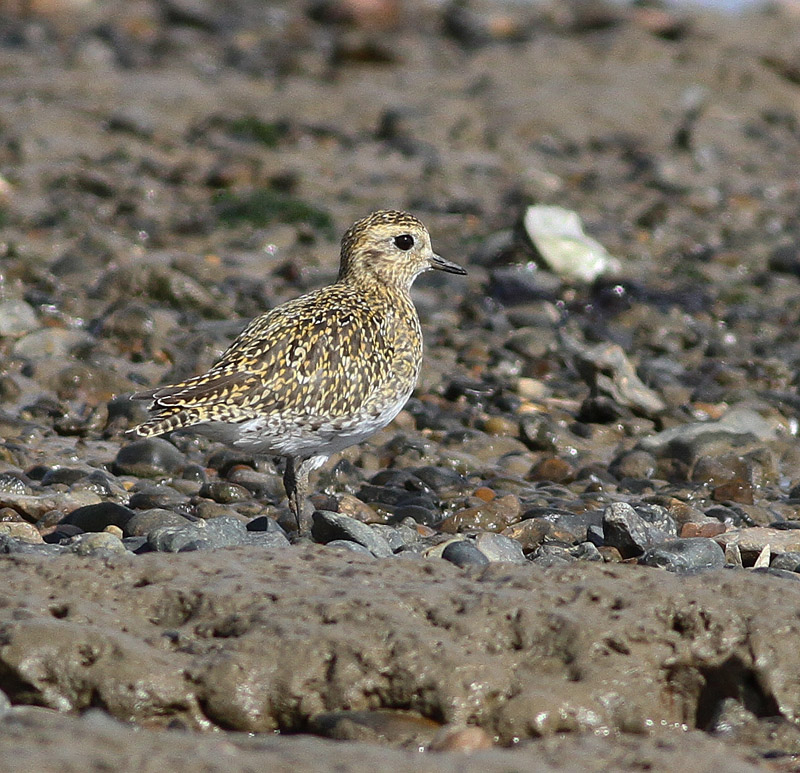
This group of golden plover were photographed on the mud at Cudmore Grove by Alan Reynolds. The sunshine shows up the golden colour on the wings and body of the birds. Flock sizes have varied in recent days on the mudflats with one group of 300 birds at the weekend being the biggest seen here so far this autumn. Alan also took the golden plover photo below.


The wind picked up during Tuesday 25th with just a couple of showers in the afternoon. Out of the wind, there was still a bit of warmth in the sunshine.
A tree pipit flew east over the car park in the morning, which was noteworthy, calling out as it passed quickly overhead. There was a bit of small bird activity amongst the tit flock near the entrance with 5 chiffchaffs, 4 blackcaps and a whitethroat seen. Up to 30 swallows passed over the park during the day.

At the park pond a male sparrowhawk glided into the tall hedge, while 6 mistle thrushes were seen heading northwards over the fields. On the water 50 mallard and a gadwall were the ducks present along with little grebes, coots and moorhens. Two tufted ducks were still on the borrowdyke.

On the pools, 8 little egrets was the biggest group here for sometime, while 50 wigeon, 100 teal, 20 snipe, 2 shoveler, 10 black-tailed godwits and 120 curlew were the main birds here. Early evening a pair of foxes were seen chasing each other around the back of the fields. The day before there had been another reasonable redshank roost at the pools with 110 birds present.

In the late Tuesday afternoon a wheatear flitted along the seawall and 30 linnets were at the Point. In the river 4 common terns flew out of the estuary, while two marsh harriers flew high up-river from Colne Point.

The day before on Monday 24th, a pair of kingfishers were seen flying fast over the pools in the fields with one bird seemingly in hot pursuit of the other as they made their way to the pond during the mid-morning. A short while later one was back on the dyke. As dusk approached at the end of the day, one kingfisher was back at the pond where it appeared to stay for the night. Through the telescope the bird was seen as it preened, to be a male with the all black bill.

The other unexpected sight from the hide by the pond at dusk, was watching a pair of muntjacs stroll along the bottom hedge for 25 metres before they tucked back into the hedge again. The male-buck with its short antlers was following closely behind the female-doe.

In the morning the first brent geese of the autumn were seen at the park with one bird seen flying west along the shore during the high tide. A little later 4 brent geese were feeding on the edge of the mud as the tide began to recede. There was a report that about a dozen brent geese have also been noted at West Mersea at their regular spot by St Peters.

Also on the first bit of uncovered mud was a flock of 18 little egrets, waiting for more of the mudflats to get exposed. Not much bird movement at sea during the morning high tide other than a few wigeon and one group of 12 shoveler.
Martin Cock saw a wheatear on Monday morning by Coopers Beach.


The first autumnal rustic of the autumn pictured above, came to the moth trap at the park during Monday night. On a windy and clear night, 40 individuals of about 12 species were noted by Tuesday morning. These included angle shades, lunar underwing, L-album wainscot, flounced rustic large yellow underwing, lesser yellow underwing, square spot rustic, setaceous hebrew character and frosted orange.

During the sunnier parts of Tuesday butterflies noted on the wing were comma and red admiral while the dragonflies noted were common darters and migrant hawkers.

Sunday, 23 September 2012

SQUIRREL SIGHTING

It was a surprise to see a red squirrel waiting at the bus stop on the East Mersea road near Meeting Lane at 7.30am on Sunday 23rd. If its hoping to catch a lift to get away from East Mersea, it has a bit of a wait as the next bus won't be along until the morning! The picture above is a bit blurred as the squirrel darted about inside the bus shelter trying to find a way out. It soon hopped out and into the nearby hedge, clambering up a small tree.

It transpires that a red squirrel was seen five days earlier less than 100m away from this bus stop, in the front garden of the Thorleys on some refuse bags before being disturbed by the refuse collectors. The squirrel quickly disappeared into a neighbours garden. Two days prior to this sighting, one was seen in a field at Home Farm in East Mersea on Sunday 16th - a day after the four reds had been released into the wild from their pen.

Sunday's weather deteriorated to an afternoon of wind and rain. Water levels on the pools in the park's grazing fields quickly rose following continuous rain. Before the rain arrived, 150 teal, 12+ snipe, 20 wigeon and 15 black-tailed godwits were present, while 94 curlew and 2 little egrets were in the fields late in the day. Two tufted ducks were in the dyke also at the end of the day.

At the park pond 25 mallard, 2 shoveler  2 gadwall were noted with 20+ swallows passing over the park as did 10 meadow pipits.At least two chiffchaffs were calling from nearby bushes but few other small birds noted in the windy conditions.

On the mudflats 300 golden plover were gathered, while 2 common terns flew along the river Colne.A sparrowhawk crossed west over the river from Brightlingsea to Ivy Farm.

On Saturday morning a spotted flycatcher was seen near the "flycatcher-gate", situated near the park entrance. In the bushes nearby were a willow warbler, 4 chiffchaffs and at least a couple of blackcaps.
In the car park 5 mistle thrushes were seen in the rowan trees, feeding on the berries.

On the park pond a female pintail was of note amongst the mallard, while on the nearby pools were 150 teal, 10 snipe, 18 wigeon and a few black-tailed godwits.A roving flock of 200+ starlings fed on berries in hedgerows, fed in the fields as well as drinking from the pools.A kestrel hunted over the fields and seawall.

At the Point a male sparrowhawk unsettled a feeding flock of 40 linnets when it hurtled into them without any warning. It was unsuccessful in catching anything. Later in the morning a second sparrowhawk flew west over the park. Also at the Point were 3 reed buntings, whitethroat, siskin in flight, 20 lapwings, 2 common terns and a common seal in the river.

A marsh harrier was reported flying past the park pond on Friday while Martin Cock saw two common buzzards at Maydays farm and a flock of 25+ meadow pipits.


This fresh looking small tortoiseshell was nectaring on the yellow flowers of bristly ox-tongues, whilst enjoying the warmth of the sun along the seawall on Saturday morning. Also noted at the park were small white, large white and a few red admirals.

This sickly looking wood pigeon, just passing the squab stage, didn't look well at the park as several flies pestered it. The bird has just left the nest and seemed to have enough flight feathers to flutter back into the nearby bushes, but didn't make any effort to do so.


Friday, 21 September 2012

REDSHANK ROOST

 Rain arrived on the Island at the end of Friday 21st, seemingly the first proper rain for nearly four weeks. The cattle grazing by the park pond in the picture above, appeared to lose the appetite to graze while the rain came down. The light faded fast with the dark cloud overhead.

The kingfisher made another appearance at the pond and looked like it was going to roost here for the night, perching in a willow bush over the water. It made at least one circuit of the pond, whistling out loudly as it flew low over the water, its colours looking unusually drab. Fifty mallard swam from the edges into the open water, while it rained.. Two gadwall and little grebe were present as were coots and moorhens.

There was a record count of 260+ redshank roosting during the late afternoon high tide on the pools in the fields. As the roosting period was drawing to an end, the chattering noise from the redshanks got louder, a great sight and sound. Also present were the usual 20 or so black-tailed godwits while 50+ curlew roosted on the field.

Earlier in the day 100 teal, 20 wigeon, 3 greylag geese, 20 snipe, little egret were on the pools while a green sandpiper flew high to the west. A greenshank was heard calling for the second consecutive day flying along the park shoreline.

The main bird feature during the morning was a big flock of house martins with 300+ flying over the park and nearby fields along with 100+ swallows and one or two sand martins. The martins semed content to stay in the area to feed, often providing the typical autumnal sight of a hundred birds sitting on some overhead wires.

In the bushes by the pond, 8 blackcaps were feeding on the various berries and 3 song thushes were noted together in one bush. Just one mistle thrush was seen in the car park. Butterflies noted during the day were red admiral, comma and small white.

At the beginning of the day a marsh harrier was seen crossing the East Mersea road near the pub, as it flew low over the fields towards Coopers Beach.

On Thursday 20th, there was a big mixed tit flock feeding in the bushes and trees in the car park with one willow warbler singing briefly amongst 8 or so chiffchaffs. A handful of finches flew over the park with at least two siskins flying with presumed greenfinches. Andy Field saw a weasel along the top of the seawall.

There was a report from Nick Green that a peregrine was tussling with an osprey near the mouth of the Pyefleet Channel, with the osprey continuing to drift west.


Moth numbers in the trap on Wednesday morning were down to about forty individuals of 12 species following a clear sky and chilly night. The first black rustic of the autumn is pictured above, looking fresh and smart with several more expected to visit the trap over the next 2 or 3 weeks.

Other moths noted included garden carpet, common marbled carpet, engrailed, lunar underwing, flounced rustic, large yellow underwing, lesser yellow underwing, square spot rustic, setaceous hebrew character, frosted orange and snout


Wednesday, 19 September 2012

RETURN OF TUFTY


William Baker was very lucky to see one of the recently re-introduced red squirrels attempt to cross the East Mersea road in front of his car near the parish boundary at Weir Farm, early on Tuesday18th. Luckily for the squirrel, it had the sense to turn back into the verge, rather than cross the road.This photograph is one of Mersea Island Society's, showing one of the reds sitting in its release pen at a private site in East Mersea.

There have been various discussions over the years about getting a population of red squirrels established on the Island, as its one of the last corners of East Anglia that doesn't currently have grey squirrels. The Society have received advice from the late David Stapleford of the Red Squirrel Survival Trust about getting the programme going on Mersea. Two breeding pairs of reds arrived at the end of August from the captive breeding centre at Pensthorpe in Norfolk with plans already in place to bring more to the Island if all goes well.

Although the Island doesn't have extensive woodland, it has many copses, small woods interlinked with lots of hedgerows. It is anticipated that the squirrels will need lots of supplementary feeding especially through this winter period.

Let's hope the squirrels can become established on the Island and let's hope they're not playing Russian roulette with the local traffic!


This herald moth was found resting inside the toilet building at the country park on Tuesday morning. When resting on a tree as in the picture above, they seem to prefer to turn upside down and face down the trunk, maybe the wings resemble a dead leaf better this way round.

On Monday 17th, Glyn Evans on his monthly walk along the north side of the Island noted 2 Arctic terns, 40 common terns, 2 common buzzard, 3 hobbies, 6 marsh harriers, wheatear, 3 whinchat, 80 meadow pipits, tree pipit and a corn bunting.

Neil Harvey watched an osprey on Sunday morning fly along Salcott Creek towards West Mersea

Saturday, 15 September 2012

BUZZING IVY BUSHES


The footpath at the top of the Firs Chase caravan site was buzzing with many insects around the ivy bushes in flower on a sunny Saturday 15th. This comma butterfly pictured above was one of three seen along the path, as were 20 red admirals and a small tortoiseshell. Adding to the buzzing sound were honey bees, bumble bees, wasps, flies and a few hoverflies too. Nearby small whites, large whites were also on the wing as were several migrant hawkers, southern hawkers and common darters.


A Mediterranean gull flew over Firs Chase early in the morning calling and thirty linnets were in the field near the caravan site.

Along the Maydays seawall in the early Saturday evening a short-eared owl was flushed by Steve Entwistle. A short-eared owl was also seen in mid afternon just to the north of the Island at Langenhoehall marshes by Hugh Owen who also saw a buzzard over his garden while a marsh harrier was seen over the marshes here and one by the Strood too.


An early evening walk along the Strood seawall on Friday 14th provided views of a number of waders on the mudflats. Amongst the usual redshank, curlew, grey plover, golden plover, black-tailed godwits was a greenshank and also a green sandpiper and 20 mallard on the borrowdyke. A common tern and little egret were seen too and the first handful of teal of the autumn were present.

Beside the seawall a corn bunting flew off, a reed bunting was heard while 6 linnets and a kestrel were noted.

Earlier on Friday at the country park, there was a good high-tide roost of 140+ redshanks at the pools in the fields - the first big one of the autumn. Four snipe, 25 black-tailed godwits, 50 curlew, 200+ teal and 10 wigeon were some of the other birds seen here.

Thursday, 13 September 2012

INCREASING TEAL


Good numbers of teal were back on the pools in the park's grazing fields with around 300 present on Thursday 13th. Numbers have been fluctuating in recent days with many teal feeding elsewhere on or near the Island. Wigeon have not been increasing as rapidly with only ten birds seen today, while on the nearby park pond 2 gadwall were seen again for the second time this week.

Also on the pools were 4 snipe although 10 had been seen on Tuesday. Twenty lapwing, 3 redshank, 50 curlew and 10 black-tailed godwits were also noted here.

The house martin passage continued for a second day with about 100 birds flying over the park including 30+ swallows and one or two sand martins on both days too. A few meadow pipits were also flying over the park calling as did yellow wagtail.

In the hedgerows 4 chiffchaffs, blackcap, reed warbler, 3 whitethroats and a song thrush were noted and a sparrowhawk passed overhead too.

Near the East Mersea Point there was the nice sight of 15 little egrets roosting during the morning high tide on the saltmarsh pools, along with an avocet, 100+ redshank and 5 grey plover. Later in the day 60 avocet and 20 golden plover were seen on the mudflats from the park.

Andy Field reported 3 willow warblers and a goldcrest amongst several small birds in the Shop Lane wood although he reported the Pyefleet seemed very quiet initially during Thursday morning.
One of the colour ringed black-tailed godwits Andy saw at the park on the 10th had been recognised 18 times since it was ringed in the Orwell river nearly five years ago. It has been a regular along the Colne estuary and has been seen at the park here in Jan 2009, Jan 2011, Jan 2012 and then now Sept 2012, as well as being seen in the Deben, Stour and near Stodmarsh in Kent during the last five years.

Steve Grimwade and his fellow Swallow Birding friends enjoyed several hours walking from the park round the seawall to Shop Lane yesterday. Amongst the birds they saw were common buzzard over Brightlingsea, hobby over the park fields, sparrowhawk across the river, 6 marsh harriers over Langenhoe, 170 avocet, 9 golden plover, 5 snipe, Mediterranean gull in the Pyefleet, 20 common tern, 5 whinchat near the Point, wheatear, 30 linnet, 3 lesser whitethroat, 7 whitethroat, 2 yellow wagtail and reed warbler.

The incoming tide pushed a greenshank and 25 redshank close to the park beach on Wednesday evening. On Tuesday 2 goldcrests and 5 mistle thrushes were noted at the park.

A weasel scuttled along the top of the seawall on Thursday and there was a common seal seen swimming offshore from the park on Tuesday. Two small tortoiseshells, 3 red admirals, 4 large whites, 6 small whites and 4 small heaths were some of the butterflies noted today.


Amongst some of the moths noted over recent nights was this large thorn, a species now seen for the third year running here.
.

The first frosted orange pictured above was in the trap on Wednesday morning, a fairly regular visitor to the trap during September.


The first L-album wainscot of the autumn pictured above, was in the trap on Monday morning. Small numbers should be noted over the next two or three weeks.

 Andy Field was quite captivated by the sight of this shore crab sitting on the path near the Point.