Saturday, 30 March 2013

COLD CONTINUES


The cold weather continues and a sunny start on Saturday 30th, soon turned cloudy. It was high tide early in the afternoon covering most of the mud off West Mersea by late morning as this view above shows, across to Packing Marsh Island.

Two great northern divers were feeding together at the entrance to Besom Creek near Cobmarsh Island, while a third great northern could be seen further offshore. Also offshore were 25 great crested grebes and two red-breasted mergansers. Closer to the Hard one shag was preening itself in the water amongst the moorings while a second bird was perched atop one of the buoys.

Other regular birds noted were 50+ brent geese along Cobmarsh Island, marsh harrier over Old Hall to the west and a small flock of 30 dunlin close into the Hard.

The short walk along the Pyefleet seawall close to Shop Lane in East Mersea on Friday 29th coincided with the high tide which had all of the saltmarsh covered. No mud was on view and many of the waders had already flown to roost elsewhere. Those noted included 70+ dunlin, 20 redshanks and a little egret on the Reeveshall pool while feeding on a flooded field were another 200+ dunlin.

Also seen on Reeveshall were 20 greylag geese, 10 linnet and a reed bunting with one of the five marsh harriers on Langenhoe seen crossing over to the Island. Feeding along the edge of the Pyefleet were 50 teal, 200 dunlin and 50 redshank with 50 shelduck forced onto the water as Pewit Island flooded.

At the end of Friday a barn owl was perched by the East Mersea road near Church Lane while a sparrowhawk flew along the length of Bromans Lane at dusk.

Andy Field found a silent chiffchaff in bushes near the Youth Camp on Friday while Steve Entwistle saw a Mediterranean gull on the beach near Seaview and a little owl in Dawes Lane.

On Thursday 28th a marsh harrier crossed high over the seawall and grazing fields at the park heading north in the afternoon. Also on the seawall was a sparrowhawk disturbed whilst attending to a recently caught bird. A kestrel was also hovering over the long grass on the seawall before perching on a nearby tree.
In the fields a wisp of 12 snipe flew down into the rushes while 300 wigeon continued to graze near the dyke.

From the East Mersea road 30+ fieldfares fed in a field near Weir Farm and 200+ golden plovers were in the Chapmans Lane field on Thursday afternoon.

Wednesday, 27 March 2013

BIRD FEEDER VISITOR

This female brambling was photographed recently by David Nicholls whilst it visited his bird feeders in his West Mersea garden in Queen Ann Road. There have been a few brambling sightings at garden feeders this winter in several places.


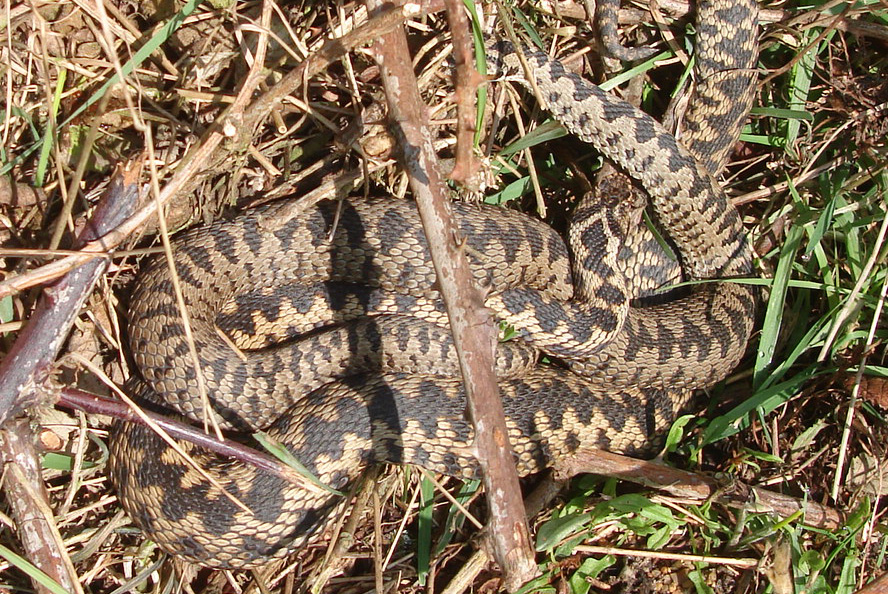
It was still a cold wind blowing across the park on Wednesday 27th but at least the sun was shining which enticed four adders out during early afternoon. This one was tucked up in a tight coil to keep warm beside the track, while three others were in the dell area.

From the hide 2 female marsh harriers were seen flying over the grazing fields, one which circled higher up above the pond as it then drifted west. In the far distance to the north, a male marsh harrier chased after a female high over Langenhoe.

A water rail scuttled quickly across the grass towards a hedge bottom where it was watched feeding for a few more minutes, with its wet red bill glinting in the afternoon sunshine. On the pond 11 tufted duck and 3 pochard were of note along with 10 shoveler and 10 gadwall. Also noted near the pond were a little egret and a curlew, while in the fields 400 wigeon and 100 golden plover were seen while 200 brent geese flew past.

At dusk the little owl perched on top of a telegraph pole beside the car park for the second evening running, although there was no sign of the second owl further along Bromans Lane seen on Tuesday at dusk.

Earlier in the day the two corn buntings were singing from opposite sides of the field at Chapmans Lane, West Mersea.


The sun broke through the clouds at the end of Tuesday 26th, which made a change from the cold grey days of late. Two little egrets, 300 wigeon, 50 teal and 5 snipe were the main birds here at the end of the afternoon. From the Point 5 marsh harriers were seen over Langenhoe to the north with a sixth bird flying past the Golfhouse to join the Langenhoe roost. In the river 10 red-breasted mergansers and 15 great crested grebes were noted. Ten avocets were reported flying past the Point earlier in the day.

Ten fieldfares gathered in the willow bushes over the pond to roost on Tuesday evening and a water rail appeared from the reeds to forage beside the pond.

On Monday 25th a barn owl hunted over the fields to the north of the park entrance mid afternoon. It paused for a few minutes and perched on some post and rail beside a neighbour's garden before resuming hunting again. At the end of the day a sparrowhawk appeared from the back of the pond scattering all the pigeons out the other side. Fifty fieldfares headed into the hedge beside the grazing fields for the evening roost.

Martin Cock saw the great northern diver and the shag off West Mersea on Tuesday 26th

Sunday, 24 March 2013

FIELDFARE FLOCK

A blurred shot of a fieldfare hurriedly snapped through the park's office window late on Sunday 24th, after a flock of 100 decided to drop into the car park. Not many other birds around during another cold day with the snow from yesterday still covering the ground. Amongst the 100 fieldfares that found a small corner of snow-free grass to feed on were 5 redwing. After a few minutes the flock flew back west.

A few human footprints in the snow at the park, not many visitors to the park today. Feeding along the sheltered cliff-top path was a group of 20 blackbirds, 3 song thrushes and a mistle thrush. At the park pond a little egret was sheltering out of the breeze under the willow tree, whilst a few gadwall, shoveler and tufted duck fed round the edge.

Snow covered most of the grazing fields with 300 wigeon and 50 teal nibbling grass along the edge of the dyke and also inside the seawall too. At the Point a marsh harrier flew low over the saltings, sending a few wigeon into the air, as it headed low south-east towards Colne Point. A short while later a peregrine was glimpsed briefly as it hurtled rapidly past the Point heading down-river. Around 25 great crested grebes were in the river Colne with a handful of red-breasted mergansers too.

Snow showers blew strongly from the east across the park throughout most of the previous day on Saturday 23rd. The main bird of note seen during a quick circuit round the park at the end of the day was a solitary chiffchaff calling loudly from bushes alongside the car park. It flew over to the roadside hedgerow along Bromans Lane still calling, the sight of all this snow around would be a big shock to its system.

At the park pond a sparrowhawk appeared out of the copse just before dusk along with some startled 200 wood pigeons and 20+ stock doves. A snipe was feeding on a boggy unfrozen bit of grass beside the pond.

Friday, 22 March 2013

CHILLY CHIFFY


Two calling chiffchaffs were seen in the cliff-top bushes at the park on Wednesday 20th. These are the first ones back from Africa at the park this spring. However the way the weather has deteriorated badly and turned chilly over the following days, they're probably wishing they hadn't been so keen to get here.
One of the chiffchaffs flew into a low gorse bush and provided some very close views as it flitted amongst the prickly branches. Having left that one bird, another one was heard calling and seen flying around the bushes, about 30 metres further along the path. The birds weren't seen again at the park after this.

Also at the park that day were the two water rails feeding in the pond-field nearer the park entrance end. They quickly scuttled back to the ditch at the sound of the car passing nearby. Also near the park entrance were a flock of 80+ fieldfares feeding in the nearby wheat field, along with a couple of mistle thrushes.

Birds of note in the park grazing fields were 35+ common snipe, 100 teal and 300 wigeon with 16 shelduck resting up too.

The little bit of sunshine on Wednesday morning enticed one adder to come out and lie up in one of its usual spots.

Along the East Mersea road two male corn buntings were perched up on song-posts near Bocking Hall and Chapmans Lane early on Wednesday morning. On Tuesday 19th Andy Field noted a common buzzard at the back of the Reswall fields and also 10 fieldfares near Church Lane in East Mersea.

The red squirrel seen in West Mersea on Tuesday was reported again over the next two days. Following the first sighting in East Road near Fairhaven Avenue on Tuesday, it was also seen that day nearby on Suffolk Avenue crossing into the Gambles garden. The squirrel was then reported at 7.30am the next day on Wednesday a further 100m westwards in Adrian Amos's garden who said he needed a double-take to be sure of what he'd just seen! The next sighting via Ian Black was by a surprised Graham Rampling who saw it cross his garden in Coast Road the following day - a further km or so to the west.

Having since spoken with Richard Taylor one of the red squirrel project co-ordinators, this red squirrel in West Mersea is a wanderer from East Mersea and one that has survived the winter months out in the wild. Of the four animals released in East Mersea last September, one is still being seen near the original release site as recently as during the previous week and there has also been the occasional sighting of an individual near the East Mersea church too.

Two more red squirrels were brought onto the Island in early February and kept in a release pen at a different East Mersea location from the original site. After five weeks the female sadly died apparently of starvation depite having plenty of food for it. The male is still in the pen. There are still plans to bring two more squirrels from Pensthorpe onto the Island and put them into the pen already constructed in a small wood in West Mersea.


Braved the very strong winds last thing on Friday 22nd to blow away some cobwebs. This little sea-blite bush on the beach at the East Mersea Point provided me with just enough shelter, but only whilst lying virtually inside it! The wind was whipping up the waves on the river but at least it had stayed dry all day. A pair of reed buntings and a dunnock were also keeping low in the bushes near here.

In the distance at least six marsh harriers were seen above the seawall of Langenhoe Point as they gathered for the evening roost. Also heading to roost were 500+ wood pigeons crossing east over the Colne to Brightlingsea /Moverons. Some of these pigeons were no doubt part of the big flock of 2000+ wood pigeons stripping the rape fields near Weir Farm earlier that morning.

In the choppy river 12 red-breasted mergansers and 20 great crested grebes were seen, the latter probably sheltering in these slightly calmer waters. Flocks of various waders including knot, dunlin, bar-tailed godwits and grey plover were swooping low across the Point as they switched mudflats with the incoming tide.

Fewer birds on the grazing fields than usual with 300 wigeon, 50 teal and 13 tufted duck present along with a few gadwall, shoveler and mallard.

Tuesday, 19 March 2013

SHAG SHOWS WELL


This adult shag performed close enough to the Hard at West Mersea for Alan Reynolds to take these two pictures of the bird nearly a fortnight ago. The green eye and the striking crest show up well in these photos.

One of the two shags has often been seen feeding close to the jetty at the Hard during the last month. The second bird that has been seen this winter is an immature bird with a paler chest and has sometimes been seen perched on one of the buoys in the Mersea Quarters.


Several Mediterranean gulls have been frequenting the West Mersea beach since the beginning of the year. Alan has managed to take these photos of adult birds moulting into their breeding plumage beginning to get their black heads.
The Med gull I watched hawking low over the Strood fields at the weekend reminded me of a barn owl in flight with the very white wings.


This bird appears to have a paler grey head than in the first picture, while the adult Mediterranean gull pictured below could be the same bird in flight in the first picture.
Med gulls are very vocal at the moment and are often flying around in pairs calling out to each other. One flew over Firs Chase calling loudly just after daybreak this morning.


At the country park on Tuesday 19th, 2 water rails were feeding out in the open in the pond-field near the park entrance. A pochard and 4 pairs of tufted duck were on the pond. On the fields 70 redshank, 14 snipe and ten pied wagtails were noted while 25 fieldfares gathered in a nearby hedgerow at dusk. A siskin flew over the car park calling in the morning. Three adders were making the most of the weak sunshine in the early afternoon at the park. 

The most notable wildlife sighting of the day was by Tony and Pam Baldwin who luckily managed to avoid running over a bewildered red squirrel in the road as they drove along East Road in West Mersea near Fairhaven Avenue just before 10.30am. This squirrel is presumably one of the existing introduced animals that has wandered into West Mersea.

Martin Cock enjoyed watching a brambling coming to his garden feeders in Broomhills Road in West Mersea today. Offshore 3 great northern divers and 4 Slavonian grebes were noted from West Mersea by Martin. The day before Michael Thorley saw one great northern diver and 4 Slavonian grebes from the end of Kingsland Road.

Also on Monday David Smith saw a peregrine, 6 red-breasted mergansers, water rail, 10 snipe and a redwing at Cudmore Grove. Martin visited Maydays Farm on Monday and reported a common buzzard and 50 chaffinches.

Belated news from last week concerned a male wheatear seen on the country park beach in front of the cliff by John Spencer and his Writtle College students on Tuesday 12th. This is the first spring migrant seen on the Island this year. Also that Tuesday Adrian Amos informed me he'd seen 25 waxwings in West Mersea in Queen Ann Road.

Sunday, 17 March 2013

STROOD BRENT


The brent geese flock of about 600 birds flew off the fields by the Strood and landed along the Channel providing a nice view of all the birds, during a walk along the seawall on Sunday 17th. The tide was just starting to come back in although there was still plenty of waders scattered along the mudflats. Despite a close look at the geese whilst in the nearby field as well as in the channel, they were all dark-bellied brent.

The main highlight was a pair of adult Mediterranean gulls flying around the fields on the edge of West Mersea, calling out loudly as they circled round. Also noted in the various fields were a grey heron, kestrel, 17 stock doves and 3 or 4 singing skylarks.

Also of note along the channel were 100 knot, 30 black-tailed godwits, 3 little egrets and 14 little grebes, while five redwings were feeding in a scrubby field along from the Dabchicks sailing club.


One of the more unexpected sights in the Strood field was this big seed-drill well and truly bogged down in the soft mud. Apparently the big caterpillar-tracked tractor had to abandon the job several days ago as the wheels of the seed-drill had sunk down a couple of feet, and was going nowhere except deeper down!


Joined Andy Field at the end of Sunday to count the harriers roosting on Langenhoe, viewed across the Pyefleet (pictured above) from the Shop Lane seawall. The drizzle held off which was a bonus although there was still a chilly breeze blowing from the south-east.

As usual the hen harriers left it till almost dark before arriving with the first sighting not until 6.20pm, a male briefly glimpsed before it dropped down, followed five minutes later by a ringtail and then a second male five minutes later again. As on previous roost-watches, the hen harriers have suddenly appeared in view and within five seconds or less, have dropped down into the usual reedbed spot at the east end of Langenhoe Point.

Less marsh harriers were counted, as would be expected for the tail-end of winter. At least thirteen birds were counted dropping into the Langenhoe Point and another two marsh harriers may've roosted further to the west. Two barn owls were out hunting Langenhoe in the last hour of daylight.

Also seen were 1000 brent geese feeding on a Reeveshall pasture, while in the Pyefleet 10 red-breasted mergansers were seen. There was a good variety of waders feeding along the edge of the water as the tide receded, while a Mediterranean gull flew over Shop Lane calling

At West Mersea 61 sanderling were seen by the beach near Seaview Avenue by Steve Entwistle on Sunday.


It was a bit windy along the Coopers Beach seawall during a walk along there on Friday 15th. The Rewsalls marshes are still waterlogged, pictured above, with 400 brent geese enjoying the wet conditions at the back of the field. Also seen were 70 curlew in the field and a kestrel hovering over the rough grassland. The only other waders seen during the high tide period were 25 turnstone on the Coopers beach.

 This sign in Church Lane near the East Mersea church caught my eye. I haven't heard of any recent sightings of red squirrels although one of them was seen over the winter a couple of times in this area.

Thursday, 14 March 2013

SHOWY RAILS


Water rails have been showing themselves at a couple of places near the pond at the park on Thursday 14th. This one was snapped as it foraged towards the west end of the pond-field towards the park entrance. Every so often it scuttled back into the nearby ditch for safety. A second water rail was seen at the east side of the pond in the wet corner of the grazing fields, darting between the clumps of rushes before disappearing into the ditch.

Also in this area a lesser redpoll landed briefly in the alders in the afternoon before flying off. Below the alders were 10 chaffinches and 10 goldfinches feeding in the field. At the pond 2 pochard, 5 tufted duck and 20 gadwall were the main ducks here.

The clear skies on Thursday morning meant a frosty start to the day but it soon warmed up enough for three adders to be seen, including these two entwined with each other.


Around 600 brent geese were feeding in the grazing fields including a pale-bellied brent goose with them. Also in the fields towards the high tide in the early afternoon were 400 wigeon, 200 teal, 100 curlew, 100 golden plover, 160 redshank, 30 snipe, 16 shelduck as well as a few lapwing and dunlin and also two little egrets. Six skylarks were noted, one or two singing while reed bunting and meadow pipits were also seen.

Looking to the north towards Langenhoe Point seven marsh harriers were in the air together making the most of the sunshine with some birds soaring up high in the sky.

The sea offshore from the park has been quiet in the last few days with 10 red-breasted mergansers, 8 great crested grebes the main birds noted other than small flocks of wigeon on the water.

The highlight of Wednesday 13th was a very close fly-past of a barn owl at the park at 3pm in the afternoon. The owl was first spotted hunting over the long grass of the main field with the place devoid of walkers and dogs for a change. The owl seemed content quartering the same area, occasionally dropping down to try and pounce on prey. I crouched down close to a bramble bush and within a couple of minutes was treated to a memorable fly-over by the owl as it passed just a few feet over head. This owl didn't seem to realise it was a human crouching down watching it, usually they veer off at the last minute after they recognise the danger. This owl carried on hunting and was last seen flying low along the grass beside the cliff-top.

Also on Wednesday 10 fieldfares and a mistle thrush were feeding in the field near the park entrance.