Friday, 26 April 2013

TAME TURNSTONES


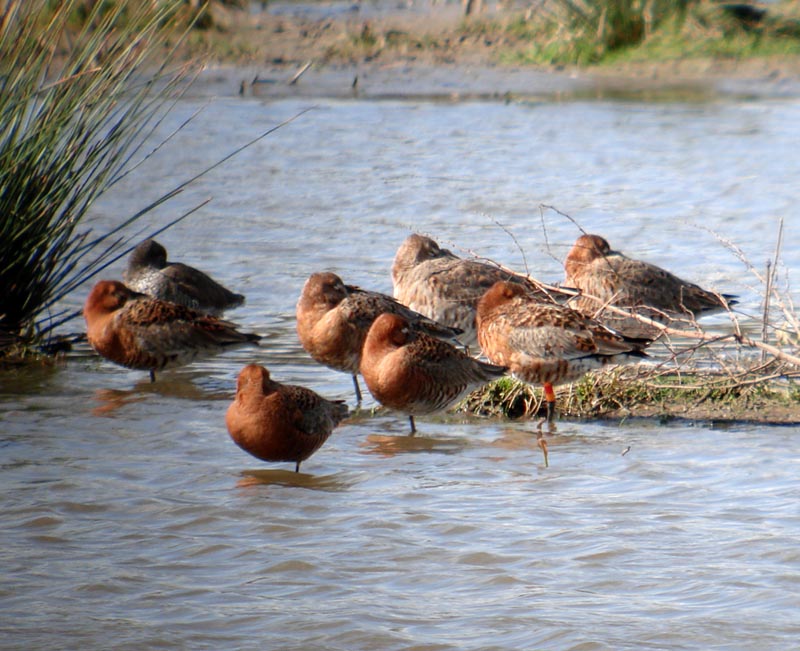
This tame group of turnstones were enjoying the sunshine whilst roosting on the side of the Rewsalls seawall at high tide on Friday 26th. It has been a regular roost site in recent weeks with 70 birds noted today and all very confiding, just five metres away.


There was a good number of wheatears seen amongst the big bales on the Rewsalls marshes with nine birds noted. Probably the highest spring number in one group that I've seen on the Island, with about a third of the birds were brightly marked males. The big bales were handy look-out perches which they kept flying back up onto.

Also noted during the mid-day visit was a yellow wagtail, 2 little egrets, 4 shelduck, 4 swallows, willow warbler, lesser whitethroat and 5 whitethroats.

During a brief visit to the country park a cuckoo was heard calling to the north of the park, over a week since the last one was heard calling. Two adders were resting at their usual location in the morning.

Plenty of warm sunshine on Thursday 25th made it feel almost muggy at times. Spent some time in the field by the park-pond, pictured above, getting the area ready for the arrival of cattle for the summer season. A sedge warbler was singing briefly from a thicket of brambles beside the water and there was also a very brief song from a reed warbler too from the reedmace.

On the water 4 pairs of pochard and 10 tufted ducks were still present and one of the swans was sitting on the nest, although probably no eggs yet.

Walking back to the car park early evening, I recognised a call of a redstart coming from the hedgeline along the central track on the park. A careful look alongside the bushes was rewarded with a flash of a bright orangey-red tail of a female redstart. The bird was watched for a few minutes as it perched on the bush, dropping down to the ground to feed. The bird stayed around in the evening for Andy and Steve to admire the bird too.

Other birds noted during the day was a male marsh harrier hunting low along the field adjacent to the car park, there was the increasingly scarce sound on the Island of a male red-legged partridge calling from the same field. The first swift for the park this spring raced low over the car park as it sped westwards.
Two yellow wagtails flew over the park as did the usual small number of swallows and sand martins.

 
This common lizard seemed brave enough to stay put when I began to move some wooden posts one of which he was using to sunbathe on, near the park pond. He was left to carry on after this picture was quickly snapped.


Six adders were out in the regular spot not far from the car park. Butterflies noted were green-veined white, comma, 5 peacocks and 2 small tortoiseshells.


The moth trap operated during Wednesday night at the park and this pretty shoulder-stripe was one to catch the eye. Just over fifty moths of about a dozen species were noted although just one new species for the season recorded, pictured below.


This frosted green was the first one of the season and often turns up in ones and twos during the spring.

Wednesday, 24 April 2013

VIPER VICTOR


After several weeks of lying around at the park, some of the adders were getting down to some serious business during a sunny Wednesday 24th. This male pictured above had just shed its skin and now shows striking black and white markings. A second male nearby was also looking very fresh having just sloughed its skin too. One of the visitors to the park showed me a newly cast-off skin yesterday, presumably from one of these two males.

Another couple of adder-watchers this afternoon, told me they'd seen the two male adders "dancing" beside the track. Sure enough whilst chatting away to them, the two males came back together again, rearing heads up, they then writhed around in the undergrowth, each one trying to force the other down. The two males seemed evenly matched, both about  45cms long, they danced around for about a minute, before parting.

When I next passed this spot, I glanced down to find one male adder curled up in the late afternoon warmth while the second male - the victor, was a few metres away locked up with a female mating! The successful male was rewarded with the female and were joined together, slowly rolling and writhing around amongst the vegetation. The bigger and duller female was pulling the bright male backwards and they then swiftly disappeared out of sight when they realised they were being watched.

This is the first time I've seen adders mate and surprised to see the male hitched up so quickly, within a couple of hours of seeing the very special "adder-dance". Also nearby was one other un-sloughed male, a tan coloured female and another female in the dell making the tally of six adders.


A couple of sand martins were flying above the park cliff on Wednesday. Elsewhere 2 blackaps, 5 whitethroats, 2 lesser whitethroats and a chiffchaff were some of the singing migrants at the park. On the fields a brent goose, 3 Canada geese, 10 snipe, 40 teal, 20 redshank, 10 black-tailed godwits were present while 2 yellow wagtails and whimbrel were heard calling overhead.

On the park pond numbers of male pochard increased to five birds with four females and 10 tufted duck also present. There was also the strange sight of the swans mating, but with the female clambering onto the back of the male, who had to have his head held under water for a few seconds.

A water vole was seen for the second day running at the south-west end of the dyke and a weasel was seen near the park entrance. Butterflies were enjoying the sunny weather with the first small white seen, along with 5 peacocks and 2 small tortoiseshells on the wing.


Andy Field took this rare shot of a female merlin perched at Maydays Farm on Wednesday during a visit there with Martin Cock.The only other birds of note were six Mediterranean gulls and a couple of house martins by the farm.

On Monday 22nd there was the very unusual sight of six black-necked grebes all in summer plumage offshore from West Mersea. The tight-knit group was first found by Martin Cock early in the morning and were present all day being seen from the bottom of Kingsland Avenue. The last time a group of this size was seen off West Mersea was probably in the 1950's, when they used to be a bit more frequent here.

At the park on Monday a singing firecrest was the highlight, as it flitted amongst bushes near the park entrance. A common buzzard drifted south-west over the car park in the afternoon and a Mediterranean gull was heard calling to the west. A willow warbler was heard singing from bushes near the hide and a yellow wagtail flew over calling. At the end of the day a little owl was perched beside Bromans Lane.

There was an unconfirmed report of about ten waxwings seen perched on a tv aerial in the Garden Farm area of West Mersea on Sunday 21st. The birds were described as being starling sized, with crests and making lots of trilling type calls.


The moth trap was set during Monday and Tuesday nights with about thirty moths on both nights with 10 species being noted. A few of the common red chestnut one pictured above, have been in the trap a few times recently.


This early grey moth pictured above, shows a little bald patch behind its head. This is the first one of the spring here and usually turns up in ones or twos to the trap. Other moths recorded included hebrew character, common quaker, small quaker, early thorn, chestnut, clouded drab, pine beauty, and the March moth.

This hairy caterpillar was marching along a little sandy path amongst the sea-blite bushes at the Point and appears to be the larva of a cream-spot tiger moth. The adult moth should be on the wing during late May and into June.

Sunday, 21 April 2013

POSING PEACOCK


Late morning was the warmest part of Sunday 21st with plenty of sunshine but before a chilly wind started to blow across the park in the afternoon. This was one of a couple of peacock butterflies seen in the sheltered spots and one small tortoiseshell butterfly was seen at the park too.

Another firecrest was found by Andy Field, this time at the park in bushes alongside the path near the hide. As ever the little bird was always on the go as it foraged and flitted amongst the branches. Mostly silent, it gave out a faint song on a couple of occasions during the late morning period whilst it was being watched.

Other migrants noted near the pond included singing lesser whitethroat, whitethroat, blackap and chiffchaff while a handful of swallows and a couple of sand martins passed over the pond. On the pond 2 pairs of pochard were of note along with 8 tufted duck. The male swan was busy building up the nest amongst the reeds.

On the grazing fields, 7 yellow wagtails were counted while 4 little egrets, grey heron,pair of Canada geese, 5 wigeon, 50+ teal, 4 gadwall,10 lapwing, 20 redshank, 5 black-tailed godwits and 3 snipe were present.

Two common terns passed the Point a couple of times while 4 red-breasted mergansers, 12 brent geese and a red-throated diver were noted offshore.Also at the Point was a pair of reed buntings, 4 linnets and a yellow wagtail flying east.

A marsh harrier passed over the East Mersea road near Bocking Hall in the evening while a little owl sat on a telegraph pole in Bromans Lane at dusk. In the morning two corn buntings were singing alongside the East Mersea road near Bocking Hall.

Andy Field heard the nightingale at Coopers Beach on Sunday morning as well as several whitethroats, lesser whitethroats and blackcaps. A fieldfare was also noted here.


This small common lizard was basking beside one of the park paths on Sunday morning. The first two individuals of the season were seen just yesterday.

On Saturday 20th the first lesser whitethroat was back at the park singing along the horseride hedgerow while 3 singing chiffchaffs were also overnight arrivals in different corners of the park. Four yellow wagtails were in the park fields, 2 siskins flew east calling and there was a common tern flying past the Point. The ruff was still in the grazing fields for its third day.
Three adders and a peacock butterfly were enjoying the warmth of the sun during the day.

The first swift seen on the Island this spring was noted by Steve Entwistle in the Empress Avenue area.

Two male wheatears were in the grazing fields on Friday 19th as were 3 yellow wagtails and the ruff was feeding around the pools. A marsh harrier flew past the park pond in the late afternoon heading north-west over the fields and another couple were seen heading north over the Point.
 Two brown hares were seen in a field near Bromans Lane in the morning.

Hugh Owen reported a red kite and marsh harrier near the Strood on Friday as well as seeing a firecrest in his Langenhoe garden.

Thursday, 18 April 2013

NEW HOME


This small grass-snake was released into the country park on Thursday 18th, having been brought from a garden in Empress Avenue, West Mersea. It's the fourth time within a couple of years that a grass-snake has been evicted and relocated from this same garden and its pond. The snake wasn't fully grown and was either a young one from last year or even the year before.

As with its predecessor, it was released in my back garden at the park where it slunk over towards a little pond to hide amongst the reeds. As it moved across the grass the long forked tongue was being flicked out to taste the air.
Four adders were basking alongside the track in the country park in the afternoon and the first peacock butterfly of the season flew across the car park.


There was a colourful flock of about 140 black-tailed godwits at the park's grazing fields, including one with a red/yellow colour-ring combination just visible on the bird on the right.
A ruff was also of interest along with 50 redshank and 5 snipe. Two bright male yellow wagtails fed beside a handful of pied wagtails while 2 greylag geese and 25 brent geese were also in the fields.

Migrants settling in at the park include 3 whitethroats, 5 swallows over the fields, chiffchaff at the pond, and at least two sand martins and blackcap both having arrived on Tuesday. On Tuesday a male wheatear was in the fields and a common tern flew past the Point and there was a report that the cuckoo was heard near the park on Tuesday too. A marsh harrier and sparrowhawk flew over the edge of the fields that evening too.

Michael Thorley found a nightingale singing from the scrubby field just inside Coopers Beach on Wednesday morning. There was an unconfirmed report of a red kite seen flying near Colchester Road in West Mersea on Tuesday morning.

A walk to the Point at the end of Tuesday afternoon was made worthwhile by the sight of three harbour porpoises swimming around feeding at the mouth of the river, just 50 metres away at times. It took almost twenty minutes to definitely confirm there were three individuals as they separated off and spent long periods underwater before coming back together again. There's usually at least one sighting a year from the Point but never three individuals here before.


The moth trap operated through Tuesday night and Wednesday night with a reasonable tally on the first session. Ninety moths of ten species were noted for Tuesday while 30 moths of 9 species were noted for Wednesday night.
This early thorn pictured above in its distinctive pose, came to the trap during Wednesday's session.


Another notable moth on both nights was this blossom underwing, two on the first night and one on the second one. This is the main month for this species so several more should be expected over the next two weeks or so, weather permitting.

Other moths noted were lots of common quakers, small quakers and hebrew characters as well as one or two clouded drabs, red chestnut, March moth and a shoulder-stripe.

Tuesday, 16 April 2013

CRANE CHASE


Glyn Evans and Alec Selley were very surprised and thrilled to see two common cranes, a rare sight for Mersea, flying off Langenhoe marshes, as they walked along the north side of the Island whilst carrying out the monthly Webs Count on Monday 15th. Glyn took this photo as a record shot of the two birds flying half a mile away through the heat haze at 12.30pm. The birds flew south-west down the Pyefleet, across the Strood heading down towards West Mersea.

I got the call from Glyn whilst I was munching through my sandwich in Firs Chase. I abandoned my lunch mid-bite, grabbed the binoculars and jogged down to the Hard only a minute away. I quickly scanned the skies and after a minute or so, successfully located the pair of cranes with their huge wing-spans flying low across Salcott Channel. The birds appeared to be dropping down a good mile to the west on the Old Hall RSPB reserve.

By luck Martin Cock was 500m further along Coast Road with his binoculars close at hand. The cranes re-appeared back in the air after five minutes or so over Old Hall and directions were quickly relayed to Martin via mobile, where eventually he was able to see the birds flying along the Tollesbury skyline. The birds may've  continued over to Bradwell. These two birds could have been the pair seen two days earlier on the Suffolk coast at Boyton, although I'm not aware of any sightings for Sunday.

These two swallows were photographed on the Oyster Fishery building, some of the forty swallows seen on the walk.Other birds seen during Glyn and Alec's walk from the Strood to Cudmore were common whitethroat, corn bunting, yellowhammer and reed buntings at Maydays, common buzzard and 6 marsh harriers on Langenhoe. 5 red-breasted mergansers, 4 knot in the Pyefleet, 15 golden plover, avocet by Reeveshall, then 5 wheatears and a whimbrel at Cudmore Grove.


This female adder was photographed on the Maydays seawall by Glyn during his walk alongside the Pyefleet.


Monday, 15 April 2013

BUTTERFLIES EMERGE


More sunshine on Monday 15th brought more butterflies out into the warmth such as this comma into the garden in Firs Chase, West Mersea.


A walk past the side of the nearby caravan site and onto the seawall revealed about ten small tortoiseshells and a peacock late morning. There was also a report of a slowworm basking by the path near the caravan site, while a few toads were croaking from the nearby borrowdyke.


At least ten swallows were seen around the edge of West Mersea and over the Strood fields, while a male yellow wagtail called loudly as it headed over the seawall and inland. Three chiffchaffs were noted at various points down the side of the caravan site. The other migrant noted was a common tern flying alongside the Hard just after mid-day.

Along the Strood Channel with the tide slowly coming back in, 2 avocet, 150 redshank and 70 black-tailed godwits were feeding along the water's edge. Also present were 50 dunlin, 5 grey plover, 3 turnstone and 10 curlew as well as 5 brent geese.

A little egret, one brent goose, 70 golden plover, 6 stock doves, 30 linnet, 3 singing reed buntings, 4 skylarks were seen in the fields. A marsh harrier was hunting low along the Peldon seawall and a kestrel sat on a bush near the caravan site.

Martin Cock visited the Youth Camp on Monday morning and saw five wheatears and six willow warblers and a muntjac deer but no sign of any firecrests.


Walked along the footpath between Meeting Lane and Shop Lane in East Mersea on a sunny Sunday 14th. Near Meeting Lane 100 redwings and 5 fieldfares were seen and a sparrowhawk was disturbed from a hedgerow. A yellowhammer flew over towards Reeveshall where later a marsh harrier was seen in the air. No warblers seen in the hedges other than a calling goldcrest.
Small tortoiseshell and peacock butterflies were seen along the path.

Near the East Mersea Youth Camp entrance Steve Entwistle tracked down one of the two firecrests, late on Sunday afternoon along with at least five willow warblers.
I couldn't find the firecrest during my brief visit around noon although I did see a goldcrest, heard a willow warbler singing and saw two calling Mediterranean gulls fly overhead. A small tortoiseshell butterfly was seen alongside the firecrest hedge. At least ten swallows were seen at various locations on the Island such as Weir Farm, Reeveshall, Rewsalls and Blue Row.

Phil Carter reported the first common whitethroat for the Island at the country park on Sunday.
The first pipistrelle bats of the season to catch my eye were hawking round trees beside Firs Chase on Sunday evening.

Ian Black also reported that Mark Farthing saw a red kite flying over Mersea Avenue on Friday 12th at about 1.30pm. Ian also watched a noticeable passage of 200 swallows flying across the country park that evening.

Saturday, 13 April 2013

FIRECRESTS FOUND

 Andy Field's visit to the Rewsalls marshes on Saturday 13th was rewarded with the discovery of a little gem of a firecrest close to the Youth Camp entrance. After I joined him to watch the bird later in the morning, we realised there were two firecrests together. Andy dashed back home and fetched his camera to take these two pictures. In typical "crest" fashion, the birds were constantly on the move amongst the bushes and tricky to photograph.

Feeding with the firecrests were two goldcrests which seemed rather dull in comparison with the brightly coloured firecrests. The faint song of the firecrest was heard at one point but generally it only called a few times, whereas the goldcrest was heard singing several times. Also heard singing was a willow warbler in the same bush along with at least a couple of chiffchaffs.
Other migrants seen was a male wheatear at the front of the Youth Camp and a fine male swallow flying low across the marshes on its way north-eastwards.

A male marsh harrier flew over the Rewsalls marshes putting up the forty brent geese as it headed towards the beach. Andy had seen a sparrowhawk and the little owl by the Youth Camp earlier in the morning. A pair of green woodpeckers, a singing mistle thrush and a few redwings were also near the Youth Camp.

Two adult Mediterranean gulls flew over Coopers Beach caravan site calling, fifty golden plover flew off the mud, a male reed bunting was singing from the marshes as were one or two skylarks.

Newly emerged yellow flowers of lesser celandines added to the feeling of spring beside a pond at the back of the Rewsalls marshes.

A look at the Rewsalls marshes the day before on Friday 12th morning wasn't as sunny as Saturday. The only migrant noted was a wheatear perched on one of the big round bales. On the wet pasture amongst the big bales were 70 brent geese, 20 teal, a pair of shoveler and a pair of redshank. Some of the 50 curlew flew onto the field behind and also noted was a little egret and a snipe on the Coopers football pitch.

As I walked along the seawall there was a confiding group of sixty turnstone roosting close-by on the high water line. A pair of adult Mediterranean gulls flew along the shore but nothing else of interest offshore.
By the East Mersea vineyard ten redwings were noted in the alders.

At the beginning of Friday Steve Entwistle saw a red-legged partridge at Bocking Hall farm and also corn bunting by the road too. The flock of 150 fieldfares were still feeding in the field near Meeting Lane mid-morning.

The regular water rail showed itself at the end of the afternoon on Thursday 11th at the country park pond. Whilst the bird was probing the wet grass for small worms, it provided an opportunity for this digi-binned image. The chiffchaff that had been singing the day before, was heard calling on Thursday. Amongst some alders near the pond were 20 redwing and the regular curlew was feeding in the field.

There was the rare sight of an East Mersea hedgehog late on Thursday night crossing the East Mersea road near Bromans Lane. I stopped the car and made sure it trundled safely into the nearby verge and away from any passing traffic. It's been several years since I've seen a hedgehog at the east end of the Island.