Tuesday, 26 November 2013

GREAT NORTHERN


There was the pleasant surprise at the East Mersea Point of this great northern diver close into the beach on Tuesday 26th. Great northern divers are scarce in the Colne, so to see one only 20 metres from the shore was a treat. The bird drifted away when it saw me but soon came back in so that it continue diving.

As an added bonus the ten snow buntings flew overhead as if just arriving back onto the Point. They circled round a couple of times before landing down on the beach.

Offshore 86 shelduck were off the park at high tide while 3 red-breasted mergansers flew out of the Colne.


Amongst the five hundred dark-bellied brent geese in the park's grazing fields was the pale bellied brent goose. Also 300 wigeon and 300 teal, 200 redshank, 50 lapwing and three snipe.

The regular grey heron was back on the park pond, perched on the willow tree over the water. On the pond were 20 shoveler, 10 gadwall and 20 mallard. In nearby bushes there was a noisy gathering of 15 blackbirds.

A couple of contrasting images of the skies from Mersea seen at either end of Tuesday with the view pictured above looking moody as the early morning sun tries to break through.


At the end of the day the sun was hidden from view as it set but there was a nice pink hue to the high clouds above it. The colours reflected onto the calm sea alongside the park beach.

Martin Cock found a female goosander and scaup in the Pyefleet on Tuesday morning and also saw a peregrine, green sandpiper and a Cape shelduck there too.
Andy Field found the long-tailed duck still near the Dabchicks sailing club at West Mersea and also the shag in the Quarters

Monday, 25 November 2013

STROLLS ALONG STROOD


There were small numbers of brent geese along the Strood Channel on Monday 25th although the main flock were feeding on a field on the Peldon side. Around 700 geese rose off the fields noisily into the air and then settled down in the nearby Ray Channel.

The most notable duck along the Channel was the long-tailed duck seen for the third day running just up-channel from the Dabchicks sailing club amongst the moorings. At times it disappears from view behind the boats. Other than the 26 little grebes mainly around the end of the moorings, it's the only bird in the water along that stretch. At times it would give its wings a good flapping in between some of the dives.

Other wildfowl along the channel at low tide were big gatherings of wigeon and teal with about 500+ birds and 35 shelduck. The usual mix of waders were noted with 30 knot and a couple of bar-tailed godwits of interest. The big plover flock was seen over the Feldy fields with 1000 golden plover and 300+ lapwing in the air.

A pair of stonechat was watched feeding in the field alongside the edge of the borrowdyke. Both birds perched up on the stalks with the male showing off its orangey chest in the winter sunshine. The only other small birds of note were 3 rock pipits, a handful of skylarks and a couple of meadow pipits.

The previous day Sunday 24th along the Strood, the other birds of note other than the long-tailed duck were two peregrines together in the air calling out as they tussled briefly and a male marsh harrier flew over Ray Island.

Daryl Rhymes visited West Mersea on Sunday morning and noted 4 common scoter, 24 red-breasted mergansers, 25 great crested grebes, a shag from the Hard and 2 distant short-eared owls flying high over Tollesbury Wick.

Saturday, 23 November 2013

PERFORMING PEREGRINES


Curlew was one of eleven species of wader seen along the Strood Channel on a sunny Saturday 23th. Of interest were 5 avocet, 30 knot, one bar-tailed godwit, 50 black-tailed godwit and 100 golden plover.

All the birds were on high alert as a peregrine flew up and down the Strood a couple of times and then spent half an hour resting on the edge of the saltings, watching the birds feeding on the nearby mud. A second peregrine then appeared, scattering all the waders as it flew north over the channel and beyond Ray Island. Soon after this, the first peregrine took off and flew low over the saltmarsh also heading north.
A couple of marsh harriers flew over the Ray Island and a kestrel was seen hovering over the rough grassland.


Whilst counting the regular group of little grebes in the channel, the distinctive but very unexpected profile of a long-tailed duck was found. The duck was keeping close company with the little grebes at the top end of the boat moorings, which is a surprising location for it and the first long-tailed duck in the channel for many years.

The long-tailed duck drifted down channel, despite the rising tide, diving along with a couple of little grebes. By one o'clock it could be seen distantly from the Dabchicks sailing club. Some time later in the afternoon, there was the report from Richard Allen seeing a long-tailed duck from St Peters - presumably the same bird drifted right down through the moorings.

Also noted were 24 little grebes, 25 shelduck, 1000 brent geese on the Peldon side, 400 mixed flock of teal and wigeon. Small birds seen included 25 skylarks, 10 linnets and two rock pipits.

Richard Allen also saw off St Peters 2 common scoter, 30 great crested grebes while alongside the Shop Lane seawall in East Mersea there was at least one twite calling amongst 4 finches, peregrine and ten marsh harriers.

Friday, 22 November 2013

BRANT WITH THE BRENT

This is the first black brant this winter for the Island, found with the brent geese on Reeveshall on Friday 23rd (standing just behind the nearest goose in the picture). Amongst the 500 dark-bellied brent, the black brant stood out with the blacker back, blacker lower chest alongside the big white flank patch. The striking neck collar is a classic black brant's, almost twice as big as on the brent and continuous across its throat too.

 Also in the field were 30 black-tailed godwits, 20 curlew and a snipe flew off towards the Pyefleet. A marsh harrier flew over Reeveshall's Broad Fleet while a sparrowhawk got mobbed by a crow over the Shop Lane wood.

The tide was coming in along the Pyefleet with 300 lapwing, 30 avocets, 100 wigeon the main gatherings noted while two little grebes were in the channel. Only one marsh harrier was seen over the Langenhoe marshes.


Noticed this Mediterranean gull in a field, whilst driving past Bocking Hall, as it stood fairly close to the East Mersea road. Also in the field were several other gulls of various species as well as 25+ curlew.

Wednesday, 20 November 2013

WHITE-FRONTS DROP IN


There was the unexpected sight of these two white-fronted geese in the park's grazing fields on Wednesday 20th. Although there were greylag geese, brent geese and lots of wigeon in the fields, this pair of geese stood out as they were in the middle of the field by themselves. The white base around the bill can just be seen on the bird on the left. White-fronted geese are scarce visitors to the fields each winter with birds rarely staying for more than few days.


Not as many wildfowl or waders were on the fields during the late afternoon - maybe a raptor had passed by earlier and disturbed the birds off. This flock of wigeon in flight were some of the 300 wigeon noted while 200 teal were around the pools in the fields.


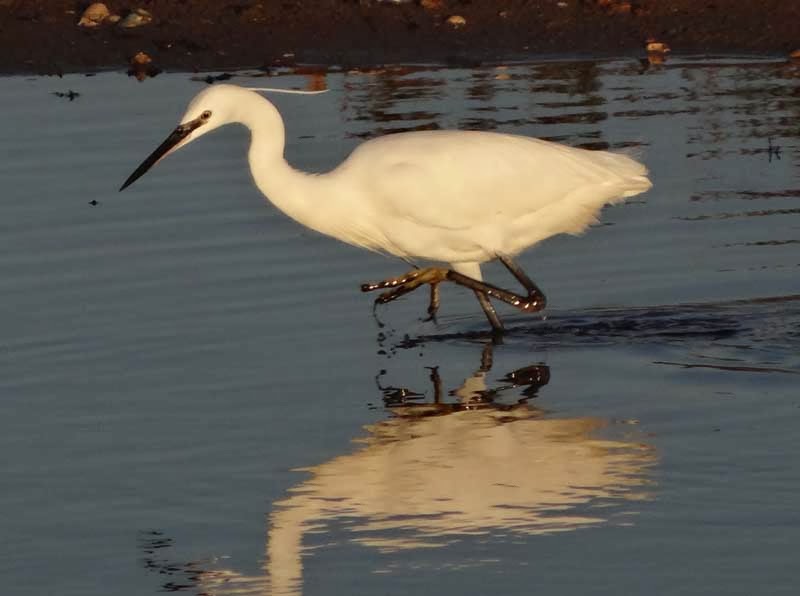
Several little egrets are regularly seen feeding along the saltmarsh creeks and in the saltmarsh pools too.


This bird was enjoying feeding in one of the saltmarsh pools beside the seawall in the late afternoon sunshine.


It was very busy with waders at the Point as they fed in the ebbing tide. The most numerous were the smallest with about 1000 dunlin spread out across the mud, some of them pictured above.


One of three marsh harriers seen late afternoon flying up the Colne towards the Langenhoe roost. This bird had been lined up to pass right over the camera whilst on the Point, but it spied me a hundred metres away standing behind sea-blite bushes and veered off to bypass me.

Andy Field and Martin Cock managed to count from East Mersea an impressive 28 marsh harriers at the Langenhoe roost on Tuesday 19th. A high count for the start of the winter period but sadly no hen harriers were seen.


Also at the Point on Wednesday was one snow bunting, although nine birds were still present first thing on Tuesday morning. Those nine birds had a lucky escape when they rose into the air as a female merlin appeared from nowhere and made a half-hearted lunge at them, before it carried on rapidly up-river.
As well as the merlin seen by Glyn at the Strood on the 18th, Martin saw a merlin chase a skylark at Maydays two days earlier

Ten red-breasted mergansers flew up river past the Point as did 100 avocets early on Tuesday and 2 rock pipits flew over the saltmarsh calling.


The birds are stripping the berries off the rowan trees in the car park but it's been great that they've lasted this long for the winter thrushes to enjoy. Up to ten blackbirds, 2 song thrushes, 2 mistle thrushes, one fieldfare, one or two jays and up to eight magpies were seen feeding on the berries during Wednesday.

Lots of loud alarm calls from blackbirds and finches in the trees by the overflow car park betrayed the presence of a little owl trying to rest half-way up a dense pine tree. A redpoll flew over the car park calling as did ten fieldares on Monday morning.

Daryl Rhymes noted a great northern diver, red-throated diver and three common scoter off West Mersea on Sunday 17th.

Two common seals were in the Colne on Tuesday 19th and one was just offshore from the park cliff feeding on a fish on Saturday 16th.

PYEFLEET POSER

I think the common seals along the Pyefleet seem to know when to pose for Glyn Evans, as they always seem to put on a good show whenever he does his monthly walk along the north side of the Island. Glyn took all these photos on Monday 18th.


High tide is the best time to see the seals on the Maydays saltmarsh along the Pyefleet Channel.

Nine snow buntings were seen feeding at the Point on Monday.


There was a flock of 25 snow buntings also seen at Jaywick on Monday. Maybe part of a recent influx.

Ten snow buntings were also seen at the Point on Sunday by Tori Andrews who also managed to get some photos of the birds.


Sanderlings are usually obliging at the Point during high tide.


Several turnstone feed along the beach, often with the sanderling at the Point at high tide.


This male wigeon shows off his fine colourful plumage in the grazing fields.


The female wigeon is not quite so brightly marked as the male birds.
Several hundred wigeon have been feeding in the park grazing fields.

The black-headed gulls have always got something to say - or is it sticking its tongue out at Glyn!

Other birds noted by Glyn on Monday's walk were a single twite on a saltmarsh fence near Shop Lane, a spotted redshank on the Reeveshall pool and a merlin by the Strood.

Friday, 15 November 2013

BUZZARD ON THE HUNT

This common buzzard was photographed by Michael Thorley as it sat in a tree beyond his back garden, to the west of Meeting Lane in East Mersea.

Michael watched the buzzard drop down to the ground but lost sight of it after that.
This bird is most likely one of two birds that have become resident in this area of East Mersea for at least a year now.

Martin Cock got a good view of a merlin on Wednesday 13th catching a skylark at Maydays Farm.

Andy Field had a very rewarding visit to the West Mersea beach when he saw a black-throated diver offshore, first located by Steve Hunting whilst he was at Old Hall. At the same time as the diver was being watched a guillemot was seen on the sea and then an Arctic tern flew past, which is late record for mid November.
A red-throated diver was seen by Martin off the Esplanade but there was no sign of the great northern diver seen from Old Hall that would have made up the full set.

At the country park a sparrowhawk flew past the pond and a water rail called on Wednesday late afternoon, then a couple of little owls duetted at dusk to the north of the park. A marsh harrier flew over the fields on Thursday afternoon.

There was a report of a woodcock found dead beside a path earlier this week, possibly lying under some overhead wires, which it may've flown into near the bus turning circle at the end of the East Mersea road.