Sunday, 11 October 2015

BRENT COMING BACK

The brent geese are becoming a regular sight at the country park, since the first ones were seen a fortnight ago. This flock of 100 were on the sea beside the Point early morning on Thursday 8th.

Also at the Point was a group of 80 avocets waiting on the last bit of mud to be covered by the incoming tide. A yellowhamer and a lesser redpoll were heard flying over while 20 linnets were feeding in the sea-blite bushes.

At the end of the day a marsh harrier flew over the Point on its way towards the Langenhoe roost.

The pair of kestrels were enjoying the morning sunshine on Thursday as they perched by their nestbox at the back of the grazing fields. A sparrowhawk was seen over the park in the afternoon.

Numbers of wigeon in the fields have been gradually increasing with 300 now present, along with 300+ teal.
The kingfisher flew along the edge of the beach from the Point, then flying over the seawall and perching briefly by the dyke on Thursday.

At the park pond five shoveler and three gadwall were seen on Thursday, the first gadwall returned after the summer break just a couple of days earlier. Twenty-five siskin flew away from the alders where they had been feeding for a while. Two lesser redpolls flew over calling heading west.

There seemed a few more smaller birds around the park on Thursday than of late such as eight chiffchaffs, 3 blackcaps and five goldcrests.

At least a hundred curlew were roosting /feeding in the grass field to the west of the park on Tuesday 5th.

At the park on Monday 4th a marsh harrier flew along the foreshore eastwards, 5 swallows passed over as did ten siskin while in the fields the second Cetti's warbler sang from the central ditch and 3 snipe were seen.

Near Rewsalls farm a big flock of 200 meadow pipits were seen by Martin Cock and Andy Field on Wednesday 8th, while nearby a handful of siskins were feeding in alders by the vineyard.

This little bunny came out to nibble the grass in front  of the hide on Thursday 8th. Plenty of rabbits around the park.

One of the striking of autumn moths is the merveille du jour, this one pictured above came to the trap at the park during the night of Sunday 4th. It was one of 130 moths of 23 species, a better catch than some recent nights. Despite being generally widespread, the merveille du jour isn't a common moth at the park and has only been recorded once before.

The dusky lemon sallow makes an annual appearance usually just the once, occasionally on a couple of nights in the autumn. The larvae feed on elm.

The flounced chestnut is another moth that is recorded just the once or twice in the autumn. Two came to the trap on Sunday 4th. The larvae feed on the leaves of various deciduous tree species.
Also noted were orange sallow, silver-Y, white-point, 12 L-album wainscots with fifty lunar underwings being the most numerous.

The moth trap on the 6th October produced just under 100 moths of 17 species including barred sallow, sallow, mallow, autumnal rustic, green-brindled crescent, dark chestnut and brindled green.

Thursday, 8 October 2015

LINNETS AND LARKS

A flock of 25 linnets was feeding amongst the sea-blite bushes at the East Mersea Point on Sunday 4th. The birds were also flying onto the nearby grazing fields to feed and to drink from the ditch.
Other finches of note seen at the park during Sunday morning included twenty goldfinches and at least two siskins in alders by the pond.

One of twenty skylarks seen at the park, this one on the seawall path, twelve others flew west over the park, while a few others fed in the fields.
Six yellowhammers passing west over the park was of interest. The only swallows seen during the day was one group of seven heading west.
Two Cetti's warblers were singing at the same time from opposite sides of the grazing fields. One singing from the reeds in the dyke was possibly a new bird in, as this is away from the usual range of the resident bird.

An immature gannet flew into view whilst scanning the east shore of the Colne with the binoculars. The bird flew just inside the mouth of the Colne passing Batemans Tower before turning round and heading back out to sea on Sunday morning.

I wondered if the gannet was going to dive down into the river to join the fishing frenzy that a group of 25 cormorants were having. Although the gannet passed right over them, it didn't seem interested and carried on its way.

Also in the river were 200 brent geese mainly along the eastern side, a great crested grebe and a common seal. Overhead there was the unusual sight of a great spotted woodpecker flying high eastwards off the Island flying from the Golfhouse area, over the Colne in the direction of the Batemans Tower area on the opposite side of the river.

A kingfisher was seen at the park pond and a sparrowhawk was noted near here too on Sunday.

Also on Sunday a red squirrel was reported visiting a garden along the East Mersea road opposite the old Pick Your Own field.

A hundred greylag geese were on the grazing fields on Saturday 3rd, some pictured above on the main pool in the fields. Amongst the 200 wigeon was a female pintail on the fields.
A male sparrowhawk flew low over the pools scattering all the wildfowl in its wake.

The kingfisher and 42 little egrets were counted by Jo Phillips and friends on Saturday afternoon.
Two siskins were seen with 10 goldfinches feeding in alders by the pond.

Late migrants were thirty swallows passing during the day, a yellow wagtail flying east and a blackcap in the bushes. Five goldcrests were also noted in various bushes and trees.

 These three wheatears were photographed on the park seawall on 25th September by Andy Field, also the picture below.


This clouded yellow butterfly was seen at the park on Friday 25th, also photographed by Andy. Up to three clouded yellows were seen along the Maydays seawall towards the end of September by Martin Cock.

This rather dull looking moth is a nationally scarce feathered brindle, a coastal species in southern England which has only been seen once before at the park. This individual was one of 75 moths of 15 species that came to the moth trap on Friday night.
 
A handful of beaded chestnuts were noted in the trap, a typical autumnal species and reasonably common.


This is the first large wainscot of the autumn season, maybe one or two others still to come.
Other moths noted included deep-brown dart, black rustic, autumnal rustic, square-spot rustic, frosted orange, L-album wainscot, setaceous hebrew character, large yellow underwing, lunar underwing, mallow and brimstone.

Monday, 5 October 2015

SQUIRREL SIGHTINGS

Up to thirty lapwings have been feeding on the park's grazing fields in the last few days. After dark they fly onto the main part of the park to feed after everyone with their dogs have left the place.

A pair of yellowhammers perched briefly on top of a tree behind the hide at the park, making a rare visit to here.

The Cetti's warbler was singing from the near side of the pond and actually showed itself briefly on Friday. In the nearby hedges up to six blackcaps and five chiffchaffs were enjoying the morning sunshine.
A common buzzard flew west over the park on Friday as did 300 golden plover flying over the car park.

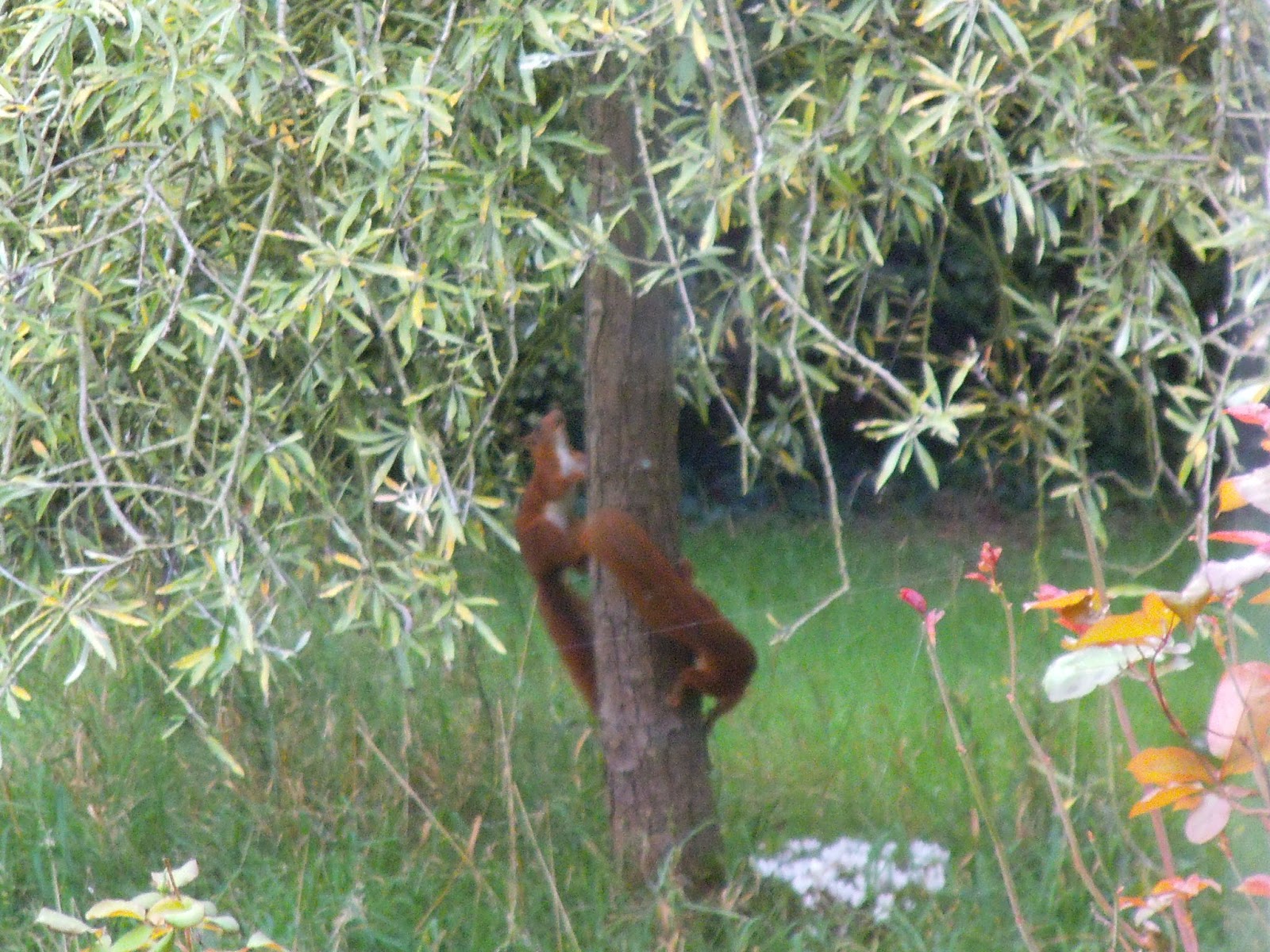
An unexpected sighting at the beginning of Thursday 1st was this red squirrel seen scampering along Bromans Lane at 7.30am as I was driving to the park. It hardly paused to stop before leaping into the grassy verge and quickly disappearing.
Having since seen the Watkins family from the nearby Bromans Farm, they too have been enjoying seeing a red squirrel for several days feeding on their walnuts in their garden.
Another red squirrel was also reported crossing the East Mersea road at the end of Thursday near Weir Farm.

At the beginning of September two red squirrels were visiting several gardens along East Road near the end of the East Mersea road, this pair being photographed by David Bullock in his garden, as was the individual pictured below.


A badger was seen in Bromans Lane just after dark on Tuesday 29th, while two days earlier another badger was successfully rescued from one of the park's pillboxes by the RSPCA having been spotted by the Pickles family. The badger seemed in good health and was released back onto the park.

This comma butterfly was enjoying the morning sunshine on Friday at the country park. Also seen were speckled wood, small white and small copper.

Overnight on Wednesday 30th, forty-eight moths of fifteen species came to the trap including this L-album wainscot, a species that turns up each autumn in small numbers.

A couple of autumnal rustics were noted in the trap, an annual visitor each autumn in ones or twos.

Friday, 2 October 2015

TON OF EGRETS

The magic figure of 100 little egrets at the park roost was reached for the first time on Tuesday 29th when 110 birds were counted in the willow trees behind the pond. The previous highest count was 95 egrets last year on the 10th September.

A spotted flycatcher was found on top of a bush near the park hide on Tuesday. Pictured here leaning into the strong easterly wind.
Six swallows flew over the fields on Wednesday 30th.

Wigeon numbers are building up each day with 120 seen on the fields on Monday and then 170 by Wednesday. The main pool pictured above is starting to fill up with wildfowl especially with the 300 teal present too.
Nienty greylag geese were feeding in the fields while twenty brent geese were in the estuary.

A kingfisher flew low along the dyke on Wednesday morning and then a second sighting of one arriving at the pond an hour later was probably a different bird. A female pochard was also on the pond while a sparrowhawk was seen a couple of times during the day.

At the Point 30 linnets were flying about, 100 avocets flew back upriver, 40+ cormorants were fishing in a tight group in the river, 2 marsh harriers were over Langenhoe Pt.

Andy Field walked along the Reeveshall seawall on Wednesday and noted a wheatear, common buzzard, 200 golden plover while on Langenhoe were 4 marsh harriers.

This stock dove perched up on a hawthorn tree near the pond on Wednesday.

Three small copper butterflies were seen on Wednesday at the park, one pictured above, also speckled wood, comma, small white and red admiral. Common darters and migrant hawkers also on the wing.

Probably the last common lizard of the summer was glimpsed at the park, here sunning itself.

Recent clear nights have kept moths catches low at the park with this barred sallow one of 28 individuals amongst ten species.

Wednesday, 30 September 2015

MARSHES TURNING BLUE

There was plenty of sunshine with blue skies over the Island on Monday 28th, here even the saltmarshes along the Strood Channel turned blue during the very high tide.

Twenty little egrets were taking advantage of the rising tide covering the saltmarshes along the channel, especially around Ray Island. This bird was wading through the water to feed in front of the Firs Chase caravan site.

An early brent goose was seen flying along the channel on Monday early afternoon.

A female pintail was spotted amongst the teal at the country park on Monday afternoon. It became a bit more recognisable once it stuck it's long thin neck up.

For several minutes the pintail snoozed beside the pools in the fields, before standing up and then flying away. A typically brief visitor to these fields.

Also on the fields were 90 greylag geese, 120 wigeon and 250 teal.
Offshore the first brent geese were seen with twenty birds seen just offshore on a shingly/mud island as the tide receded.

This poorly field vole was found staggering across the grass of the park on Monday. A close look at it revealed a severe tick infestation around its flanks, one tick just about visible in the photo.

A common buzzard flew across the East Mersea road near the church on Monday afternoon.
At West Mersea three little gulls were seen feeding offshore from the Esplanade late on Monday 28th by Martin Cock.

Other birds of note on the Island seen by Martin in the last fortnight have included -
25th - curlew sandpiper, grey wagtail, two common terns and a clouded yellow at Maydays farm; 23rd - 40 wigeon and six chiffchaffs at the country park; 21st - two spotted redshank, green sandpiper and greenshank at Maydays farm; 20th - grey wagtail at the Cross Lane sewage works; 18th - swift over West Mersea; 15th - gannet and harbour porpoise from Coopers Beach while a spotted flycatcher and 2 ruff were at Cudmore Grove.

Tuesday, 29 September 2015

GANNETS UP THE COLNE

This immature gannet was seen heading down the river Colne from Alresford Creek direction towards Mersea Island on Thursday 17th. It was photographed by Alan Reynolds from Fingringhoe Wick Nature Reserve. This bird was one of six reported flying up river earlier in the day towards Wivenhoe and the Hythe.

A few common terns were seen and photographed on Monday 14th by Glyn Evans during his walk along the back of the Island with Andy Field.

The last of the common terns are usually seen into the beginning of October. This one hovering over the waters of the Colne.

A juvenile common tern seen in flight.

A brightly marked male yellow wagtail also photographed by Glyn.

Most of the yellow wagtails have all gone by the end of September.

A common buzzard seen passing overhead, a more regular sight these days.

The distinctive profile of a golden plover in flight with the rounded head and short bill.

Sunday, 13 September 2015

POORLY KINGFISHER

Sad to report a kingfisher found very poorly by my wife Nolly, lying on the ground in front of the Firs Chase caravan site on Saturday 12th. The bird seemed to have been attacked on the back of the head and it was very weak. Having brought it home and put it in a box, it hardly moved and then died a couple of hours later.
At least one other kingfisher was still on the Island on Saturday being seen at Cudmore Grove.

A party of long-tailed tits passed noisily through the Firs Chase garden on Saturday afternoon. Earlier a goldcrest was heard calling and small groups of swallows and house martins have passed overhead.
At the beginning of the week the pied blackbird was seen back in the garden on Monday morning.

Forty collared doves were perched up on wires near the Firs Chase cemetery on Saturday evening. A hobby was reported by Neil Mortimer trying to catch a swallow over St Peters marsh on Friday.

The Lavenham Bird Club visited the country park on Saturday 12th and reported sightings of 65 little egrets on the pond, kingfisher, 2 snipe, 2 whinchats, Cetti's warbler and common buzzard.

On Sunday there was the pleasant surprise of a firecrest feeding in a cherry plum tree outside the front door of the house in Firs Chase on a drizzly Sunday afternoon. Feeding with a goldcrest it proved elusive at times especially when the 30+ long-tailed tits, blue tits and great tits passed through, which made it more difficult to keep a track of.

Two spotted flycatchers were found by Martin Cock on Sunday near Meeting Lane, following up from two seen in Cross Lane the day before by Martin.
At the park on Sunday 10 blackcaps, siskin flying over, swift over the Golfhouse, two ruff and two snipe on the fields.

Alan Reynolds visited the park on Thursday 10th and photographed this flock of redshank flying off the fields at the park.
Another of Alan's pictures of one of the sixty linnets seen at the East Mersea Point.
Sixty were still present in the area on Sunday morning.

A Mediterranean gull photographed by Alan off Waldegraves at West Mersea.

At the park two clouded yellows were seen by the pond on Monday 7th and probably the same two again by the seawall a few days later by Liz Cutting. A hummingbird hawkmoth was feeding on buddleia in Firs Chase on a drizzly Sunday 13th. A red underwing was resting on the outside of one of the park buildings on Thursday 10th. An adder was reported crossing a path by two regulars on Thursday 10th.