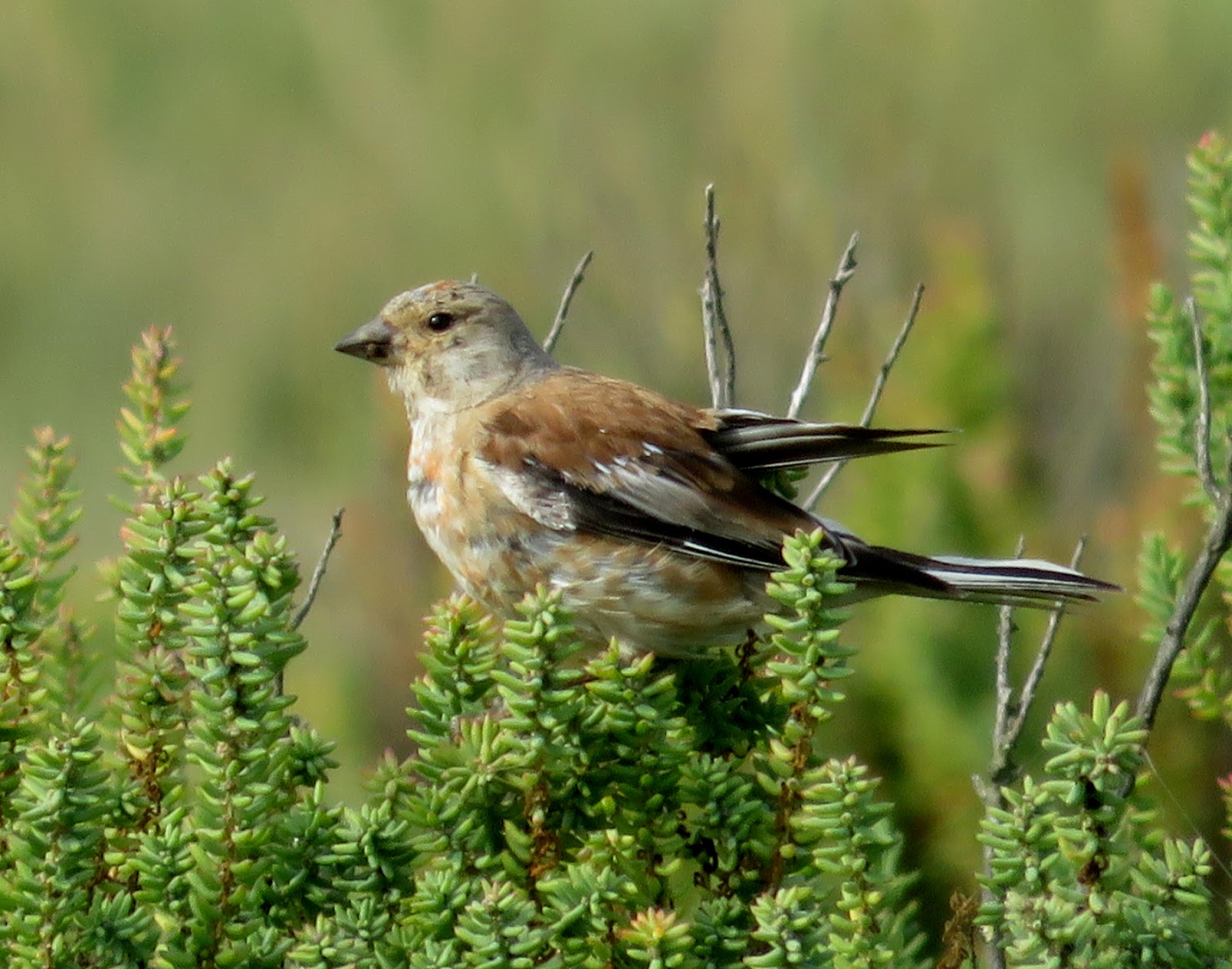
Wednesday, 5 October 2016

CONFIDING WHEATEAR

The beach in front of the park beach was the warmest place for this male wheatear to be, sheltered from the northerly wind by the cliff on Sunday 2nd. It seemed quite confiding and posed nearby for some photos.

The wheatear continued to pose during the morning for photos, this one above and below taken by Andy Field.

This male bird seemed a bit scruffy, maybe it had a rough flight to reach Mersea the previous night.
An immature wheatear was along the seawall on Saturday morning.There was a whinchat over the weekend in the park's grazing fields.

At the park on Sunday were 4 blackcaps, 5 chiffchaffs, 150 swallows, 2 goldcrest while a white wagtail was seen by Andy. A marsh harrier was seen over the car park first thing by Andy and then a second bird flew over the Point later in the morning.

The kingfisher was hard to locate at the park pond early on Sunday morning but eventually it showed for Andy here. The Cetti's warbler was singing, the water rail called, 3 song thrushes perched up. The year's record little egret count so far, of 102 birds was made by Helen Mussett on Sunday.

On Saturday 5 yellow wagtails were with the cows in the fields, 50 linnets at the Point, 30 brent geese in the Colne, 86 little egrets roosting, 2 shoveler by the pond, 25 meadow pipits and 2 goldcrests noted.

On Friday 30th 24 goldfinches were feeding near the pond, whitethroat, 5 blackcaps, 20 swallows 2 house martins and 6 chiffchaffs were noted at the park.
At West Mersea on Friday a manx shearwater drifted out of the Blackwater passing from Old Hall towards West Mersea, the sighting relayed from Brian Churches at Old Hall Point to Andy.
A barn owl flew high over Blue Row as it got dark on Friday evening. A grey wagtail and 2 sandwich terns were seen at the Youth Camp by Martin Cock.

At the park on Thursday 29th a hobby flew over the Point and out across the mudflats south-west, a wheatear on the beach, 30 avocets in the Colne, 10 brent geese, 30 swallows passing over the park during the day, 8 chiffchaffs in a big tit flock, 55 little egrets at the roost and 6 mistle thrushes.
A spotted flycatcher was found in Cross Lane by Martin on Thursday, a sparrowhawk flew past a flock of 50 linnets at Bocking Hall and 5 red-legged partridge were near Manwood Grove near Shop Lane.

At Bocking Hall on Tuesday a large flock of 1000 starlings were perched on wires near the farm. On the park fields at high tide were 160 curlew.

In sheltered spots around the park several dragonflies were on the wing either migrant hawkers or common darters like this male pictured above by Andy on Sunday. Four red admirals were on the wing and a speckled wood too.

Sheila Rayner stopped her car in Bromans Lane early on Wednesday morning to watch a red squirrel in the middle of the road. She watched with amazement as it then scampered underneath her stationary car to carry on down the road. The Watkins family in the nearby Bromans Farm have been seeing the red squirrel scamper across their barns and also strip their walnut tree of nuts over recent days.

Moth trapping at the end of September into early October can be quite rewarding at the park and this splendid merveille du jour on the 28th has been the main highlight.

Several feathered ranunculus have been seen at the trap over the last week.
Around 180 moths of around 18 species were logged on both 28th and 29th at the park with the bulk of them being lunar underwings.

A couple of the sallow moths have been noted, as the name suggests, it feeds on the leaves of sallow trees. A few barred sallows also seen.

Some smart looking black rustics have been noted along with deep-brown darts too.

The autumnal rustic is a regular in the autumn in small numbers over several nights.

The flounced chestnut is an annual visitor to the trap in the autumn.
Also noted were beaded chestnut, square-spot rustic, mallow, large-yellow underwing, broad-bordered yellow underwing, L-album wainscot, snout, setaceous Hebrew character, shuttle-shaped dart, red-green carpet brindled green, green brindled crescent and rush veneer.

Tuesday, 27 September 2016

SEPTEMBER SHOWER

Having been away for a couple of weeks, Mersea has stayed very dry, although these wigeon at the park pond must have enjoyed this rare September shower. There was a brief downpour lasting a few minutes around the middle of the day on Monday 26th.


Numbers of duck at the park pond have increased noticeably over the last fortnight with nearly 150 ducks present on Monday with roughly a third each of mallard, teal and wigeon.

 Several of the wigeon were also commuting between the borrowdyke inside the seawall and the pond. The adjacent grazing fields are completely dry at the moment, so nothing suitable for wildfowl yet.


Ten little egrets had to endure the downpour of rain on Monday, this one holding on tight at the top of a dead tree as the rain pelted down.
A snipe was flushed off the edge of the pond by the cows when they walked past.

An osprey flew west past the park just offshore as the tide was receding just after midday on Monday. Flocks of waders and gulls scattered away as the osprey flew slowly along the outer edge of the mudflats.

A short while earlier two immature gannets were seen high over the outer part of the Colne, flying back out of the estuary past Colne Point. One common tern was feeding offshore with some gulls.

One swallow and a chiffchaff were the only other late summer migrants noted on Monday, although a whinchat was seen first thing Monday by Andy Field in the grazing fields.


Thursday, 8 September 2016

CLOUDED YELLOW

A clouded yellow was resting beside the shrubby seablite bushes at the East Mersea Point on a dull start to Tuesday 6th.
On the wing at the park the next day were small heath, small white, comma and speckled wood.

Up to 11 mistle thrushes have been feeding at times recently on the rowan berries on the trees in the car park. The birds have managed to get through about half of the berry crop so far.

A greenshank flew over the park calling on Wednesday as did up to ten yellow wagtails during the day. By the pond 42 little egrets roosted late afternoon while a sparrowhawk and 15 goldfinches were seen.

On Tuesday a wheatear was at the Point along with 70+ linnets while a reed warbler was seen in the dyke reeds. Five yellow wagtails flew over calling, 100+ swallows flew around while 2 wigeon were at the pond.

A kingfisher was seen along the park dyke on Sunday 4th by Martin Cock.

At Maydays farm a hobby, marsh harrier, 2 common buzzard, curlew sandpiper, greenshank, 6 whinchat, 5 wheatears were also seen by Martin.

Another appearance of red squirrel feeding in the trees behind the buildings at the park on both Tuesday and Wednesday mornings. Both times the squirrel has been feeding on the hornbeam nuts.


This is the tell-tale sign that a red squirrel has been in the hornbeam tree above because the ground is littered with these green nut clusters.
The red squirrel scampered along the car park hedgeline at the beginning of Thursday heading towards the cliff-top trees.


Five members of the Essex Moth Group joined me at the country park on Wednesday evening for a mothing session. Around sixty species of both micro and macro were noted from eight traps.


By 5am the main highlights had been 4 large thorns, hedge rustic, feathered gothic, cypress pug, orange sallow, with a small number of silver-Y, rusty dot pearl and rush veneer as migrants.

The colourful autumnal colour pattern of the centre-barred sallow came to the moth trap at the park.

Four L-album wainscots are a regular in small numbers each autumn, four came to the trap in the early hours of Thursday.


This interesting micro Dioryctria sylvestrella caught our eye with its neat markings and large size.


Two great silver diving beetles inside the traps was an unusual sight.

Monday, 5 September 2016

PARK SQUIRRELS

Two different red squirrels have been seen recently at the country park for the first time. This one pictured was crossing behind the park bungalow in the afternoon on Monday 5th. On Saturday one red squirrel was reported by a visitor in the car park early in the morning and after a little bit of searching, it was watched trotting up the entrance track towards me before turning back and heading back out through the park gates. This individual had a small worn patch on its snout.

A short while later in mid morning another visitor reported seeing a red squirrel in the trees above the horse-ride on the northern side of the main part of the park. This one was also relocated and was watched inspecting a number of acorns but leaving them on the branches.

I've had a number of red squirrel reports from various island locations over the last week such as Ivy Lane, top of Meeting Lane, Chapmans Lane, Fairhaven Avenue and Mill Road.

A family of pied wagtails has been feeding in the car park for the last week, including foraging on the roof of the buildings. Two yellow wagtails were with them on the ground on Monday and another six were heard passing over during the day.

A hobby flew over the car park towards the cliff on both Monday and Sunday upsetting the flock of 20 swallows. A hobby had also been seen flying rapidly west over the car park entrance on Friday 2nd. A sparrowhawk also upset the hirundines on Monday too as it drifted west.

There was a big feeding flock of 250+ herring gulls on the Chapmans Lane field early on Monday 5th.

The grey herons have been a bit outnumbered by little egrets at the high tide roost at the park pond recently. The largest little egret count so far this autumn was on Saturday 3rd with 97 birds counted.
A kingfisher made a brief but noisy appearance on Saturday.
Duck numbers are slowly building up with forty mallard and eight teal seen on the pond on Monday. There was a wigeon and ten teal on the pond on Thursday 1st with 10 house sparrows in a nearby hedge.

At the Point on Saturday a sanderling, wheatear and two ringed plover chicks were seen by David Wallace.

At Maydays farm Martin Cock reported seeing on Saturday 3rd, 6 whinchat, 5 wheatear, curlew sandpiper, 2 green sandpiper, 2 greenshank, 42 knot, 30 bar-tailed godwits, 313 grey plover and 3 little terns.

Several migrant hawkers and common darters are hunting around the park at the moment.

This small toadlet was crawling along one of the dried ditches at the park on Thursday 1st.

The moth trap at the country park has noted about thirty species of macro moth over three recent nights. The most notable being four large thorns, one above, on the night of Sunday 4th. The first large thorn of the season was just two nights earlier.

There has been a reasonable number of moths in the trap over the last week or so with nearly 190+ noted of which fifty percent were setaceous Hebrew characters and square-spot rustics.
Other moths noted included oak hook-tip, Chinese character, common carpet, green carpet, latticed heath, small blood vein, cypress pug, common wave, poplar hawkmoth, turnip, flame shoulder, large yellow underwing, nutmeg, common wainscot, white-point, flounced rustic, silver-Y, snout, vines rustic, angle shades and rosy rustic.

This large old lady moth was found hiding in the gents in the park toilets.

The white spots on the vapourer look like a pair of eyes, this one caught on 31st August.

The neatly patterned feathered gothic is a regular moth in early autumn at the park, two noted on 31st.
A common moth at the moment is the light emerald, the second generation on the wing now in good numbers with ten on each of the three recent nights.

Thursday, 1 September 2016

EGRETS GATHERING

Little egrets seem to be everywhere at the moment with this one pictured feeding in the shallows as the tide came in beside the East Mersea Point on Wednesday 31st.

During high tide the little egrets gathered on the trees and bushes beside the park pond where Andy Field counted 93 birds on Wednesday. Last year the egrets peaked in the autumn at 110 birds. As well as his picture above of some of them squabbling, he also took this video clip below, click on the wording -

Feeding on the sea-blite bushes at the Point on Wednesday were about fifty linnets, one shown above.
Four wheatears were on the beach at the Point too.

Two ringed plover chicks continue to flourish along the beach, now two weeks old. There's been no sign for a few days of the third chick.
Also from the Point were 100 golden plover, 2 little tern, 50 avocets and Mediterranean gull. Flying over the fields was a mixed flock of 75+ swallows and house martins while Andy noted 25 yellow wagtails near the cows.

Along the Reeveshall seawall this whinchat was photographed by Andy on Wednesday morning.

The whinchat was quite obliging for this photo, unlike a nearby wheatear that was more wary.

At the country park on Tuesday 30th a flock of 11 house sparrows chirping noisily from a hedge near the park pond was very notable. The first sparrow flock at the park for at least ten years! A sparrowhawk and a willow warbler were also noted on Tuesday.

The first sighting of willow emerald at the country park was made by Andy on Wednesday, captured on this photo. It was found in the middle of the day resting on some nettles in a sheltered spot from the wind, near the pillbox in the corner of the park. The only other record for the Island was about three years ago at Maydays farm.

Two clouded yellows were seen at either end of the park seawall on Wednesday morning.

Another red underwing spent the day resting on the side of one of the park buildings in the car park, the third individual to do so over the last three weeks.

Monday, 29 August 2016

PASSAGE WHINCHATS

Four whinchats were perched on bushes beside the Maydays farm borrow-dyke in the shimmering heat of Monday 29th. There was plenty of sunshine during the walk along the seawall but there was a strong heat haze too. The whinchats are having a brief stop-over here for a day or so before  continuing south for the winter.

Birds noted over Reeveshall and Maydays included a common buzzard, 2 kestrels, yellowhammer, 2 reed warblers, lesser whitethroat, 2 common whitethroats, 6 linnets, 20 house martins and a yellow wagtail.

As the tide receded during the middle part of the day, this common seal enjoyed a bit of basking on the north side of the Pyefleet. Two more seals were basking on the saltmarsh further up the Pyefleet.

Birds feeding along the channel were 2 little terns, common tern, whimbrel, 8 little egrets, 50 grey plover and 100 redshank. On Langenhoe a hobby appeared to be hawking after dragonflies while a female marsh harrier was seen  quartering the marsh.

Several butterflies were noted in the hot conditions with two clouded yellows of most interest, also 10 common blues, 15 small heath, 2 small tortoiseshell and 25 small whites seen.

In Firs Chase a willow warbler in the garden first thing, a yellow wagtail, 10 swallows, 10 house martins and kestrel flew over while 3 common buzzard and a sparrowhawk circled high over the Hard.

A search for curlew sandpipers proved rewarding along the east end of the Pyefleet on Sunday when 11 birds were found on the mud near the Oyster Fishery. The digiscoped image above shows a moulting adult on the left and a juvenile on the right - as were most of the others seen close-by. Later in the afternoon, quite possibly the same eleven birds were seen near Ivy Dock by Steve Entwistle.

Other birds at that end of the Pyefleet with the tide going out were 50 avocet, 200+ golden plover, 10 ringed plover, 10 dunlin, 8 grey herons, while 50 common terns were feeding on a shoal of fish in the Colne.

On the army ranges of Langenhoe on Sunday, Richard Hull and Andy Field saw the red-backed shrike still present after being first seen on Friday. Also garganey, 2 little stint and 6 curlew sandpipers 6 green sandpipers, 4 ruff, 2 greenshank, common sandpipers, 3 marsh harriers, hobby and juvenile cuckoo while on Friday 6 whinchat were seen.

This family of mute swans with three young have recently taken up residence in this dyke near Shop Lane, probably a family from Reeveshall's Broad Fleet.
Calling from the clubrush filled dyke between Ivy Dock and the Oyster Fishery was a water rail which showed itself as it preened. Twenty swallows passed over as did a couple of sand martins.

A common sandpiper was heard calling in flight as it passed south over the country park just after dark on Saturday night.

A couple of walks were made along the Strood seawall on Saturday at low tide and also the day before at high tide, as seen above. Most birds were noted on Saturday such as a pair of Mediterranean gulls, 4 greenshank, 25 grey plover, 200+ redshank, kestrel and 10 linnets. On Friday 100 golden plover were in the field and 2 common terns were along the Strood.
Two Mediterranean gulls were seen flying off the field at Chapmans Lane on Friday morning.

A pair of common darters were perched on a couple of posts in the Firs Chase garden on Sunday 28th while a couple of migrant hawkers were busy catching insects.
The only butterflies noted in the garden have been speckled wood, several small white, red admiral, comma and holly blue.

The moth trap was run at the country park on the nights of the 25th and the 27th, with the latter being better with 240 macro moths of 34 species. This worn bordered beauty was a nice addition to the recent regular fare.

The second Webb's wainscot of the year was probably the most notable although the earlier record was in a different location, by the seawall a fortnight previously.

A shiny burnished brass visited the trap on the 25th, the coppery sheen showing up nicely.

One of the autumnal coloured moths, the frosted orange was seen on the 25th.
Other moths included oak hook-tip, orange swift, Chinese character, green carpet, sharp-angled peacock, latticed heath, poplar hawkmoth, iron prominent, white-point, tree lichen beauty, sandhill rustic as well as a few rusty dot pearls and rush veneers.