Thursday, 5 April 2018

PERFORMING PEEWITS

At least four pairs of lapwings are nesting on the grazing fields at the country park, with the females sitting tight while the males perform their tumbling display flights and doing their peewit calls. Hopefully there won't be any more rain in the next few days to flood the lapwing eggs.

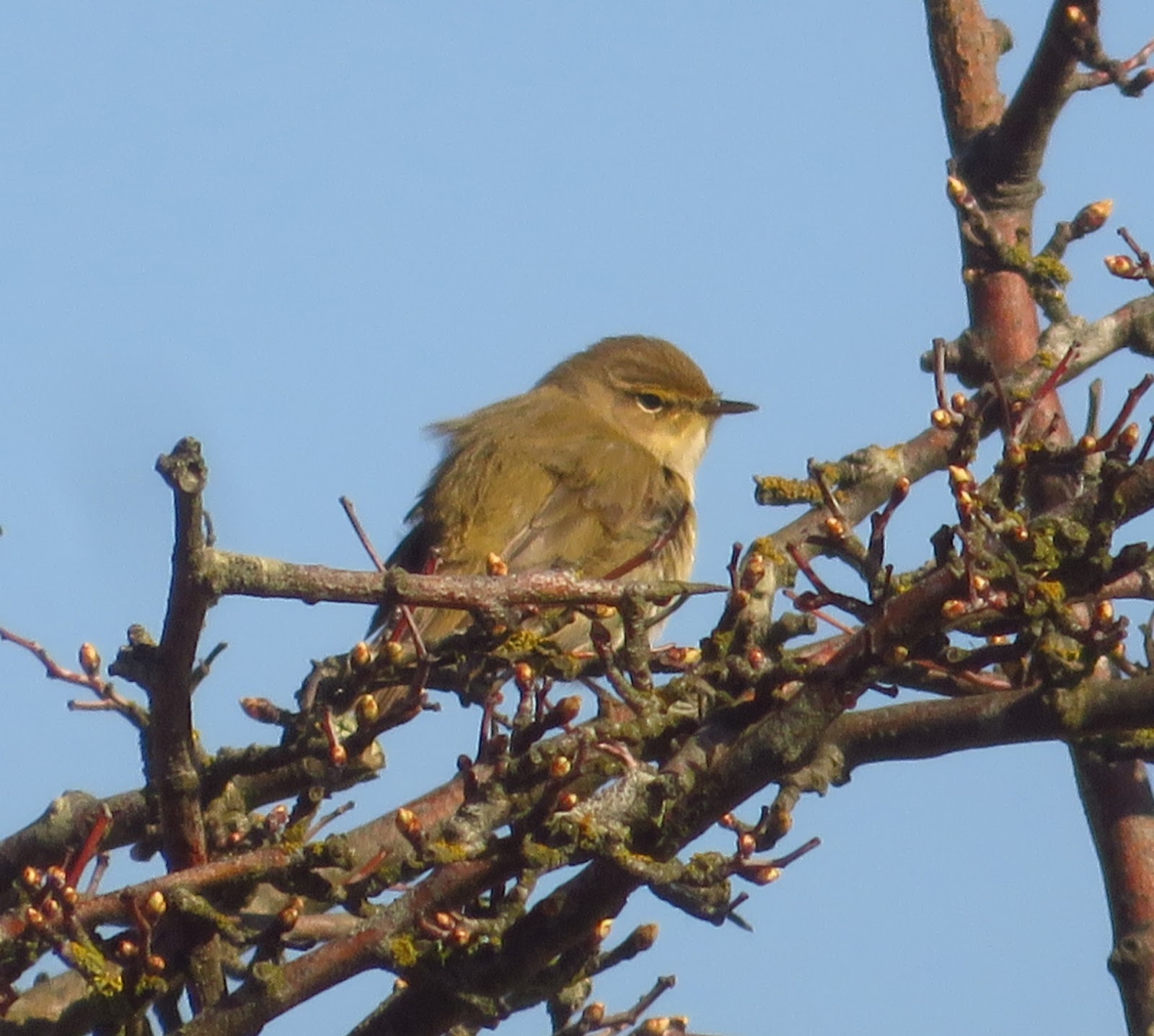
A common buzzard appeared to come in off the sea and fly north-west over the fields on Thursday 5th, frightening the 300 brent geese into the air. A chiffchaff and Cetti's warbler were singing near the park pond in the morning and 3 pochard were on the pond. The mute swan pair seem to start incubating on their nest among the reedmace last weekend, so hopefully some young to appear in mid-May.

There was the nice sight of three little egrets stalking the shallow waters in the fields on Wednesday 4th. Not only have the egrets been absent following the cold snap last month but the grazing fields have only begun to provide feeding opportunities following all the recent rains. A grey heron was also feeding nearby with the egrets.
In the afternoon 70 redshank roosted at high tide, 500 starlings fed in a big flock on the fields, 18 shelduck and 25 shoveler were of note.

A common snipe was resting with eyes open beside the park pond on Wednesday afternoon.
A male blackcap was singing from bramble bushes beside the pond - while a sparrowhawk was seen flying into the copse at the back.

On Tuesday 3rd the first swallow of the spring came hurtling over the seawall, flew low and fast over the fields, before disappearing off to the north. The chiffchaff and Cetti's warbler were singing by the park pond.
The pair of pintail was still on the park's fields for the second day on Tuesday, also 200 brent geese, common snipe and a little egret flying over.

Two peacock butterflies enjoyed the sunshine on Wednesday 4th with this one resting briefly on the park seawall.
A brimstone butterfly was seen on Thursday 5th near the East Mersea pub by Annie Gordon.


Wednesday, 4 April 2018

PAIR OF PINTAIL

Recent rains have provided great conditions for ducks on the park's grazing fields with the highlight on a soggy Monday 2nd being a pair of pintail. The smart looking male pictured above in the middle of the fields was first spotted when it stuck its long tail up in the air while it was feeding in the water-filled creek. A female pintail was asleep closeby. This is the first spring record of pintail in the fields.


There is a lot of surface water on the two fields filling up ditches, creeks and the borrowdyke too. Wildfowl seen were 300 wigeon, 100 teal, 20+ shoveler, 10 tufted duck, 6 pochard, pair of gadwall and 30+ mallard. Waders were 20 redshank, 20 curlew, 4 nesting lapwing, two pairs of oystercatcher, 4 black-tailed godwit and a common snipe.
In the early evening of Monday a barn owl was hunting the grass fields behind the grazing fields. By the park pond a chiffchaff was calling and a little egret flew over the park. A muntjac deer disappeared into the hedge behind the pond in the evening.


On Sunday four pochard, 20 shoveler, little egret, 300 brent geese and 2 black-tailed godwits were seen in or near the park fields. A chiffchaff was still by the park pond and another one by the Golfhouse while a rock pipit was near the Point.


A red-throated diver was offshore from the Youth Camp, also there 6 Mediterranean gulls seen by Andy Field on Sunday 1st. At West Mersea two great northern divers, 4 red-breasted mergansers and 30 sanderling were seen offshore by David Allen on Sunday.


A peregrine flew over the park fields late on Saturday 31st, passing over high enough not to scare any birds off. A few minutes later a sparrrowhawk flew over the Point and landed near the seawall for a few minutes before flying off. In the river were 20 great crested grebes and 4 red-breasted mergansers.


In the fields 300 wigeon, 2 Canada geese, with 6 pochard and 8 tufted duck in the dyke and pond. A little egret was on the saltmarsh, the chiffchaff and singing Cettis warbler were at the park pond.


A pair of red-legged partridge were near Bromans Lane and another pair by Bocking Hall on Saturday 31st.

The moth trapping season kicked off at the country park in the evening of Sunday 1st but only lasted the first four hours before the rain stopped play around midnight. There were 25 moths of 6 species by the end of the session, including this oak beauty.

Just into April but a half a dozen March moths were still on the wing.

A single shoulder stripe was resting on the outside of the trap.


The most numerous moth was the common quaker with 15 individuals, also a few small quakers and a clouded drab.

Sunday, 1 April 2018

SISKIN SIGHTING


An unexpected sight of five siskins which turned up to feed in the garden of Martin Cock's West Mersea garden on Tuesday 27th - the two photos kindly forwarded onto me by Martin. A  female and male pictured above.


Another photo of the male siskin taken through the glass of the window, showing its brighter yellow-green plumage. There have been a few other reports recently from north Essex of siskins visiting garden feeders.


At the Rewsalls area on Tuesday, Martin saw 20 redwings and 5 fieldfares and later a chiffchaff at the country park.


Four noisy Canada geese were on the park's grazing fields on Wednesday 28th. Pairs of Canadas and greylag geese often check out the breeding opportunities in these fields each spring but none have ever tried. Later three greylag geese were seen in the fields in the afternoon.
During a day of rain on Wednesday the grazing fields had a few more waders feeding on them with 100 redshank, 25 turnstone, 10 golden plover, 10 dunlin 5 black-tailed godwit, 20 curlew 6 lapwing and four grey plover.


Offshore a red-throated diver on Wednesday was the first one seen this year from the park, also in the Colne ten great crested grebes while 8 avocets were feeding along the edge of the mud.


The water rail was out feeding on the marshy margin of the park pond as the light faded at the end of Wednesday. A sparrowhawk perched on a tree at the back of the pond, a chiffchaff called from willows while a different sparrowhawk was seen later over the Point.


A chiffchaff was heard calling from the bushes by the park pond on Thursday 29th and also seen feeding among the reedmace.

A couple of red squirrel boxes were fixed high up the cedar tree in our Firs Chase garden in West Mersea on Friday 30th - thanks to the tree-climbing skills of Will Montgomery and his head for heights. A red squirrel was seen by Nolly twice at the feeder in the cedar during Thursday 29th.

Monday, 26 March 2018

SIGNS OF SPRING

A sign of spring in the Firs Chase garden on a sunny Monday 26th was this colourful peacock butterfly fluttering around the flowering cherry plum tree.

Whilst watching the male blackcap feeding on the fat balls in the garden, a chiffchaff was also seen feeding nearby in the cherry plum blossom. The male blackcap is most likely the wintering bird still with a taste for the fat, while the chiffchaff is probably a newly arrived migrant.

The confiding robin was looking closely at the compost pile in the corner of the Firs Chase garden.

Another sign of spring during the walk onto the Strood seawall was the sight of two small tortoiseshells, this one on flowering rosemary in Feldy View.

The first singing chiffchaff was from a bird in a tree by the Strood borrowdyke on a sunny Monday morning. Another chiffchaff was also seen a short while earlier by the Firs Chase caravan site.

A black brant was resting on the Strood Channel on Monday, here on the left of two dark-bellied brent geese. Also along the channel at low tide were 200 dark-bellied brent geese, 30 teal and 50 wigeon while a pair of pintail flew south out of the Ray Channel.
A sparrowhawk circled high over the fields, a green woodpecker crossed over the channel to land in the trees on Ray Island, 50 golden plover were in the ploughed field and 4 black-tailed godwits on the mud.
A distant male marsh harrier could be seen from the Hard, high over Old Hall Marshes doing its roller-coaster display flight.

On Sunday 25th during a visit to Maydays Farm, highlights were displaying marsh harrier over Langenhoe and Reeveshall, four birds seen in total, 3 common buzzards on the Mersea side, 2 little egrets, 4 red-breasted mergansers, 5 great crested grebes, 30 greylag geese, 4 Canada geese with four black-tailed godwits on the Pyefleet mud.
On the game-cover crop were 40 linnets, 30 chaffinches, 4 yellowhammers while ten redwing were near Haycocks Lane. Two muntjac deer were seen running over the Maydays fields by Martin Cock.

A walk along the Strood seawall on Saturday 24th provided views of two black brants with 1000 dark-bellied brent geese - one of the brants seen front right in the picture.

Both black brants were picked out among the large flock of brent geese as they fed on the wheat field on Strood Hill - before the flock flew off to sit in the Strood channel.
Also noted on the walk was one avocet, 5 black-tailed godwits, 50 teal, 50 wigeon, 30 linnets, 2 reed buntings while from the Hard were two more avocets and a red-breasted merganser.

On Friday 23rd one black brant was with the 600 brent geese by the Strood, also 5 common buzzards, kestrel, 100 knot, 5 black-tailed godwit, grey heron and a great crested grebe.
In the Firs Chase garden a female blackcap, goldcrest and a sparrowhawk were seen on Friday.

At the country park on Wednesday 21st a chiffchaff was heard calling near the pond. A buzzard circled over the fields near the East Mersea church while earlier in the day a marsh harrier flew over fields towards Rewsalls. A Cetti's warbler was heard singing near the Oyster Fishery by Martin.

The male black redstart was still at Coopers Beach on Tuesday 20th, here photographed by Martin Cock who also saw the immature male bird here too. Over West Mersea a red kite was seen by Martin, flying north-west over Yorick Road on Tuesday.

At the country park the barn owl was hunting late afternoon on Tuesday, a snipe was by the pond and two small 'crests' were busy feeding in bushes at the back of the pond.

The red squirrel made another visit to the nut feeder in the Firs Chase garden on Saturday 24th in the morning. This male has been making brief visits to the feeder most days over the last fortnight. It has also been seen recently in the neighbouring garden of the Marshalls.
A red squirrel has also been seen recently in the Entwistles garden in Empress Drive on 22nd and 23rd March.

Tuesday, 20 March 2018

INFLUX OF BLACK REDS

A smart adult male black redstart was found at Coopers Beach caravan park on Saturday 17th by Michael Thorley who took these two photos of it. This is a different bird to the one seen in recent weeks which was an immature male

As well as the general dark grey appearance, this male bird black redstart showed white panels on the wings. On Monday 19th while watching the adult male black redstart a second adult male and the immature male all appeared together at the east end of Coopers, feeding on the beach - as did a female stonechat.
A black redstart was also seen at West Mersea by David Allen near the beachhuts by Seaview Avenue.

A near adult Mediterranean gull with its black-head, which had been flying over the beach at Coopers, landed on the football pitch with some black-headed gulls.

At the country park the barn owl was seen hunting over the fields during the last hour of daylight on Monday. The lack of visitors onto the main part of the park resulted in 5 lapwings and 7 golden plover feeding undisturbed.

At the start of Monday a male blackcap was seen feeding on the fat-balls in the Firs Chase garden - presumably the same wintering bird that has been visiting the garden for the last couple of months. A brambling was also seen feeding under the feeders.

The frozen park fields looked very wintry on Sunday 18th with birds gathered in one or two corners where there was less snow. Still some 300 wigeon, 15 shoveler and five black-tailed godwits were in the fields, with two female pochard on the dyke. A redwing was with blackbirds near the car park.

A sparrowhawk flew over the park pond early on Sunday morning and a second bird was seen later disturbing the hundreds of waders and wildfowl roosting on the saltmarsh near the Point. In the river at the Point were two red-breasted mergansers, 4 great crested grebes, while a rock pipit and kestrel were also noted at the Point.

Saturday, 17 March 2018

STALKING HERON

The park's grazing fields have become much wetter recently, providing more marshy conditions for more birds such as this grey heron seen stalking round the pools on Friday 16th.

Up to 20 shoveler have been feeding on the main pool in the fields now that it has filled with water. Also 10 gadwall, 150 teal and 500+ wigeon in the fields on Thursday.


Seven pochard were on the park pond on Thursday afternoon along with ten tufted ducks.
A snipe was feeding by the marshy edge to the pond on Wednesday 14th and Friday 16th. A common buzzard flew west over the grazing fields and the pond on Wednesday.


Forty redshank roosted in the fields at high tide on Wednesday, also 5 black-tailed godwits seen on Wednesday and Friday. Two snipe were also feeding among the pools on Friday.
The pair of kestrels were seen noisily mating on their tree at the back of the fields on Friday. A sparrowhawk flew over the car park earlier in the morning.
A common buzzard was seen perched by the water's edge near the Strood causeway on Friday morning.


A barn owl hunted over the park in late afternoon on Thursday 15th, providing good views to some dog-walkers.
A fieldfare was by the car park on Wednesday while on Tuesday the calls of little owl and red-legged partridge were heard to the north of the park.


At West Mersea a sparrowhawk, goldcrest and 500 starlings gathering to roost were seen from the Firs Chase garden on Monday 12th.


 A grey partridge paid a visit to Michael Thorley's garden in East Mersea, near Meeting Lane.


 Michael was practicing camera techniques on a rabbit at the bottom of his garden when the image in his viewfinder changed as this grey partridge appeared into shot.


It's the first time Michael's seen grey partridge here in his garden.

Sunday, 11 March 2018

STROOD BRANTS

There were masses of dark-bellied brent geese all along the Strood Channel on Sunday 11th. At least 3000 birds were noted, most in the channel but another big flock rising up from the Peldon side and dropping down into the Ray Channel. Some of the geese have also been feeding in the arable field beside Strood Hill and then flying back onto the channel.

When the geese were all scattered along the channel, it was a good opportunity to scan the geese. It wasn't long before a black brant was found, this one pictured above, much blacker with a bigger white neck collar and whiter flank.

A little further along the channel a second black brant was located on the opposite side, the bird pictured facing left in the centre. The blacker back and lower neck again stood out from the other geese. This brant has less of a white flank than the other brant.
Both these same black brant individuals were also seen along the Strood on Friday 9th.
 
A pale-bellied brent goose was present on Friday, Saturday and Sunday along the Strood channel in the company of the dark-bellied brent.

It has been a long time since I've seen so many brent geese in the area of Strood Channel and the Ray Channel. Some of the flock feeding on the Mersea side, while others feeding on the Peldon side. On a very dull Sunday walk, the sound of all the calling geese brought some life to the area.
Something spooked all the birds off the Peldon fields and flying away from here to Old Hall were 50 greylag geese and 20 Canada geese.

Small numbers of pintail have been an unusual sight along the Strood channel and also in the air over Ray Channel. Eight birds were noted on Friday, then five in the Strood on Saturday - three of them pictured here sleeping, and then fifteen seen on Sunday.

Also on Sunday 11th along the Strood were marsh harrier, common buzzard, 300 knot, 20 black-tailed godwit, 5 bar-tailed godwit, 300 golden plover and red-breasted merganser.
Similar birds noted on Saturday 10th with common buzzard, sparrowhawk, marsh harrier, 150 shelduck and 400 knot
Birds seen during the Strood walk on Friday 9th were 2 common buzzard, 2 kestrel, 10 black-tailed godwits, 300 knot and 300 golden plover.

Little egrets have seemingly made themselves scarce since the snow. Most of them appear to have left the area when the snow began covering the ground and the watercourses froze. This little egret was feeding along the Strood borrowdyke on Sunday 11th.

The only small birds noted were  2 singing reed buntings, rock pipit, 4 linnets and 5 skylarks.

A common snipe was photographed by Stephen Marshall feeding in his Firs Chase garden during the spell of snow last week. Probably the same bird seen in our nearby garden about the same time by my wife Nolly.

A red squirrel was seen in Stephen's Firs Chase garden on Sunday 11th and a male red squirrel was seen at our feeder in Firs Chase on Friday 9th.