Monday, 25 November 2019

BRANT WITH BRENT

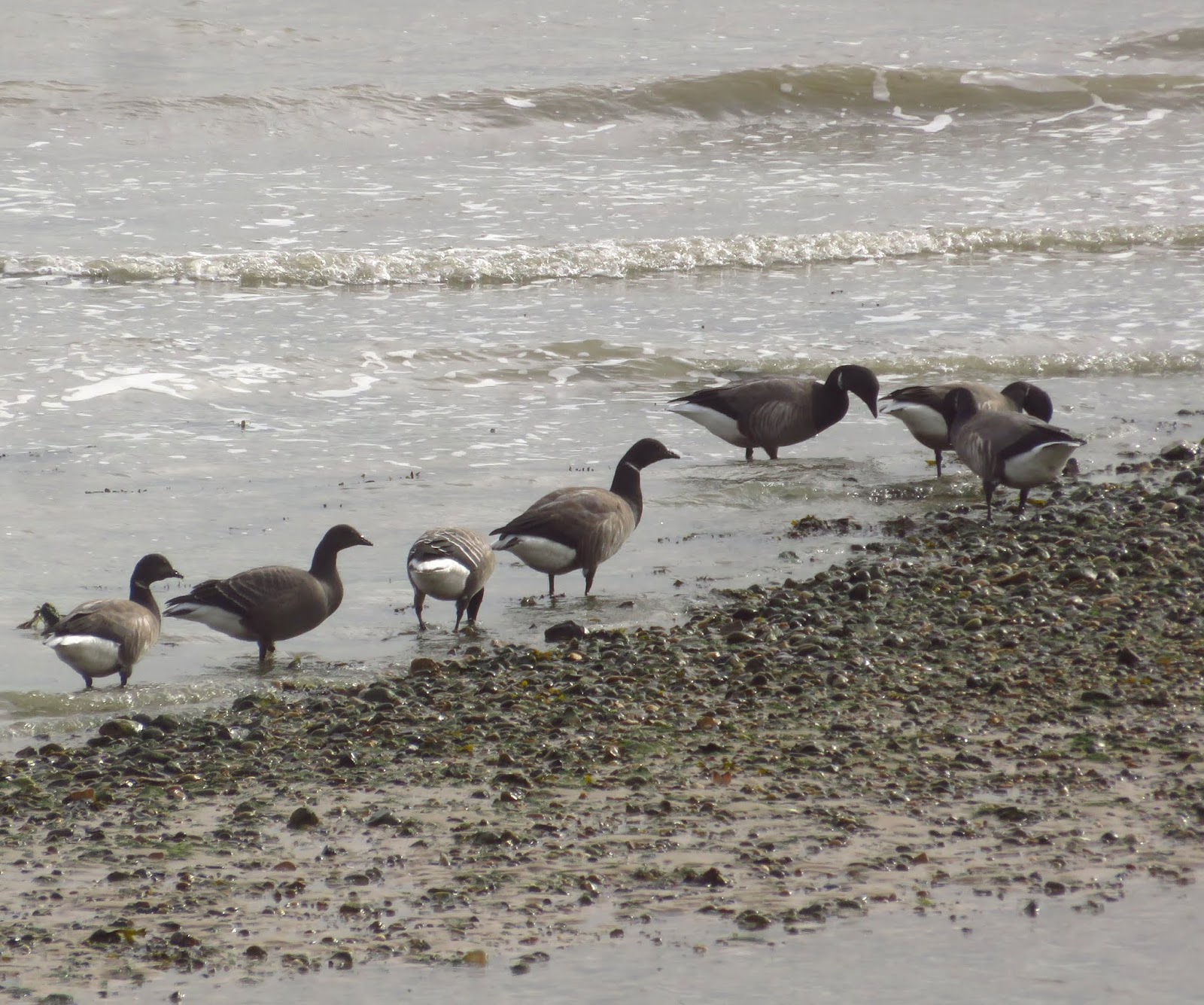
The black brant was feeding close to the path behind the Dabchicks sailing club in West Mersea on a dull Monday 25th. Pictured here at back left with a family of dark-bellied brent geese showing two adults with four young.

Even in the dull and grey conditions the black brant features of broad white collar and the blacker back contrasting with the white flanks, stand out from the brent geese.

A ringtail hen harrier was watched flying over the Strood fields on Monday, hunting along the borrowdyke, then scattering the wader roost on the saltmarsh near the Strood causeway before crossing over the road at about midday and heading north-east to the Pyefleet. This is presumably the same bird seen the previous day at the west end of the Pyefleet which spent ten minutes resting on the saltmarsh near Langenhoe Creek before heading towards the Island near the Strood. This is the first hen harrier seen on the Island this year.

Also on Monday along the Strood channel was a marsh harrier on Ray Island, common buzzard, two sparrowhawks and a kestrel. Four rock pipits were by the seawall, 30 carrion crows and a mistle thrush were by Feldy View.
A guillemot was diving for food amongst the boat moorings opposite the West Mersea Hard on Monday.

Along the Bower Hall section of the north side of Mersea Island on Sunday 24th, two marsh harriers, two common buzzards, 2 kestrels, 15 corn buntings, 4 rock pipits, common snipe, 800 knot and three common seals were seen near the top end of the Pyefleet channel. Close-by at Maydays farm, 700 brent geese fed in the fields, 20 red-legged partridges, 3 yellowhammers and a mistle thrush were noted.

At West Mersea on Sunday 24th, Jonathan Norgate saw 2 red-throated divers fly out to sea past the Monkey Beach, while another one later flew over the Hard. A chiffchaff was seen again in the scrub at St Peters.

On Saturday 23rd a Lapland bunting flew east along the Reeveshall seawall calling as it headed towards the Oyster Fishery. Other small birds in the area included 20 corn buntings, 22 goldfinches, 8 linnets, rock pipit, fieldfare and three stonechats. A large flock of 1000 brent geese fed in one field, marsh harrier, buzzard, sparrowhawk and two kestrels were also seen.
In the Pyefleet 4000 knot were feeding on the mud, four little grebes and four great crested grebes were in the channel and a green sandpiper flew out of a ditch. A red squirrel was in a tree alongside Shop Lane near Fishponds Wood.

A black-throated diver swam close to East Mersea Point as it swam upriver into the Colne on Friday 22nd. A peregrine flew over the park's grazing fields scattering all the birds especially the 1000 wigeon, 48, black-tailed godwits, 100 lapwing as well as the 1000 golden plover roosting on the mud. The peregrine dropped down onto the mud and stood there for several minutes surveying the scene.
Also on the fields were 11 greylag geese, 15 goldfinches and a sparrowhawk flew over, while on the saltmarsh two rock pipits were noted.

A handful of lapwings were feeding in the horse paddock by the East Mersea Golfhouse on Friday.
On the northside of Bromans Lane, twenty red-legged partridges were seen in a field.

A song thrush was at the feeder in the Firs Chase garden on Thursday 21st, as was the coal tit and a great spotted woodpecker.

In the fields near Rewsalls Farm on Thursday 21st, there were 25 corn buntings, 25 chaffinches, 20 pied wagtails, 5 fieldfares, 15 blackbirds, 30 skylarks were seen feeding. Two green woodpeckers had a a lucky escape from the clutches of a sparrowhawk while a chiffchaff was calling from a hedgerow.
Ten Mediterranean gulls were feeding with a small flock of black-headed gulls and two kestrels were also hunting over the fields.

A walk along some of the Strood seawall on Wednesday 20th provided views of an avocet, 66 shelduck, 15 knot and a rock pipit while a mistle thrush was near Feldy View.
At Maydays on Wednesday Martin Cock saw the kingfisher, stonechat and 4000 knot.

Offshore from the Monkey Beach at West Mersea on Tuesday 19th, Andy Field saw 2 red-throated divers, great northern diver, eider and three common scoter.

Monday, 18 November 2019

BLACK BRANTS

The black brant was feeding at the West Mersea Hard around noon on Monday 18th, along with about 20 brent geese. This the third sighting of a black brant over the last few days in slightly differing areas, possibly involving two different birds.

A black brant was just offshore from Waldegraves caravan site on Saturday 17th, this bird showing the same pattern of dark streaks on the white flanks. The broad white neck collar seems the same on all three brants photographed.

The first black brant sighting was this bird in front of the Firs Chase caravan site on Friday 15th, showing more dark streaks on the white flanks than the other bird.

Also seen on Monday 18th during a walk along the Strood seawall were 180 wigeon, 140 teal, 24 little grebes, 12 avocet and a bar-tailed godwit. A marsh harrier was by the Strood causeway, common buzzard by Strood Hill and a second bird over Ray Island. Small birds included stonechat, 50 linnets, 2 rock pipits, 25 skylark and 10 reed buntings.

A new visitor to the Firs Chase garden feeder was this coal tit which was first seen on Friday 15th and again on Sunday and Monday. It made repeated visits to the peanuts and also to the black sunflowers, often with other tits.

Three of seven red-breasted mergansers in the Pyefleet Channel on Sunday 17th, were photographed here by Andy Field. A video clip by Andy of the mergansers displaying is at - https://www.youtube.com/watch?v=zlMIIH81eU8&feature=youtu.be;

Also seen along the Pyefleet seawall whilst carrying out the monthly WeBS count were 350 brent geese, with a further 1000 at the country park. Also 2 kingfishers, 2 stonechats, 2 rock pipits, 3 yellowhammers, one redwing, 500+ knot, 95 avocets, 160+ shelduck and two greenshank. On Langenhoe 10 marsh harriers, two common buzzards and ten fieldfares were noted on the ranges. At the country park 200 wigeon, 30+ black-tailed godwits and 2 greylag geese were on the fields while 5 bar-tailed godwits were near the Point. A little owl perched at the park pond at dusk and at least one water rail squealed from the reeds.

Five seals were seen along the Pyefleet and there was an interesting report on Sunday by two visitors to the Island of two possible Chinese water deer seen running across the large grass field at Reeveshall, disappearing into the reeds.

At West Mersea on Sunday, Moira Jackson saw 3 red-throated divers, peregrine and a Mediterranean gull.

A large flock of 105 sanderling were feeding on the Waldegraves beach just before high tide on Saturday 16th. One of the sanderling was colour ringed. A grey wagtail flew west along the beach.
Offshore from the Youth Camp were 35 common scoter, 50 great crested grebes, red-throated diver and 90 brent geese.
David Allen reported an Iceland Gull flying to the shingle island beyond Seaview Avenue on Friday, also great northern diver flying towards the Dabchicks, 40 sanderling, 15 turnstone, 20 great crested grebes and a Mediterranean gull.

The proposed boating lake at the Youth Camp is starting to fill up with water and on Saturday there were ten Mediterranean gulls and 25 ringed plovers seen here. Also roosting in the nearby flooded field were 45 redshank, 10 curlew, 5 little egrets, 2 teal and 20 mallard. A buzzard, sparrowhawk, 3 stonechats, rock pipit were also noted, while later 52 corn buntings perched on wires near Rewsalls Farm.

Several thousand knot were seen in the Pyefleet channel at Maydays on Saturday by Martin Cock.

On Thursday 14th a female common scoter was offshore from St Peters at West Mersea, also a reed bunting, skylark and two rock pipits were seen here too. Michael Thorley saw 2 red-legged partridge, 2 fieldfare and 10 long-tailed tits in his East Mersea garden on Thursday.

At the country park on Wednesday 13th, Andy Field reported 2 common scoter, stonechat, 12 sanderling at the Point while among the brent geese, 10% of the 600 brent geese were juveniles.

Tuesday, 12 November 2019

REGULAR REDS

At least two red squirrels have been visiting the feeder in the Firs Chase garden over recent weeks. This female with the big bushy red tail, has been tucking into some wild cobnuts that were gathered off the ground of a campsite in the Dordogne a few weeks ago!

Several blackbirds have been feeding on the cotoneaster berries in Feldy View.

A flock of 600 brent geese were seen along the Strood channel on Tuesday 12th. Several youngsters with the white wing-bars were seen in this group on the water.

The brent geese had been feeding in the wheat field before being flushed off to land on the water.
Also seen were a marsh harrier by the Strood causeway, 500 dunlin roosting by the causeway, while rock pipit and stonechat were by the seawall.

On Sunday 10th at the country park grazing fields, 700 brent geese, 500 wigeon were flushed off by a paramotor, while of interest at the Point were a stonechat and 200 knot. At the country park pond 100 teal, 20 shoveler, 4 gadwall and a chiffchaff were noted.
From the Esplanade on Sunday two common scoters offshore, were first reported by Steve Entwistle then four were seen by Jonathan Norgate who later reported a new flock of seven birds, also a chiffchaff at the Monkey Beach.

Along the Reeveshall seawall on Saturday 9th, a green sandpiper and merlin were seen by Martin Cock. Michael Thorley visited the East Mersea Point on Saturday morning and noted a stonechat, 4 rock pipits and 6 sanderling.
At the country park on Friday 8th, Andy Field saw 5 sanderling, 3 red-breasted mergansers, a few redwing and 200 teal on the park pond.

Tucked among the branches of a hawthorn bush was this little owl seen near the Waldegraves caravan site on Friday 8th. Also a water rail feeding among the reeds of the pond, 3 goldcrest in Cross Lane while offshore were 80+ sanderling, 10 Mediterranean gulls, 50 brent geese, 100 cormorants and a common seal.

Four fieldfare, 2 redwing, chiffchaff, 2 goldcrest were seen by Feldy View on Thursday 7th.

On Wednesday 6th there was a large roost of 1000 golden plover on the mud along the Strood Channel.

Also along the Strood that day were 500 dunlin, 10 knot, 100 wigeon and a Mediterranean gull.
A stonechat, two rock pipits and 15 linnets were seen from the seawall.

A male gadwall was an unusual visitor to the Strood on Wednesday, feeding beside some of the wigeon. Also in the channel were 25 little grebes.

A distant merlin perched on top of a tree on Ray Island on Wednesday and spent several minutes scanning around from its vantage point. Also a common buzzard on a tree at the back of the Strood fields and a sparrowhawk noted too.

A firecrest was seen in the Firs Chase garden near the end of Wednesday afternoon, in the same bushes as the four were seen the previous day. A sparrowhawk glided over the garden, luckily ignoring the small birds.

On Tuesday 5th the flock of brent geese feeding in the Strood field had 90 juvenile geese among the flock of 455 birds. Two marsh harriers were noted over Ray Island while the stonechat was again inside the Strood seawall and there was a siskin seen flying north over Feldy View.

In Firs Chase during Tuesday afternoon, four firecrests were watched feeding in the garden with some tits. They were very busy feeding among the bushes and trees like birch, holly and yew, calling regularly to each other. A chiffchaff was calling earlier in the day in Firs Road.

A silver Y moth was attracted to the lit window in the evening of Monday 4th at the Firs Chase house. A red admiral was seen near Feldy View on Tuesday 12th.

Monday, 4 November 2019

EXOTIC PINTAIL STILL PRESENT

The exotic white-cheeked pintail was drawing attention to itself in the park's grazing fields on Monday. At least one bird has been present on and off for four weeks now, at times with a second bird although no sign of it today.

At least 200 wigeon were feeding in the park's fields with another 100 birds on the nearby saltmarsh. A male wigeon pictured here beside a female mallard.

The wigeon were feeding alongside 600 brent geese in the fields, 50 lapwing and 200 starlings up until something spooked them into the air, flushing the geese onto the mudflats.

Twenty black-tailed godwits were feeding along the edge of the grazing fields. Two stonechats were also seen along the edge of a field, later seen near the Point with a third stonechat. A chiffchaff was feeding in a bush by the dyke, another chiffchaff seen in the main part of the park. Two rock pipits, 5 reed buntings and ten skylarks were at the Point too. A mistle thrush was by the bus turning circle.

A flock of 400 knot rested on the mud near the Point, the first biggish flock of the winter recently arrived. Scattered across the mud too were 150 avocets with many other avocets seen in the distance. Upriver were ten great crested grebes off the Geedons.

Making the most of the sunny and calm conditions on Sunday 3rd and walked the seawall on the north side of the Island along the Pyefleet. Birds of note included green sandpiper, snipe, 100 avocets, 200+ knot, 1000+ dunlin, female red-breasted merganser, 2 great crested grebes, 50 teal, 70 wigeon, 4 marsh harriers, 2 common buzzards, sparrowhawk, five kestrels, 9 stonechats, 2 rock pipits, 50 linnets, 25 goldfinches and a fieldfare. A goldcrest was seen in Fishponds Wood.

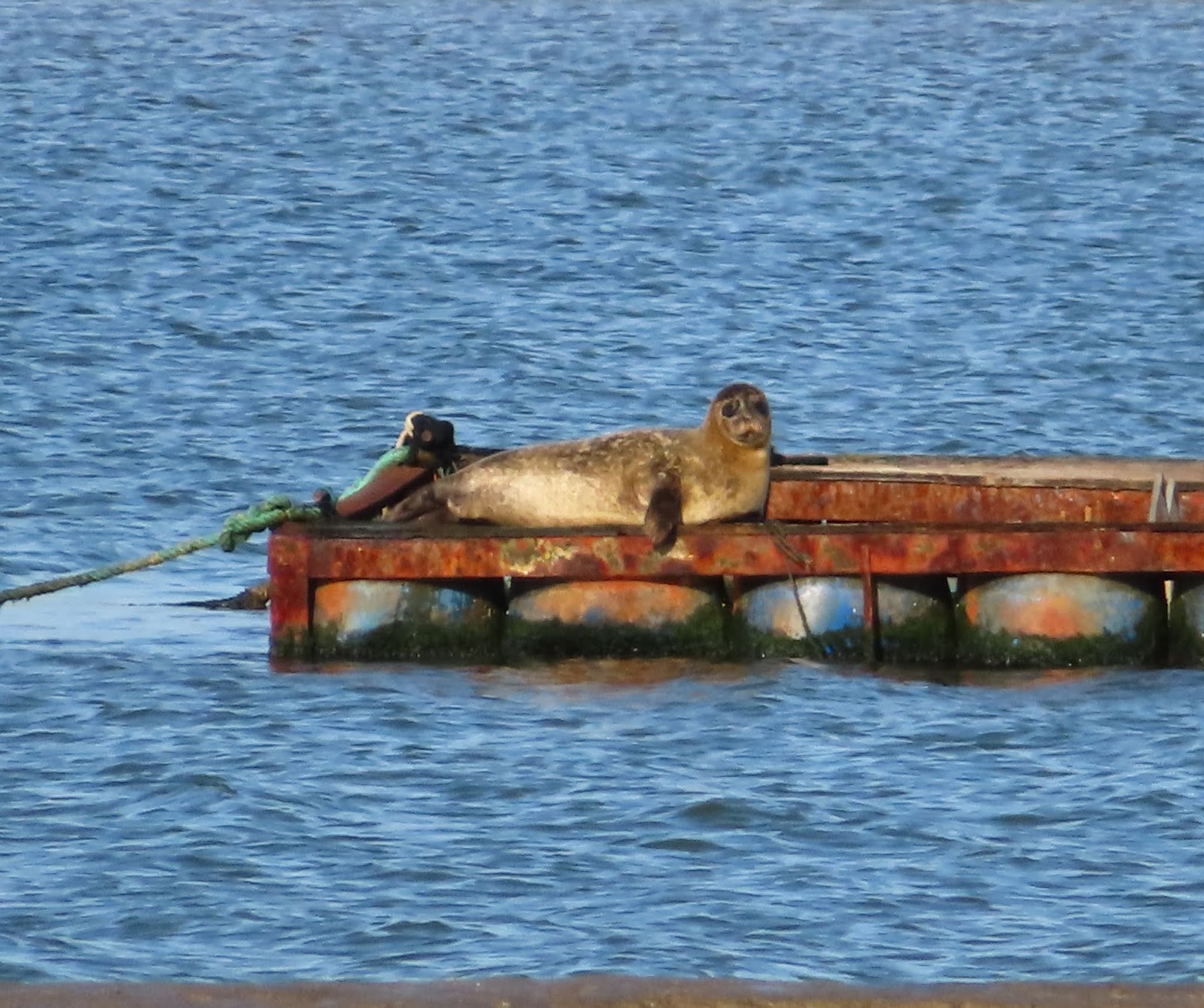
A common seal rested on the floating pontoon in the Pyefleet channel and then slid back into the water when two other seals appeared.

Interested to discover a badger had wandered out onto the mud towards the Pyefleet, showing here the broad foot-print with the long claws at the front. One paw-print lies on top of the other, the rear one placed on the front paw-print.

At first the two trails across the mud looked like two animals but a closer look showed just one badger went out 40 metres across the soft mud and then came back to the saltmarsh.

Also at Maydays on Sunday were a pintail, 4 snipe and a kingfisher seen by Martin Cock. At the Youth Camp, Andy Field reported 2 stonechats, 2 rock pipits, 25 Mediterranean gulls and a common buzzard. Jonathan Norgate saw a great northern diver and a common scoter off West Mersea, with a second common scoter being seen later.
A firecrest was found by Martin in his West Mersea garden in The Coverts and a second firecrest was in the Firs Chase garden mid afternoon.

A brambling was reported in a garden in Whittaker Way on Saturday.

At least 100 redshank were along the Strood channel on Friday 1st.
Feeding in the fields were 500 brent geese, 100 lapwing, 300 starling, stonechat and 50 linnets. A late swallow flew casually along the seawall, feeding back and forwards over the fields as it drifted south-west, also a painted lady butterfly was notable for November.
A redwing, 15 blackbirds and a sparrowhawk were seen around Feldy View.

At East Mersea on Friday 1st at the end of the afternoon, Andy Field counted 16 marsh harriers at the Langenhoe roost, as well as a peregrine, merlin and two common buzzards, while a stonechat was on Reeveshall.

On Thursday 31st a peregrine crossed over the channel and headed over the Strood fields, swooping low towards some wood pigeons. A marsh harrier flew over Ray Island while upsetting some of the 100 wigeon and 70 teal on the saltmarsh. Twenty avocets fed along the channel while some of the 400 brent geese fed in the nearby field. Also a Mediterranean gull, 2 rock pipits, stonechat and a redpoll seen flying over.

In the warm conditions in the afternoon a common darter and a red admiral were seen in the Firs Chase garden.

At least one red squirrel has been seen most days stopping off to feed in the Firs Chase garden. The grey squirrel that has been seen on and off in the Firs Chase area since mid June was finally caught on Sunday.
A pipistrelle bat was hunting over the Firs Chase garden late afternoon on Monday.

This brick moth was one of eight moths in the trap on the evening of Sunday 3rd. Other moths included feathered thorn, yellow-line quaker, red-green carpet, large wainscot, Blair's shoulder knot and a diamond-back moth

Thursday, 31 October 2019

BARNACLES WITH BRENT

Two barnacle geese were found by Andy Field in the country park grazing fields feeding with the 600 brent geese. The dull upperparts and the lack of barring on the flanks suggest the birds were juveniles. Andy took these two barnacle pictures.

It's difficult to tell if these barnacle geese are wild ones or just feral ones having a fly-about. The last barnacles seen at the park were four seen on this same day, the 30th October two years earlier in 2017!

Andy counted the brent geese and found 70 juvenile geese among the flock of 600 birds, possibly a below average breeding season. Also noted in the area were 200 wigeon, some in the fields and some on the saltmarsh, as well as 25 shoveler and 35 little egrets. At the Point were two sparrowhawks one carrying a turnstone, 2 stonechats, rock pipit, 40 linnets while 100 shelduck were on the mud.

The female eider was seen in the Colne by Andy on Wednesday, while at West Mersea a red-throated diver was seen flying offshore from the beach huts by Jonathan Norgate.

At Firs Chase on Wednesday 30th a flock of ten fieldfares flew over and appeared to land nearby, also in the garden was a chiffchaff, two goldcrests and two great spotted woodpeckers flying over. The regular female red squirrel was seen at the garden feeder.

A blackbird with a white face was seen beside the Firs Road cemetery on Tuesday 29th. A flock of 10 redwing and 2 fieldfare flew over and another flock of 20 redwing was seen later in Firs Chase.

Along the Strood seawall on Tuesday, the kingfisher perched on the sluice outfall, a peregrine flew over the fields, stonechat, 2 rock pipits, 50 linnets, 25 skylarks, 20 meadow pipits, 70 brent geese, 50 wigeon, 15 knot, 10 black-tailed godwit and 23 avocets were all noted from the seawall.

There was a high tide covering all the saltmarsh in the little bay at Reeveshall on a sunny Monday 28th. On Reeveshall a sparrowhawk, common buzzard, 4 little egrets and a muntjac deer were seen, while a brambling called as it flew west along the seawall. Four marsh harriers were seen over Langenhoe.

A firecrest was found on the edge of Fishponds Wood in Shop Lane on Monday, along with a couple of goldcrests. A male siskin dropped briefly in and a fieldfare was heard calling. A red squirrel was seen beside the wood.

Monday, 28 October 2019

SNOW BUNTING ON BEACH

The first snow bunting of the winter dropped briefly onto the East Mersea beach near the Point on Sunday 27th. It was found and photographed by Andy Field feeding close-by along the strandline, although dodging the many walkers enjoying the sunshine.

Earlier on Sunday three black redstarts were discovered by Jonathan Norgate beside the beach huts on the West Mersea Esplanade. Andy managed to catch up with them and took these two photos of a nicely marked male.

As well as this male black redstart, two other female/ immature birds were watched feeding sometimes on the beach and also between the beach huts. By mid morning they had disappeared as more people were out walking and also as the tide pushed up the beach too.
Two swallows were seen flying west along the beach at Seaview.

These two white-cheeked pintail were photographed beside the park dyke by Andy on Sunday morning.

Later on Sunday morning two black redstarts were seen in front of the East Mersea Youth Camp. Both were female / immature birds and were feeding on top of the frontage perching on the post and rail fence, before flying back into the camp.

Keeping company with the two black redstarts for a short while was a pair of stonechats, this male perching on the fence above the beach.

The female stonechat was also nearby, moving along the fence as I walked along.

Offshore an immature gannet was watched early afternoon flying towards the mouth of the Blackwater, doing one or two dives into the water. A flock of 150 gulls fed offshore from the Youth Camp on a shoal of fish, including a couple of Mediterranean gulls.

A poor phone-photo of the proposed boating lake beside the Youth Camp, already filled with some water and birds too. A roost of 85 ringed plovers, 10 redshank and 200 gulls including 8 Mediterranean gulls.

The gulls and waders were enjoying a work-site on a Sunday without any of the usual working disturbance.

A neighbouring marsh is also filled with water too, holding 10 redshank, 30 curlew and 10 little egrets. A common buzzard perched at the back of the Rewsalls marsh, earlier three common buzzards drifted high and west along the beach above Waldegraves. A muntjac deer was seen feeding along the edge of the marshes.


On Friday 25th at East Mersea Point, the purple sandpiper was seen flying across the Point just after high tide, although it couldn't be found anywhere subsequently. Also present here were 300 brent geese, some feeding on the mudflats and others feeding in the grazing field, 75 turnstone on the mud too, 200 golden plover overhead and the 2 white-cheeked pintail back again along the borrowdyke. At the Point were stonechat, 2 rock pipit, 20 linnets while 3 swallows also seen passing over.

Beside the Strood on Thursday 24th, the stonechat was still present, also 5 reed buntings and 25 linnets, with 20 blackbirds around Feldy View cemetery.
Martin Cock reported 5 rock pipits and a redwing in the drizzle between Coopers Beach and Fen Farm On Thursday, also a swallow passing over West Mersea.

David Nicholls reported seeing a long-eared owl while he was walking through the scrub on Ray Island on Saturday 19th.