Wednesday, 10 June 2020

NESTING MARTINS

At least 32 nest holes have been excavated by the sand martins on the Cudmore Grove cliff, when the park was visited on Monday 8th. There were only half a dozen sand martins seen flying around the park, while standing on the beach, birds would quickly appear by the cliff and crawl straight into the holes. It's great to see the cliff being used by the sand martins again after being absent since 2011.

A check of the ringed plovers nesting on the East Mersea Point beach revealed one pair with a well-grown chick, as well as another pair in the nearby muddy bay.
As well as these resident ringed plovers, 12 other non-breeding ringed plovers were feeding on the nearby mudflats with 18 dunlin and a turnstone. Also six curlew and fifty oystercatchers were feeding on the mud off the park.

The ringed plover chick was sprinting along the beach at East Mersea Point on Monday. The parents led me away from this chick so I quickly walked on past, snapping a photo and then leaving it be. There was no sign of any other chicks or nests at the Point although a ringed plover nest had been reported a fortnight previously.

On the saltmarsh pools near the Golfhouse were two pairs of redshank and four lapwing but no avocets or common terns.
In the Colne was a great crested grebe in the river and a buzzard high overhead, while on the mud were six shelduck and two little egrets also noted.

The female kestrel presumably from the nearby nestbox was seen having a drink and a quick bathe in the pool in the park's grazing fields on Monday.
Three pairs of pochard and three pairs of tufted duck and a male shoveler were present on the park pond, while the Cetti's warbler and reed warbler were heard singing.

A hobby flew north over the East Mersea Road near the Mersea Barns on Monday, while Sarah Thorley sadly found a dead green woodpecker near Moore Lane in East Mersea.
A buzzard was seen by Steve Entwistle being mobbed by crows over his West Mersea garden, while in Mersea Avenue, Ian Black reported a sparrowhawk and two Mediterranean gulls over his garden.

A brown hare was crouched down in a field at Maydays Farm on a blustery and drizzly Sunday 7th.
Birds noted during the seawall walk at Maydays were a hobby flying fast and low over the fields on its way over to Langenhoe, a male and female marsh harrier on Reeveshall and another pair on Langenhoe, three common buzzards, a continual flow north-west of 300+ swifts, two yellow wagtails, singing corn bunting and one singing sedge warbler. Four great crested grebes were in the Pyefleet, 45 shelduck along the mud, 3 pairs of redshank on saltmarsh, while two pairs of meadow pipit, a cuckoo and three lapwing were also of note.

Earlier at Maydays Steve Entwistle reported two sedge warblers feeding young, four singing reed warblers, two yellow wagtails, cuckoo, two marsh harriers, four buzzards, a kestrel on Maydays and three others on Langenhoe, while a hobby flew over Haycocks Lane.

Also checking the north side of the Island on Sunday was Andy Field who reported between Shop Lane and the Oyster Fishery, a few swifts over the Reeveshall plantations, singing corn bunting, common tern, 3 buzzards, cuckoo, Cetti's warbler and a pair of oystercatchers with two chicks near the Oyster Fishery. Shaun Bater also reported seeing this family of oystercatchers a few days earlier with three chicks.

The Coopers Beach stonechats were photographed on Saturday 6th by Jonathan Bustard, here the male perched up.

The female stonechat also photographed by Jonathan on Saturday - the pair feeding young still in their nest.

Earlier on Saturday morning a red kite was seen by Steve Entwistle flying west over his Empress Drive garden and after a quick phone call, it was seen shortly afterwards from Firs Chase as it headed towards St Peters.

Also over the Firs Chase garden on Saturday were a sparrowhawk, two Mediterranean gulls, ten swifts and a juvenile stock dove feeding on the lawn with an adult. A circuit around the Firs Chase caravan site produced a kestrel, common tern, two whitethroats and two yellow wagtails.

Shaun Bater was pleased to see a red squirrel in his Estuary Park Road on Saturday

The little owl showed well in the East Mersea garden of Michael and Sarah Thorley near Meeting Lane early on Friday 5th. Photo taken by Michael.

Sarah reports hearing sounds from time to time from the owl box in the shed in the back garden. The little owl pictured by Michael shows the distinctive white stripe on the back of the head.

Seems like the little owls are nesting in the Thorley's garden again - one of several nesting pairs on the Island.
Also seen from Michael's house on Friday were 31 swifts.
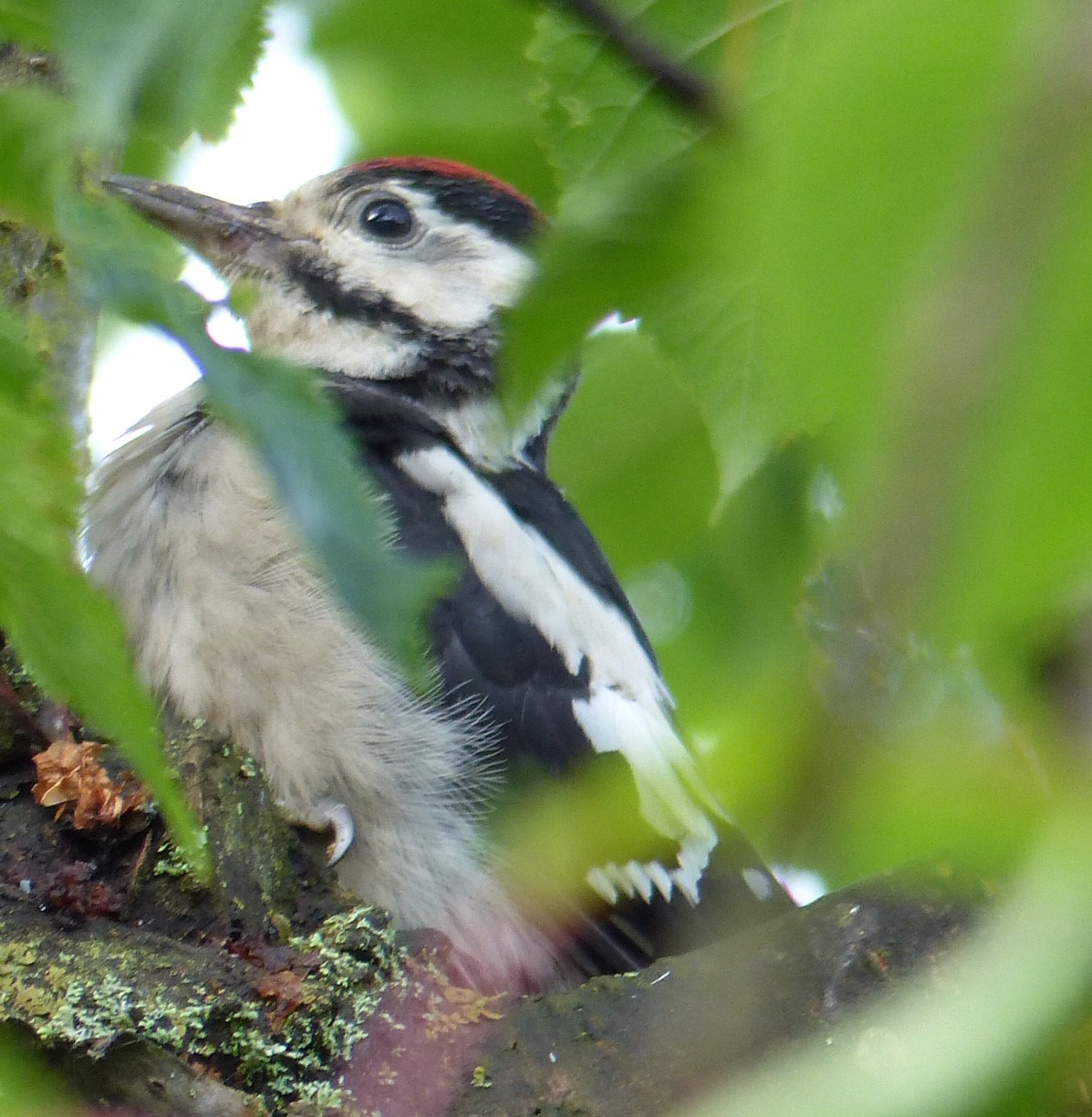
A great spotted woodpecker chick emerged from its nest-hole on Friday morning in Phil Passfield's back garden in Yorick Road. The male was still bringing food to it, although there had been no sign of the female or any other chicks in recent days.

Along the Strood seawall on Friday were a common buzzard, six yellow wagtails, singing cuckoo, common tern in the channel, redshank calling on Ray Island and 20 swifts over the houses.
Ian Black reported a starling at his back garden feeders showing 3 unusually pure white tail feathers.

A song thrush was prostrating itself in the midday sunshine in the Firs Chase garden on Thursday 4th.

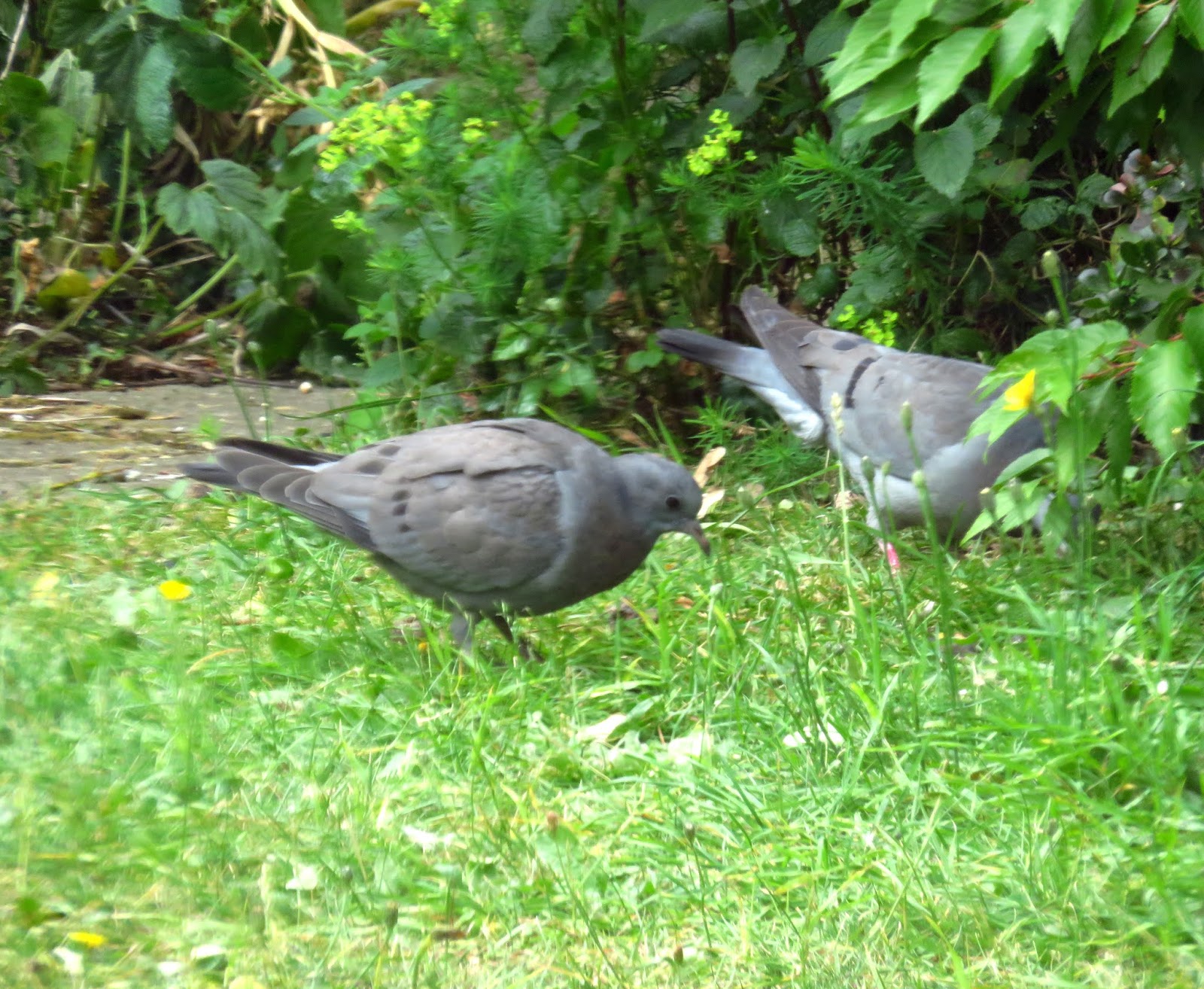
A fledged young stock dove was a surprise visitor to the Firs Chase garden on Thursday 4th. Its the first visit by a young one here although the adults have nested somewhere close-by.

At Cudmore Grove Andy Field reported seeing the kestrel pair in the nestbox at the back of the grazing fields on Thursday 4th, also at least four sand martin holes in use at the cliff.

On Wednesday 3rd a distant osprey was seen from the West Mersea Hard circling high over Salcott Creek, upsetting some of the local gulls, before it drifted north towards the Ray Channel.
The male marsh harrier was seen over the Strood fields, also noted were two buzzards, two cuckoos, two common terns, eight yellow wagtails, singing sedge warbler, four singing reed warblers and a pair of redshank on the Ray. The two oystercatchers sitting on nests in the fields appear to have given up after sitting for nearly three weeks.
A female cuckoo was heard doing its bubbling call as it flew low over the Firs Chase garden on Wednesday afternoon.

Sunday, 7 June 2020

BACKGARDEN HAWKMOTHS

Moth trapping was carried out on twelve nights during May in the back garden in Firs Chase.
The fine continuous sunny weather during the daytime meant the night skies stayed clear too, which usually means a drop in night temperature. Moth numbers were generally quite low averaging only about twenty species in the first three hours of the night while the trap was operating.
The main highlight of the month has been the variety of hawkmoths with six species seen during the month, including this colourful elephant hawkmoth.

Two eyed hawkmoths arrived together just after midnight on the 31st - their colourful eye- markings hidden on the hindwings.

The lime hawkmoth was seen on three nights, with their camouflage markings. This was the first of the hawkmoth species to be seen in May, this one on the 19th.

Just one privet hawkmoth was recorded, seen on the 20th - the largest resident moth in the UK.

A couple of pine hawkmoths were seen in the last week of May.

The commonest hawkmoth, the poplar hawkmoth was the last one to show, making its appearance on the last night of the month.

One impressive cream-spot tiger moth was a colourful surprise on the 26th. A moth usually found in grassland habitats especially along the Essex coast and seawalls.

This toadflax brocade is the first individual to be trapped on the Island, although not the first record. It is a species that has spread rapidly across Essex in recent years and was expected to be found in the trap soon. The first individual seen on the Island was found at a porch light in the Potifars garden in Shop Lane in 2018. Last summer caterpillars were seen feeding on purple toadflax in Feldy View.

The first alder moth seen on the Island was trapped in the Firs Chase garden on the 26th.

This clouded brindle has not been seen on the Island before, although its reasonably widespread across Essex.

The sand dart is a coastal speciality and found mainly in north-east Essex. It was seen most early summers at Cudmore Grove when trapping was done regularly there.

Not many tawny-barred angle moths have been seen on the Island previously, this one is the first for the garden.

This shiny micro-moth called Coast Green Case-bearer or Coleophora amethystinella, was first discovered as a British species in 1973 at Fingringhoe. Since then it has spread into neighbouring counties and along the south coast, while becoming commoner in Essex in recent years. It has distinctive metallic green wings and orange hairs round its eyes.

A lesser stag beetle, minus a hind-leg, was seen near the garden moth trap on the 25th May.

Wednesday, 3 June 2020

MARSHES MUNTJAC

This muntjac deer was seen out for a stroll on the old marshes near the Coopers Beach holiday park during a sunny and hot mid morning on Tuesday 2nd. It was watched for about ten minutes having a graze in the back corner of the marsh and then a drink from a small ditch.

This buck muntjac deer appears to have recently shed its previous antlers and now shows the short stubs of the new growth.
The previous day a muntjac deer was also seen late morning strolling along the back of the country park's grazing fields.

The pair of stonechats was watched near Coopers Beach with the male perched beside the childrens playground.

The female stonechat was also perched up in the same area, catching insects in the air. When a magpie arrived on the scene, both birds became anxious and making the distinctive "chaking" calls like two stones being knocked together.

Also seen in the Coopers / Rewsalls marshes area were a pair of buzzards calling high up, a male marsh harrier high over the sea, two common terns, a pair of Mediterranean gulls flying past and a kestrel. Five shelduck, two little egrets, male reed bunting and a singing reed warbler were on the old marshes.

Two ringed plovers were seen on the Fen Farm beach on Tuesday, looking as if they thinking about nesting. A reed warbler was singing from a nearby reedbed, as was another on the east side of Coopers Beach.
There was an unwelcome sighting of a grey squirrel on the ground near some caravans at the back of Coopers Beach.

An osprey was seen being mobbed by crows by Martin Cock as it was flying east over his West Mersea house in the Coverts just after midday on Tuesday.
Two hobbies flew north-east over Andy Field's house in High Street North on Tuesday afternoon. At the end of the afternoon a hobby seen by Ian Black carrying prey towards the Firs Chase caravan site, was probably the same hobby seen twenty minutes earlier flying fast over the Firs Chase garden.

A little egret flew out of the borrowdyke near the Oyster Fishery in East Mersea and perched on this nearby bush on Monday 1st June. There were three other little egrets seen standing together in a nearby sheep field.
A Cetti's warbler was singing from the bushes by the Oyster Fishery, a pochard flew past while a buzzard was seen flying up into some trees. Earlier a Cetti's warbler was also heard singing for the first time in bushes near Fishponds Wood in Shop Lane.

On Reeveshall a male and a female marsh harrier were seen at separate times on Monday, while at least two lapwings were on the rough fallow field strip. In the Pyefleet were a pair of great crested grebes, one brent goose and forty mallard near Pewit Island at low tide.

Andy Field also visited Reeveshall on Monday morning and noted a singing corn bunting, three common buzzards and two common terns, 24 shelduck on Pewit Island and a pair of marsh harriers on Langenhoe. An unidentified deer was also seen briefly behind the reeds of Broad Fleet.

There was no sign of any birds, other than a black-headed gull, on the partially dried up saltmarsh pools near the East Mersea Point on Monday. There have been several pairs of avocets and a pair of common terns on the small island but they seemed to have gone.
A ringed plover was seen on the mud near the Point, two reed warblers were singing in the dyke reeds, two lapwings were in the fields and ten sand martins were in the air near the cliff and fields.

The male corn bunting seen and heard singing from an old thistle stalk near the Reeveshall seawall, photographed by Andy Field on Monday.

Along the Strood seawall on Sunday 31st, a distant hobby flew along the opposite seawall of Feldy Marsh, the regular male marsh harrier was hunting the Strood fields, two cuckoos were heard, five yellow wagtails, while over the houses and adjacent fields were 55+ swifts.
Four common terns were seen in the channel and also near the Hard and a little tern was seen near Packing Shed island.

In Mersea Avenue Ian Black noted 23 swifts overhead and a green woodpecker from his garden and later on Sunday two Mediterranean gulls by the Dabchicks and a red squirrel in the Lane.

Sunday, 31 May 2020

GARDEN DELIGHTS

Wild orchids were enjoying the hot sunshine in Dave Chadwick's garden on the Esplanade on Saturday 30th, with seventy spikes of common spotted orchids in flower. The green-winged orchids that were flowering in the same garden at the start of the month have all finished.

Three pairs of yellow wagtail were present in the wheat fields to the east of Rewsalls Farm on Saturday 30th. This male here is carrying food for its chicks and is showing a metal ring on its leg - it would be interesting to know where it was ringed.

At least five yellow wagtails including the three males were feeding in one part of the wheat field, perching on the tops of the corn whilst catching insects.
Nearby a pair of house martins is nesting on the side of the Rewsalls House.

On the boating lake by the Youth Camp were a pair of Canada geese, pair of shelduck, twelve mallard, pair of reed buntings and meadow pipit while a sparrowhawk was seen at the Youth Camp.

At West Mersea two common terns and a pair of Mediterranean gulls were seen from the Hard. A common buzzard flew over High Street North being chased by a crow.

On Friday 29th along the Strood seawall, both male and female marsh harriers were seen quartering the fields at different times, also a buzzard seen too. Two cuckoos were flying together calling as they passed over the seawall. A meadow pipit rose up into the air singing and then drifted across the Strood channel to Ray Island.

Along the Strood dyke were one singing sedge warbler, four reed warblers and three reed buntings, also two emperor dragonflies and three four-spotted chasers.
In the skies above the houses and the fishing lakes were at least sixty swifts which is the biggest gathering for several years. Ten house martins were flying about Strood Hill.


This cream-coloured starling was photographed by Jenny Amos in her East Road garden close to Oakwood Avenue.

The starling has been seen several times over the previous fortnight and usually in the company of about forty other starlings. The pale cream colouration is a leucistic phase, rather than the pure white of an albino bird. It is obviously doing the rounds of several gardens and worth looking out for.

The little owl was photographed by Michael Thorley, sunbathing at the back of his garden near Meeting Lane on Friday 29th in the evening.
Three grey partridges were seen near Meeting Lane on Friday by Michael.
Earlier at the country park on Friday several sand martins nest building at the cliff with another six flying up and down the nearby dyke. Two pairs of pochard were at the park pond.

Birds noted by Andy Field between Shop Lane and Meeting Lane on Friday included cuckoo over Reeveshall, pair of sparrowhawks in Fishponds Wood as well as the usual chiffchaff, blackcap, whitethroat and lesser whitethroat. Two common terns were in the Pyefleet.
A Mediterranean gull was seen by Jonathan Bustard on the West Mersea beach in the evening eyeing up some chips!

On Thursday 28th along the Strood seawall, the usual male marsh harrier was seen over the fields, three cuckoos were seen /heard, a pochard flew past, also eight yellow wagtails, sedge warbler, three reed warblers, three reed buntings and a lesser whitethroat were all noted.

At Cudmore Grove on Thursday, Steve Entwistle reported seven sand martins by cliffs, two lapwings in the fields, also five male tufted ducks and four male pochard on the dyke and pond.
A pair of grey partridge was seen in a field between Meeting Lane and Weir Farm by Michael Thorley.

A pair of swifts peered out of the nestbox in Andy Field's house in High Street North on Wednesday 27th. A few days earlier there was a bit of a dispute witnessed on his camera when a third bird came into the box.

Next to Cobmarsh Island on Wednesday were four little terns seen fishing in Besom Fleet in late morning. One bird initially spent a bit of time fishing close to the boat moorings, diving down to catch fish. It was then joined by three other little terns and after a brief fly-about they then dispersed. It's likely these four birds are the same ones seen recently by the beach at Old Hall point.

Steve Entwistle was pleased to pick out two very distant peregrines sitting on top of the Bradwell power station.
Six common terns and two whimbrel were seen in the Mersea Quarters, a pair of ringed plover displayed on Cobmarsh Island, a cuckoo flew from Feldy Marsh over to the Dabchicks, while at St Peters a reed warbler was singing near the boardwalk.
In the evening Ian Black reported seven whimbrel over the Hard and a great spotted woodpecker over The Lane. Two cuckoos flew over Andy Field's garden in the morning.


The male stonechat was photographed by Shaun Bater near Coopers Beach play area on Wednesday 27th. The pair presumed to be breeding has been seen carrying food in recent days.

A pair of great spotted woodpeckers has been nesting in the Passfield's garden in Yorick Road.
Both birds are pictured here close to the hole by Phil's trail camera.

The male great spotted woodpecker with the red on the back of the head seen here at the hole in the cherry tree. Phil has commented that the chicks are making a lot of noise from the hole.

Both male and female great spotted woodpecker pictured here, the male bottom left corner.

A yellow patch of common catsear on the sunny Strood seawall on Tuesday 26th.

A spotted flycatcher showed briefly on Tuesday morning in the rough scrubby corner down the side of the Firs Chase caravan site. It switched perches a handful of times before disappearing down the hedge at the back and not reappearing. This area seems to be a favoured stop-off spot in the autumn for flycatchers.

Over the Strood fields on Tuesday were a marsh harrier, common buzzard, cuckoo, seven yellow wagtails and a singing sedge warbler in the dyke.

At Reeveshall on Tuesday Andy Field reported two avocets and a sedge warbler, while two common terns were in the Pyefleet, marsh harrier on Langenhoe and in Shop Lane were two buzzards and a singing chiffchaff.

In Firs Chase a cuckoo flew over calling in the evening, also a goldcrest singing and two great spotted woodpeckers and five swifts seen flying over.

A hurried snap of the first meadow brown butterfly of the season before it flew away near the Firs Chase caravan site on Thursday 28th, also a Mother Shipton moth beside the seawall.

A speckled wood resting along the path at the top end of the caravan site on Tuesday 26th.

Wednesday, 27 May 2020

NESTING OYSTERCATCHERS

An oystercatcher was perched on a boat near the Dabchicks sailing club on Monday 25th. It's probably nesting in one of the moored boats in the area.
Two pairs of oystercatchers are still sitting on their nests in the Strood fields.
A walk along the Strood seawall on Monday produced a common buzzard, two cuckoos, Mediterranean gull, eight yellow wagtails and a singing sedge warbler. A pair of redshank was seen on the Ray Island saltmarsh at the south-west end. A green woodpecker and sparrowhawk were seen at Feldy View.
An emperor dragonfly was seen hunting over the Strood saltings.

Oliver Cottis reported a great white egret on the shoreline at low tide between Waldegraves and Seaview on Monday morning, also a cuckoo and two whitethroats.

At the Oyster Fishery on Monday, seven pochard and two tufted ducks were seen on the pool by Martin Cock, also two sedge warblers and 3 cuckoos in the area, while a pair of avocets was on the Golfhouse pools. Matt Cock reported a ringed plover nest with two eggs at the Point - the second pair to have bred here this spring.
Steve Entwistle also reported a pair of avocets, pair of common terns, five house martins, blue-tailed damselfly by the Golfhouse on Monday morning.
David Bullock reported that the six pairs of avocets apparently sitting on nests on the Golfhouse pools seen on Saturday, had all given up by Sunday evening.

On Sunday 24th along the Strood, a sparrowhawk, two cuckoos, sedge warbler, three reed warblers, three shelduck and a common tern were noted.

In East Mersea Steve Entwistle reported a pair of common terns and two avocets were on the Golfhouse pools, a pair of ringed plovers with two chicks were at the Point near the pillbox, 25 whimbrel and two common terns flew past the Point, while seven bar-tailed godwit were seen off Ivy Dock
Walking the footpath east from Meeting Lane Steve saw 14 Canada geese flyover, four-spotted chaser, hairy dragonfly, 16 holly blues, 2 red admirals, orange-tip and 50 small white butterflies.

Patches of thrift add a splash of pink colour to the St Peters saltmarsh.

Dark clouds were passing over the Blackwater estuary on Saturday 23, seen here near Waldegraves.
Offshore two common terns were fishing, while at the boating lake near the Youth Camp, a reed warbler, five mallard, five shelduck, little egret, cuckoo and ten swallows were seen. A brood of five mallard ducklings were busy diving underwater at the Waldegraves pond.
A brown hare was in a field by Weir Farm.

The male and female stonechat was seen on Saturday by Steve Entwistle near Coopers Beach play area. A sanderling was reported by Billy Smith near East Mersea Point.
At Meeting Lane there was no sign of yesterday's spotted flycatcher although a willow warbler was heard singing, blackcap, chiffchaff, several whitethroats and seven long-tailed tits were seen by Michael Thorley.

At West Mersea on Saturday a small flock of house martins and sand martins with a few swifts were seen flying over the Strood fishing lakes by Andy Field. A female sparrowhawk flew over Ian Black's Mersea Avenue garden. A small heath butterfly briefly stopped off in the Firs Chase garden.

Along the Strood seawall on Friday 22nd, the regular male marsh harrier was quartering the fields, also a common buzzard flying up-channel. Two sand martins flew over the channel, a pochard flew to the reservoirs, two cuckoos, meadow pipit, two common terns, four shelduck, three whimbrel and a lapwing were noted.

At Meeting Lane on Friday a spotted flycatcher was found by Michael and Sarah Thorley which was present until the evening. East along the footpath were a blackcap, Cetti's warbler and a vocal cuckoo.

A male whitethroat sang from a bush beside the West Mersea Glebe on Thursday 21st. Fifteen swifts were in the skies while beside Wellhouse Farm were ten house martins with another ten around the Wellhouse Green houses.
Twelve male yellow wagtails were noted in the wheat field near Whittaker Way which is the biggest concentration in one area on the Island for many years. Also a cuckoo calling from the wires.
Along the Strood seawall were two Mediterranean gulls, lapwing, sedge warbler and a common tern.
An emperor dragonfly was flying over the rape field near Strood Hill and two speckled woods were tussling together near here.

Several colourful flowers of salsify were seen in the Glebe extension field, their flowers opened up for the morning period.

At East Mersea the long-eared owl was possibly seen again on Thursday by Mike Dawson by his wood near the Oyster Fishery, seen briefly in flight. There was no sign of it from the seawall despite a look. Six pochard, two cuckoos were in this area while two avocets were on Reeveshall pool, seen by Martin Cock.

At the country park on Thursday, Steve Entwistle reported whitethroats were everywhere and a few blackcaps present, with four sand martins by the cliffs. Insects of interest there were two small heaths, four speckled woods, six holly blues and  lots of azure damselflies.

Ian Black reported a great spotted woodpecker in Mersea Avenue on Thursday while in the evening he saw two red squirrels in The Lane.