Monday, 29 August 2011

BEACH VISITORS


Painted ladies have been in very short supply this summer, so it was nice to see this one pictured above, enjoying the sunshine as it rested on the sandy cliff at the park on Bank Holiday Monday 29th. There was a cool northerly breeze blowing across the park but down on the beach it was nice and sheltered and this painted lady flitted along breaking off from nectaring with a spot of basking.


There weren't many visitors to the park beach in the morning and most of the folk who came to the park missed the best part of the day, as it turned cloudy in the afternoon. They also missed seeing the painted lady basking under the blue skies!

A wheatear was still present on the first bit of beach along the seawall for the second day running and a second bird was at the Point in the afternoon. There was no sign of any sand martins along the cliff with the last birds seen in the area a week ago. A couple of sand martins were still flying around with some of the swallows, which maybe local birds.

Offshore with the tide receding in the afternoon one sanderling was seen with ten dunlin with 30 ringed plover seen on nearby mud. Five common terns flew past and four eider were just offshore although 5 birds were noted on Sunday.

At the park pond a male sparrowhawk sat in the hedge by the pond for some time, enjoying surveying the surroundings as well as enjoying the morning sunshine. It was a classic male bird with bright peach banded chest and grey back with its bright yellow eyes staring out. In the nearby bushes 4 blackcaps, 5 common whitethroats and a couple of lesser whitethroats were noted while 3 or 4 chiffchaffs could be heard calling from various parts of the park. Two little egrets roosted by the pond at high tide with the usual mix of wildfowl on the pond such as mallard, gadwall, teal, shoveler and tufted duck.There was no sign of the turtle dove that was seen by the pond on Sunday, perched on a bush and later feeding on some bare ground.

During the day 5 yellow wagtails were noted over the park while at the Point 80 linnets were still feeding in the sea-blite bushes.

A marsh harrier was seen quartering the fields near Weir Farm in East Mersea on Monday.
Martin Cock saw a female peregrine fly over his West Mersea garden on Sunday and a hobby flew over on Saturday. At Maydays farm 4 whinchats were seen near the seawall on Sunday.

Four adders were seen between the hide and the park entrance on Monday morning while the previous day three were noted and 3 common lizards in various locations too.

There seemed slightly more butterflies enjoying the sunshine on Sunday because of less wind and two small coppers, one pictured above, were enjoying the warmth out of the north-westerly wind. Also seen were 1 brown argus, 2 common blue, 4 small heath, 2 speckled wood, 2 meadow brown, 1 red admiral, 1 large white, 30 small white and 4 green-veined white.


This male ruddy darter basked on a hawthorn bush sheltered from the breeze on Sunday. Also seen were common darter and migrant hawkers around the park too.


Over Sunday night, this pretty green carpet was one of the moths found in the moth trap on Monday morning. Seventy moths of 15 species were noted in the morning with the cool night breeze keeping numbers down.


This treble bar was the only different moth in the trap compared with recent nights. It's a widespread moth that usually makes an annual appearance at the park trap.

Saturday, 27 August 2011

THUNDERY SHOWER


The country park felt the force of Saturday afternoon's brief thunder storm when a bolt of lightning struck a visitor's umbrella throwing it onto the ground. Surprisingly the person was unscathed by the ordeal! The picture above shows a distant rainbow in the evening to the east over Brightlingsea. It had been quite warm during the first half of the day despite the northerly breeze.

Two marsh harriers flew over the grazing fields, one of them scattering 150 teal from the pools. Two young sparrowhawks were seen landing in a tree to the north of the park in the morning. A green sandpiper flew over the fields while a common sandpiper briefly landed along the dyke and then at the pools before flying off again. Ten yellow wagtails were feeding in the fields beside the cattle while 2 wheatears were seen on the nearby beach. At the Point 80 linnets and 5 reed buntings were amongst the sea-blite bushes and offshore 5 eider were in the Colne.

On the mudflats in the evening 50 avocets and 200 black-tailed godwits were the main waders of interest while 8 little egrets, 10 common terns and 2 little terns were also seen.

At the pond a male gadwall appears to be the first male duck to have completed moulting and is looking quite smart again. One little egret at high tide, 20 mallard, 2 shoveler and 2 tufted ducks were the main birds here. In nearby hedges ones and twos of reed warblers, blackcaps, chiffchaffs, lesser whitethroats and several common whitethroats with a song thrush also noted.
There was a better mix of warblers here on the previous day Friday 26th, with 5 blackcap, 10 lesser whitethroat, 25 common whitethroat, 3 chiffchaff, willow warbler and 2 reed warbler. The nightingale was still calling from the car park bushes on Saturday morning.

At the beginning of the morning a hobby was seen flying low over a field by Bromans Lane. The previous evening just after nightfall a tawny owl was seen in the car headlights crossing over the Lane from one side to the other - the first tawny sighting in the Lane this year!

The sunshine during Saturday was warm enough for three adders to bask by the main track in the park.

Andy Field visited the Reeveshall seawall on Thursday morning and noted sparrowhawk, 4 wheatears, marsh harrier, 3 green sandpipers and 50 avocets with the tide coming in.


The moth trap was left running through Friday night into Saturday morning and this pretty canary-shouldered thorn was one of the moths to catch the eye. It's an annual visitor to the trap in late summer / early autumn but only with ones and twos each year.


The bigger cousin the large thorn was more interesting as it's regarded as both an immigrant and also a nationally scarce species in the UK being mainly found in the south-east of England. The park had it's first large thorn last year at the end of August. Not clear from this picture was the half-open position that the moth held the wings, as opposed to the nearly closed position of the canary-shouldered thorn. There was also an appreciable difference in size.

Amongst the 21 species of moth during Friday night's session were common carpet, lime-speck pug, turnip, square spot rustic, flounced rustic, straw underwing, frosted orange and yellow belle.


This neatly marked archers dart was a nice find in the trap after Wednesday night's session. It's been recorded here two or three times before and appears to be mainly found in Essex at coastal sites.


One of the regular visitors to the trap in late summer is the common setaceous hebrew character, pictured above. Several have been in the trap during recent sessions although the most numerous moth is still the flounced rustic.

Twenty-three species totalling 110 individuals were noted on Wednesday night and included green carpet, orange swift, latticed heath, light emerald, turnip, nutmeg, white-point, rosy rustic, spectacle, rosy minor and common wainscot.

This male speckled bush cricket was found resting on a glass window of one of the buildings in the park. One of the big hind-legs is missing from this individual but the mass of tiny specks that help identify this bush cricket can just be seen on the green "thigh" in the picture.

Wednesday, 24 August 2011

REEVESHALL WADERS


Enjoyed an evening walk along the Pyefleet Channel for the last couple of hours on Wednesday 24th. It was a very rewarding session with a good variety of wildlife to admire, even without the trusty telescope for a change. The incoming tide brought many birds closer to the shore with this group of roosting gulls digi-binned for a slightly closer image, were seen in the Reeveshall bay. This group of mainly black-headed gulls were some of the 2000 gulls following a tractor and cultivator in a nearby field.

Eighteen species of waders on the walk was a good tally despite the nearness to high tide and lack of mud on show. For a change it was good to see some waders using the Reeveshall pool, the first ones this summer since the avocets stopped using it to raise their families. Three green sandpipers, 3 greenshank, 2 redshank, 4 lapwing and 7 teal were noted here.

Other waders seen on the Pyefleet were 2 ruff, 4 whimbrel, 50 curlew, 3 knot, 250+ black-tailed godwit, 15 bar-tailed godwit, 25 oystercatcher, 100 redshank, 40 avocet, 10 golden plover, 20 grey plover, 10 ringed plover, 25 lapwing, 10 turnstone, 3 common sandpiper and 1 dunlin.


Twelve little terns flew up and down the Channel and 20 common terns also seen with some resting on Langenhoe Point. Close to high tide the four local eider drifted to Langenhoe Point to rest, while earlier 15 cormorants, 3 grey herons, 4 little egrets were noted along the Channel.

Two common seals drifted along the Pyefleet on the rising tide towards their usual resting spot further west by Maydays saltings.

On Langenhoe 6 marsh harriers were seen late in the evening settling down to roost with one of the birds seen hunting over Reeveshall earlier in the evening. A sparrowhawk crossed low over the Pyefleet to Reeveshall and a second bird was seen by the tree plantation near the Oyster Fishery. Two kestrels were seen at opposite sides of Reeveshall, hovering over the fields.


There was a nice red colour to the borrow-dyke to the north of Shop Lane as the last of the light began to fade. Managed to get a nice but brief view looking down on a water vole in the dyke but as it wasn't expecting to see my big silhouette so close, it quickly swam back to the clump of club-rushes. A brown hare was seen crouching low by the Reeveshall pool at dusk.

Five wheatears were still perching on fenceposts and feeding on the ground near the Shop Lane seawall as the light faded. A sixth wheatear was found on a fence on the western edge of Reveshall. Several flocks of yellow wagtails were flying back and forwards across the Pyefleet looking for somewhere to roost and it was difficult to tell if they were the same birds seen earlier but at least 30 birds were noted.

Andy Field had walked part of the same seawall from the country park earlier in the day and noted hobby, 6 wheatears and 2 whinchat between Shop Lane and the Oyster Fishery, ruff and 6 green sandpipers on the Reeveshall pool, a total of 20 yellow wagtails, 2 sedge warblers, while 7 of the 8 eider were seen from the park.

Earlier in the day at the country park a common buzzard drifted south to the park, turning back near the pond where lots of the wood pigeons took fright and flew off. Chris Burr reported seeing a common buzzard two days earlier over Shop Lane. A turtle dove and willow warbler were noted in the morning at the pond and a second willow warbler called from the car park. A green sandpiper flew along the park beach and later a greenshank flew over the park calling. Martin Cock found a wheatear in the horse fields by the Golfhouse and the previous day Martin Dence had reported a dozen yellow wagtails with horses north of the park. At the Point on Tuesday linnet numbers appear to have built up gradually to about 150 birds now and the avocet family are still on the pools near the Golfhouse.

Two adders were seen basking in the afternoon sunshine along the park track, one individual a small sub-adult maybe born last year. Butterflies have included red admiral, small heath, speckled wood, meadow brown and small white.

Just outside the mouth of the river Colne, the harbour porpoise was seen again with it coming to the surface regularly and reasonably easy to follow. On a couple of occasions it needed to swim out of the way of a big coaster and then a yacht that passed nearby. A common seal was seen from the Point and may've been one of the ones seen later swimming up the Pyefleet.

Sunday, 21 August 2011

MERSEA QUARTERS


Enjoyed a day at the west end of the Island with a walk along the Strood Channel in the morning and then an afternoon canoe in the Mersea Quarters on Saturday 20th. The morning's sunshine faded away in the afternoon with the air soon cooled down by some rain in mid afternoon. The view above is looking back to West Mersea's Coast Road area, taken from Old Hall Point.

There was a good scattering of the regular waders along the Strood Channel during the low tide in the morning. Waders of note included 4 greenshank, 10 knot, 20 grey plover, dunlin and 20 black-tailed godwits. A hobby was seen circling high over the Channel and then drifting north towards the Peldon area. Around the Quarters were 10 common terns, 2 little terns, 3 little egrets and 4 swifts heading west over the water and the first little grebe of the autumn amongst the moorings.

A restless painted lady along the seawall was the main butterfly of interest by the Strood during the morning, also seen were small heath, small white, green-veined white, small tortoiseshell and meadow brown.


On the western edge of the Quarters on the Old Hall Marshes RSPB reserve is this bird-rich saline lagoon -Pennyhole Bottom, pictured above. It was great to see water still present here as some previous Augusts, it has dried out completely. Up to 400 waders were roosting or feeding during the late afternoon high tide. Unfortunately most of the birds were some distance away from the seawall and looking into the sun didn't help.

In less than an hour on the seawall a noteworthy 19 species of wader were logged either on Pennyhole or on the adjacent mudflats as the tide receded. Two little stint, 3 little ringed plover, spotted redshank, 2 greenshank, 4 green sandpiper, common sandpiper, 5 avocets, 5 knot, along with varying numbers of the commoner waders such as redshank, curlew, oystercatcher, lapwing, golden plover, grey plover, ringed plover, dunlin, turnstone, black-tailed godwit and bar-tailed godwit.

In bushes nearby 2 whinchats perched up as did sedge warbler and some reed warblers. Up to 25 yellow wagtails flew around calling and flying over the main reedbed were a couple of marsh harriers.

The following day 3 willow warblers were in a small birch tree in Firs Chase, West Mersea and a greenshank flew south over Coast Road in the afternoon.

Friday, 19 August 2011

RAY ISLAND VISIT


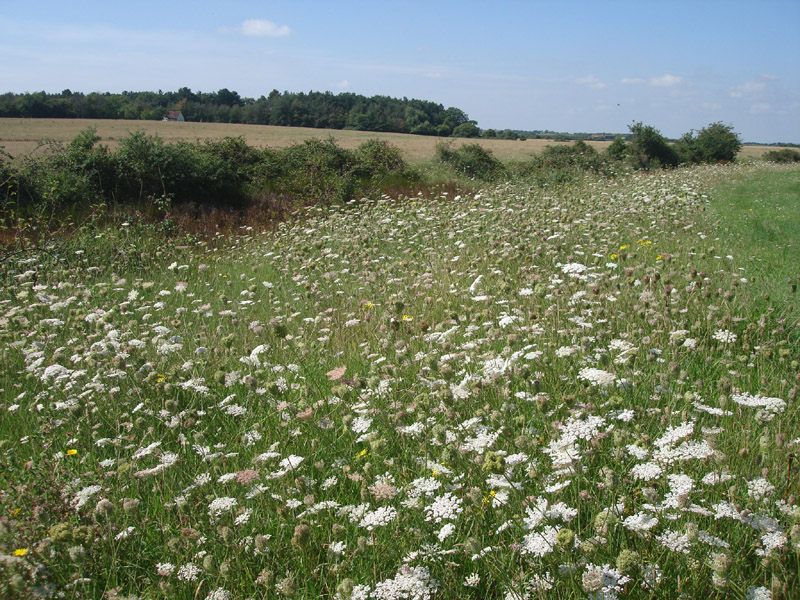
Lots of sunshine on Friday 19th provided an enjoyable backdrop to a walk along the Reeveshall seawall. Masses of white-flowering wild carrots bloomed along the sides of the seawall as well as the inside folding beside the dyke, as in the picture above.


Most of the butterflies enjoying the sunshine were 30+ small whites, meadow brown, small heath and green-veined white, pictured above. Five speckled woods were in the Shop Lane wood.

As in recent days two hobbies again put in a performance with the second bird only being located high in the sky after it was heard calling. After watching the two come together over the Pyefleet, the second calling bird was seen as a browner-marked juvenile hobby alongside the darker adult. A big feeding flock of 200 swallows over Reeveshall kept their distance.

A sparrowhawk was seen flying over the fields and a kestrel was seen hovering above one of the pastures. A male marsh harrier carrying some small prey flew away from Reeveshall towards Langenhoe where it dropped down presumably to feed some young.

Waders were scattered along the Pyefleet mud with 2 greenshank, 25 avocet, 70 black-tailed godwits, 10 grey plover being the main waders of interest. Forty little terns rested on Langenhoe Point with 10 common terns seen too. There were no birds seen on the Reeveshall pool.

Two yellowhammers and 3 yellow wagtails were seen near the seawall while in the nearby wood a willow warbler called and 2 chiffchaffs were noted.


Later in the day my wife Nolly and I, canoed to Ray Island to try and enjoy some of the peace and quiet amidst the drone of nearby jet-skies and water-skiers. However the disturbance didn't seem to deter a male marsh harrier from crossing the Ray saltings and over the Strood Channel. A high tide roost of 12 little egrets were seen and also noted on the Ray were green woodpecker, common whitethroat, yellow wagtail, while flying along the Ray Channel were 7 whimbrel and 4 common terns.


It didn't take long to find this big wasp spider at it's web in the rough grass on Ray Island, waiting to catch some of the many grasshoppers and crickets that were leaping about.

On Thursday at the country park Andy Field found 2 whinchats in the grazing fields keeping low in the fresh breeze. At the Point 70 linnets flew around the seablite bushes, up to 4 yellow wagtails flew about, the avocet family were still present and nearby 200 golden plover were on the mud.

Two turtle doves were seen in the car park briefly as well as near the pond, while one was seen later on wires over Bromans Lane. A sparrowhawk was seen over the car park and probably a different bird perched at the back of the fields later in the morning.


Several of these light emeralds moths, picture above, were in the moth trap at the park on Wednesday night. This is one of the second generation following on from the first lot seen in the spring.


The oak hook-tip is a regular visitor to the trap in the summer in small numbers. The wings have the characteristic curved wing-tips.
Other moths noted included maidens blush, common carpet, brimstone, small white wave, scarce footman, brown-tail, large yellow underwing, white-point, smoky wainscot, spectacle, snout, frosted orange, setaceous hebrew character, flounced rustic and uncertain.


This red underwing moth spent the day resting on the door of the hide, its markings blending in well with the pale wood. Having tried to coax it gently away from the handle, it flew off with big flickering red, white and black wings, flying up and down the nearby path for a few minutes before choosing to come back to the hide door again!


Wednesday, 17 August 2011

LOADSA LADYBIRDS


Numbers of ladybirds have dropped slightly over the last week although this discarded apple had fifty ladybirds nibbling on it during Wednesday 17th on the park seawall. Having passed this apple twice over the last couple of days, each time it has been covered in ladybirds. Whilst walking around the park in recent days, one or two of these little bugs have been nipping folk on any bare skin including my own.


Two wheatears were seen from the seawall along with 30+ linnets on the saltmarsh and also the unusual sight of a corn bunting that had briefly joined them in the nearby grazing field. Up to 8 yellow wagtails were seen in the fields near the cattle. On the saltmarsh pools near the Golfhouse the family of avocets with the four young were still present.


Dodging lots of sailing boats involved in the annual Round the Island Race was one common seal just outside the entrance of the Colne estuary. About ten common terns were fishing in the outer part of the river too during the afternoon high tide.

Andy Field managed to find a garden warbler on Wednesday morning feeding with other warblers in the hedgerow near the park pond. It was a good find as it's hard work trying to find this uncommon Mersea passage migrant with usually only one sighting a year. There was a previous park record this spring of one singing in the spring early one morning.

Other birds noted in the area of the pond were 2 young sparrowhawks and two turtle doves seen by Martin Cock and also reed warbler, blackcap, common whitethroats and lesser whitethroats in the hedgerows. As in previous days a hobby was seen on a couple of occasions over the park, while in the car park the nightingale was heard calling from its usual bushes.

On the park pond 2 shoveler and a gadwall were noted along with the usual mix of teal, mallard, tufted ducks, little grebe, coot and moorhen. On the grazing field pools 25+ teal were the main ducks along with little egret, snipe and 8 black-tailed godwits were seen.

On Tuesday 7 whimbrel flew over the park whistling as they headed south. Thomas Harris reported seeing 2 hobbies and 3 eider from the park during his visit. At dusk a little owl was seen perching on a telegraph post beside Bromans Lane. A second bird flying off the same post lower down was probably a kestrel.

On Monday Glyn Evans and Andy Field saw 3 whinchats and a wheatear from the seawall between Reeveshall and Ivy Dock. A marsh harrier flew over the East Mersea road near Bocking Hall as it hunted the nearby fields and a flock of 50 martins near Chapmans Lane included both house martins and swallows.

The sunshine on Wednesday brought a few butterflies out with common blue, small heath, meadow brown, hedge brown, speckled wood, red admiral, small white and large white noted at the park. An adder was basking beside the track in the morning at the park and there was a report of a small one seen on the south side of the park. Three wasp spiders were found in a different part of the park from last week's individuals.


As in previous years this large red underwing moth wasn't anywhere near the moth trap but found on Tuesday 16th on the wall inside the park's ladies toilets! They do seem to like resting during the day on the outside of these buildings and occasionally inside too. Last year was a good year for red underwings with up to about ten individuals seen at the park during August and early September.


The moth trap was run on Tuesday night with low numbers of moths noted. This relatively common frosted orange is the first one of the season and no doubt will be followed by several others over the next month or so.


Likewise this first orange swift of the season will be followed by several others in the coming month here at the park. Amongst the other 50 moths in the trap, the flounced rustics accounted for half of that tally. The other moth species noted were the usual ones of recent sessions.

Sunday, 14 August 2011

HAWKERS AND HOBBIES


The sunshine on Sunday 14th was ideal for dragonflies with this migrant hawker seen taking a rest on a bush after hawking along a path. Several migrant hawkers were on the wing at various spots around the park, as were a few ruddy darters and southern hawker too, while about 4 emperor dragonflies were patrolling the park pond.


Surprisingly there weren't any dragonflies to be seen along the park dyke although 25+ small red-eyed damselflies were seen, along with common blue damselflies and blue-tailed damselflies.
Whilst watching the damselflies, a water vole was seen swimming along the opposite bank and then staring out from one of the many burrow-holes. Two reed buntings and several reed warblers were in the reeds by the dyke.

A hobby was seen circling over the car park and then climbing high over the park. There has been a spate of hobby sightings over the park this weekend with a pair seen near the pond on Saturday morning and then two again in the afternoon. A single bird was also seen on Saturday flying over the park, probably checking out the local sand martins. Martin Cock had a hobby over West Mersea on Sunday.

A sparrowhawk was seen on Sunday flying over the Point and sending the flock of 30+ linnets into the air. The day before a sparrowhawk was also seen perched above the park pond much to the consternation of a group of 7 teal that had been snoozing beneath it.

The highlight of the Saturday morning walk past the park pools was hearing the recognisable "chip-ip-ip" calls of a wood sandpiper. The manner it started calling loudly as it flew over the pools suggested it had just taken off from them. It was a struggle to see the bird from the path through the trees as it flew around but eventually it was seen flying across the park to the beach.

The other unusual sight on Saturday was a family of four avocet chicks with their mother that dropped onto the pools to wash and preen. Although breeding avocets can be aggressive to other birds, it was a surprise to see a little egret lunge at the mother avocet with its long beak, forcing it to take evasive action and back off.
The avocets soon flew off and landed on the saltmarsh pools by the Golfhouse where they were still present on Sunday.

Also on the pools on Saturday were the first snipe of the autumn, 10 lapwing, 20 teal and 2 black-tailed godwits. During the day six yellow wagtails flew over the park with at least two being seen around the feet of the cattle. In bushes by the pond a reed warbler and blackcap were joined by lesser whitethroats and common whitethroats. Four swifts flew over in the morning and in West Mersea early on Saturday evening ten swifts headed west over Coast Road.

On the mudflats on Saturday the main waders to catch the eye were a greenshank and also the big flock of 300+ black-tailed godwits. Many of the godwits and other waders were flushed off the Pyefleet mud by a microlight aircraft. Other waders flying past were 100 curlew, 250 redshank, 50 turnstone while also noted on the mud were dunlin, bar-tailed godwit, ringed plover, golden plover and oystercatcher. At high tide on both days were the resident summering 5 eider. Late on Sunday evening just after nightfall, a common sandpiper called out as it flew south over the park in the dark.

In the warm weather on Saturday the tanned adder was seen again on the track near the park entrance but couldn't be located on Sunday. Four badgers and two foxes were reported on Sunday evening near the park pond.

Butterflies noted on Saturday included 5 small tortoiseshell, 1 peacock, 5 red admiral, 2 comma, 10 small white, 4 common blue, 20 meadow brown, 30 hedge brown, 8 small heath and 5 speckled wood.


A ruby tiger always brightens up the moth trap with it's red colouration and this one was being savoured as it's probably the last sighting of the season.
The moth trap was run on both Friday and Saturday nights but numbers were low with only about 70 moths of 25 species being seen. The most notable moth was a tree lichen beauty, the second record for the summer.


The common flame shoulder can look quite smart when they're fresh and brightly marked like this one.

Other moths included willow beauty, light emerald, magpie, brimstone, lime-speck pug, turnip, lesser broad-bordered yellow underwing, common wainscot, white-point, flounced rustic, uncertain, straw underwing and setaceous hebrew character.